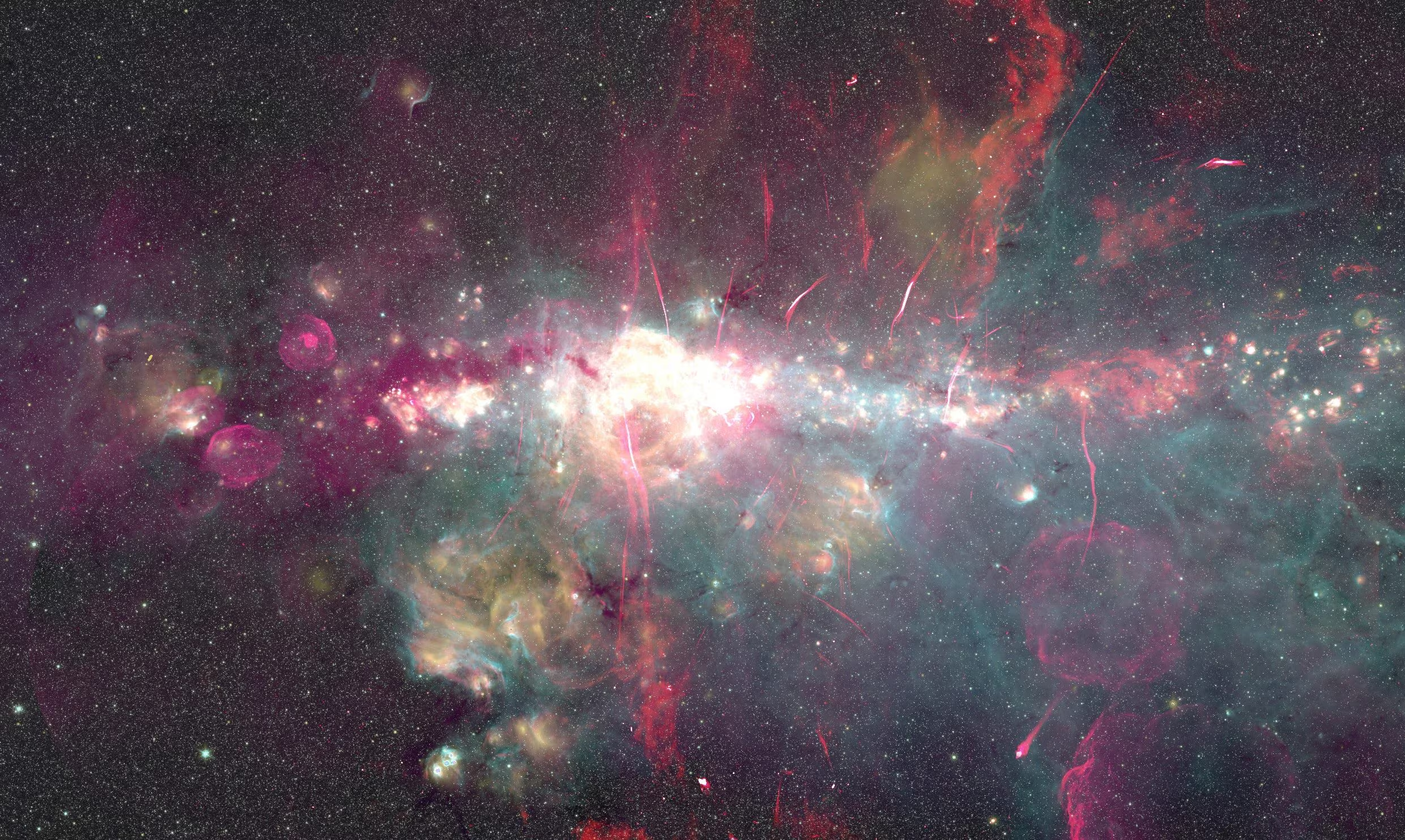
An international team led by Astrobiology Center of Madrid identified one for the first time sugar in the interstellar medium: theerythrulosea chiral molecule formed by four carbon atoms. It was detected in the molecular cloud G+0.693−0.027located approximately 27 thousand light years from Earth near the center of the Milky Way, comparing radio observations from the Yebes and IRAM telescopes with the signature of the molecule measured in the laboratory.
The discovery, published on Nature Astronomyproves that sugars relatively complex they can form in the interstellar mediumthe material from which stars and planets are born. It is not proof of the existence of extraterrestrial lifebut strengthens the hypothesis that part of the molecules involved in prebiotic chemistry may have exogenous origins, i.e. not generated directly on the primordial Earth.
How the first interstellar sugar was detected
The international team led by Astrobiology Center of Madrid managed to take over theerythrulose using data from two radio telescopesthe 40 meter diameter one of the Yebes Observatory (Guadalajara) and the 30 meter diameter one of the Institute of Millimetric Radio Astronomy (IRAM) of Pico Veleta (Granada).
Both were pointed in the direction of the molecular cloud G+0.693−0.027a region of gas and dust near the center of the Milky Waya 27 thousand light years from Earth, already known to researchers due to the discovery of complex organic molecules considered precursors of the “building blocks” of life.
The researchers analyzed the various frequencies of the radio spectrum obtained from the two radio telescopes, finding 12 row groupscorresponding in total to 17 spectral transitions (the characteristic “signature” of an atom or a compound) compatible with those produced by the molecule of erythrulosea sugar consisting of four carbon atoms which is found naturally in raspberries on Earth and is also used in the cosmetics industry.
When analyzing the radio spectrum, scholars also looked for the “spectral signature” of other less complex sugarsthat is, made up of fewer carbon atoms, such as glyceraldehyde and dihydroxyacetone, which, being simpler, are considered the most probable precursors of terrestrial sugars. Neither was detected: from the observation limits it appears that theerythrulose is between 8 and 17 times more abundant compared to analogous three-carbon sugars, which remain undetectable in the ultrasensitive observations that have been conducted.
The data thus obtained were inserted into complex quantum chemical and astrochemical models to try to answer the question of where these complex sugars come from. The models indicate that theerythrulose is formed efficiently on grains of interstellar dust starting from simpler two-carbon aldehydes and alcohols and not through the addition of one carbon atom at a time as was thought in the past. Interstellar erythruse may thus have contributed to the reserve of sugars available for metabolic and replication processes in the early Earth, fundamental for the subsequent development of more complex life forms.
The importance of the discovery of erythrulose
The sugars I am molecules essential for life on Earth since they perform numerous biological functions: they act as source of energy for cells, while ribose and deoxyribose form, together with phosphate groups, form the scaffolding of RNA and DNA respectively. Experiments aimed at replicating the conditions of the primordial Earth show how these compounds are synthesized inefficiently under these conditions and at very low concentrations. Hence the hypothesis put forward by scientists that part of these molecules may have occurred formed in the interstellar medium to then reach Earth through asteroids or through the raw material from which planets like Earth were formed. Although ribose, glucose and other monosaccharides have been detected in samples of asteroids, for example the asteroid Bennu, belonging to the Solar System, so far no sugar has been observed in the interstellar medium, the medium from which new generations of stars and planets form.
The discovery of erythrulose provides the first observational test what a true sugar can form in the interstellar medium and strengthens, without definitively proving it, the hypothesis that a part of the sugar inventory available on the primordial Earth had aexogenous originthat is, external to the Earth. The discovery is also significant because erythrulose with 14 atoms is the largest non-cyclic molecule so far identified in the interstellar medium, the first with four oxygen atoms and the second chiral molecule detected in interstellar space.
