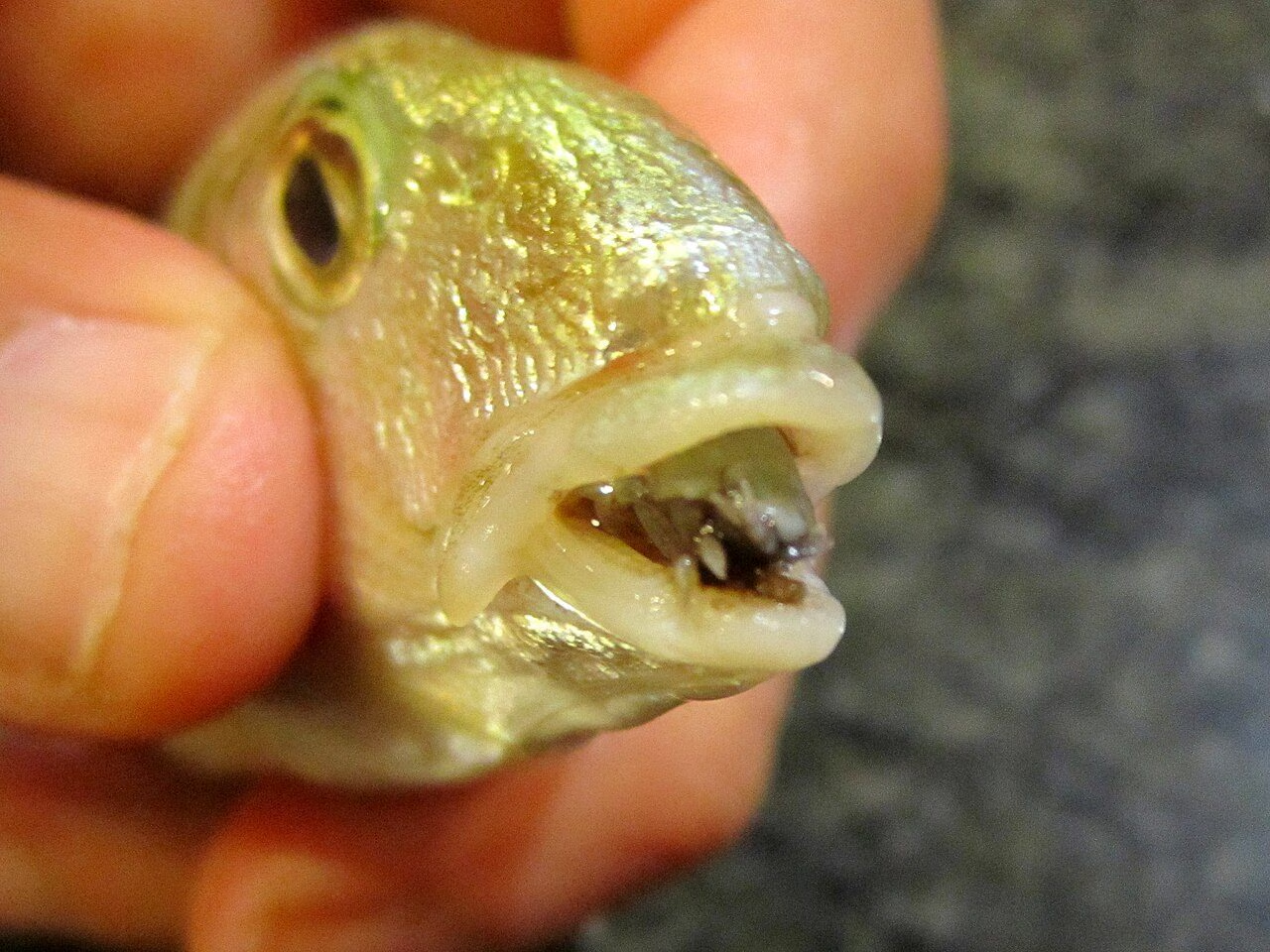
Many of us have had lice, especially as children. An unpleasant sensation, but never as unpleasant as that felt by some fish when lice find them in the mouth. In reality, we are not talking about actual lice, but about marine crustaceans that insinuate themselves into the oral cavity of fish and yes they completely replace the language. For this reason, and because they feed on blood just like those small insects that occasionally infest our hair, they are commonly called “tongue-eating liceThe species most studied for this macabre characteristic is the Cymothoa exiguabut buccal parasitism and many other characteristics are shared with the entire genus Cymothoa, spread from the Pacific, Atlantic and Indian Oceans to the Mediterranean itself, where they often infect fish such as murmurs and breams. But that’s not all: they are the only known case in the animal kingdom in which a parasite entirely and successfully replaces a vital organ of the host, and to do so they have a rather particular life cycle.
A hermaphroditic crustacean: the study
The life cycle of the tongue-eating louse is well described by a 2015 study. The larvae are born exclusively from male sexand swim in the water until they encounter a potential host. At this point the unfortunate fish can also become infected with multiple larvae at the same timewhich penetrate from the gills until you get to the tongue. Here, then, the magic starts: while the smaller males remain in the gill areathe largest one change sex and turns into a female. A passage which, as reported by Cook and Munguia in another 2015 study, greatly modifies the body of the parasite, which increases in size and instead reduces eyes and appendages useful for swimming, which then, once anchored to the fish, will no longer be needed.
How a parasite can become a tongue: the little hooks
But the transition from male to female also involves another change: the development of useful structures for hooking up better for the guest. To describe us i pereopodsas the seven pairs of legs of tongue-eating lice are called, is an article published by some Brazilian researchers in the newspaper Revista Brasileira de Zoologia, which tells an impressive detail: the pereopods end in robust and curved dactyls, a sort of small hooks which allow the parasite to remain firmly anchored to the fish’s tissues.
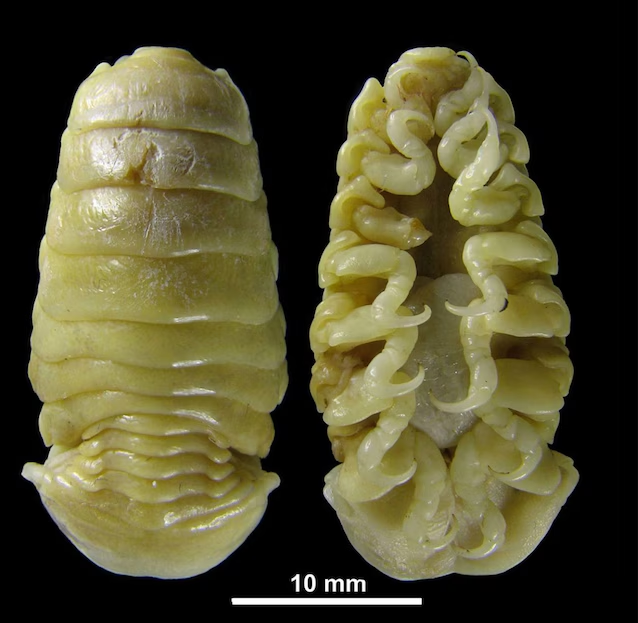
Once the transformation is completed and this characteristic is also strengthened, the parasite is ready to attach to the host’s tongue. Then begin to suck its bloodto the point of causing it necrosis and, finally, the fall. In reality, however, the language does not disappear completely. In fact, although most of the organ degenerates, a small stump still remains attached, namely the muscular base. As explained by Brusca and Gilligan in a 1983 article, it is precisely here that the parasite anchors itself with its hooked pereopods. And this is what makes the mechanism even more surprising: since it remains fixed to the residual muscular part, the parasite it can be moved by the fish itself, following the movements of the base of the tongue and becoming in all respects an extension of it. The fish continues to live and continues to be able to eat, while the tongue-eating louse survives feeding on mucus and blood of the guest.
The females develop a protective chamber in which the eggs are kept
But how does this crustacean reproduce? In some species, mating actually occurs when the female has now replaced the tongue of fish, while in others the process occurs much earlier, at the time of infiltration through the gills. In any case, the eggs are kept in a sort of pouch, one incubator pocket placed on the female’s belly. As a 2015 article tells us, this pouch is not permanent. During a particular molt, in fact, the female develops “lamellae” (flat structures similar to plates called oostegites) under the body, which then overlap and close forming a protective chamber. Only later, when the eggs hatch, will the newly hatched larvae come released from the pouch. Often, however, this phase coincides with the death of the tongue-eating lousewhich in turn causes even the death of the fish. Without a tongue, whether real or replaced by the parasite, the animal is unable to feed itself.
The real problem is not feeding, but breathing
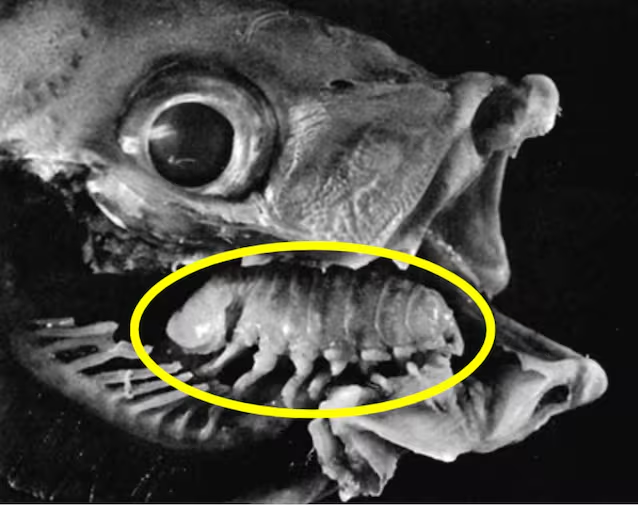
This further demonstrates how the tongue-eating louse becomes fully fledged a new and functional languagewithout which the fish cannot survive. Rather, the main problem is another: breathe. In an article published in 2013 in the journal Marine Biology, Parker and Booth demonstrate that infected fish, especially after the first year of age, are smaller and lighter of uninfected fish of the same age. According to the authors, this slowdown in growth it doesn’t come from a lack of food – indeed, the study data indicate that infected and non-infected fish continue to eat the same prey and in similar quantities – but from chronic respiratory stress. The female parasite – which is larger than the male – it drastically reduces the physical space available in the mouthwhile the males – remaining in the gill area – they obstruct the passage of water.
We’re talking about one reduction in respiratory efficiency: Fish could live for years in one condition of reduced oxygen availabilitywith consequences on metabolism, movement and above all growth.
Sources
Brusca, R. C., & Gilligan, M. R. (1983). Tongue replacement in a marine fish (Lutjanus guttatus) by a parasitic isopod (Crustacea: Isopoda). Copeia, 1983(3), 813-816. Cook, C., & Munguia, P. (2015). Sex change and morphological transitions in a marine ectoparasite. Marine Ecology, 36(3), 337-346. Parker, D., & Booth, A. J. (2013). The tongue-replacing isopod Cymothoa borbonica reduces the growth of largespot pompano Trachinotus botla. Marine biology, 160(11), 2943-2950. Thamban, A. P., Kappalli, S., Kottarathil, H. A., Gopinathan, A., & Paul, T. J. (2015). Cymothoa frontalis, a cymothoid isopod parasitizing the belonid fish Strongylura strongylura from the Malabar Coast (Kerala, India): redescription, description, prevalence and life cycle. Zoological Studies, 54(1), 42. Thatcher, V. E., Silva, J. D. L. E., Jost, G. F., & Souza-Conceição, J. M. (2003). Comparative morphology of Cymothoa spp.(Isopoda, Cymothoidae) from Brazilian fishes, with the description of Cymothoa catarinensis sp. Nov. and redescriptions of C. excisa Perty and C. oestrum (Linnaeus). Revista Brasileira de Zoologia, 20(3), 541-552. Williams Jr, E. H., & Bunkley-Williams, L. (2019). Life cycle and life history strategies of parasitic Crustacea. In Parasitic crustacea: state of knowledge and future trends (pp. 179-266). Cham: Springer International Publishing. Grano-Maldonado, Mayra I. & León, Gerardo & Aguirre, Hugo & Salgado-Barragán, Jose. (2025). New host records of parasitic isopods of Tropical Eastern Pacific marine fishes, with remarks on the taxonomy and distribution of the species. Nauplius. 33.
