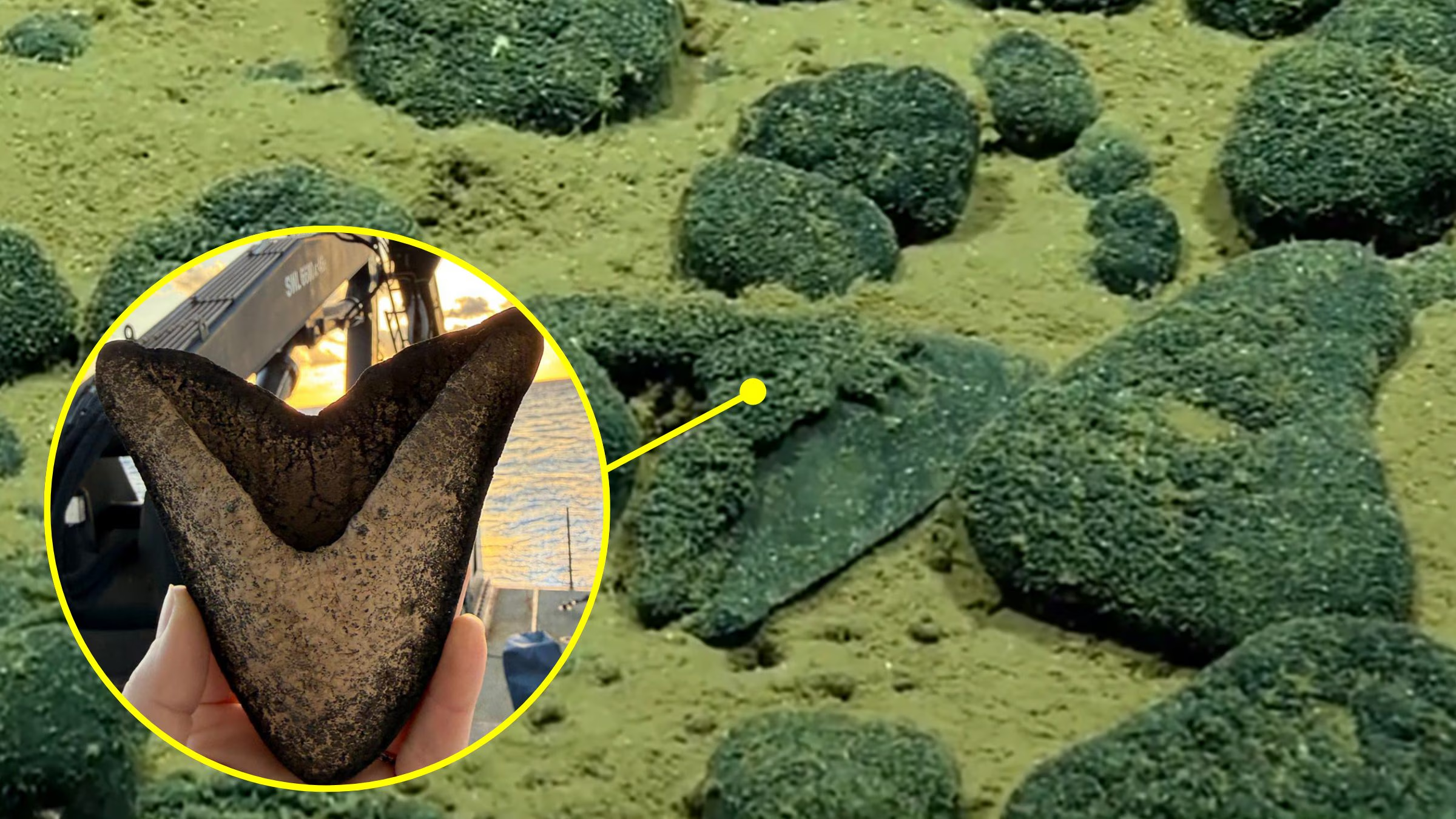
During an expedition with ROVs (Remotely Operated Vehicle) in the very deep waters of Cook Islandsin the South Pacific, scientists from NOAA (the US body that deals with oceans and atmosphere) have recovered huge fossil shark teethmost likely belonging to megalodon (Otodus megalodon), blackened by a crust of iron and manganese oxides deposited layer after layer over millions of years. It was not an isolated finding: the teeth appeared on many of the dives, always among the fields of polymetallic nodules that cover that backdrop. The ancient giant of the seas is considered the largest predatory fish that ever existed and capable of exceeding 20 meters in length before its extinction which occurred approximately 3.6 million years ago.
Submarine exploration and polymetallic nodules
From the 19 July to 13 August 2026 NOAA’s oceanographic vessel Okeanos Explorer is leading the expedition 2026 Cook Islands ROV Explorationin collaboration with the Cook Islands Seabed Minerals Authority, the U.S. Department of State, the U.S. Geological Survey and the Ocean Exploration Cooperative Institute. The work on the fund was entrusted to Deep Discoverera ROV (Remotely Operated Vehicle, i.e. a remote-controlled vehicle without a driver on board) capable of going down to 6,000 meters deepmore or less 3.7 miles.
Whenever Deep Discoverer touched the seabed in the southwestern part of the archipelago area he came across polymetallic nodules (spherical mineral deposits rich in manganese, iron and other metals). And in many dives, among those nodules, fossilized teeth of off-scale dimensions emerged: several they exceeded 7 centimetresand the largest touched the 13 centimetres.
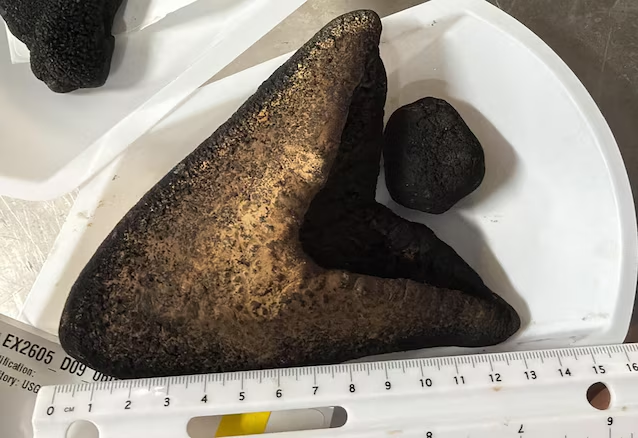
Why so many teeth right in the middle of the nodules? The explanation lies in very slow chemistry of the deep. When a shark loses a tooth (it loses and regenerates tens of thousands over the course of its life), made of apatite very resistant, this can remain on the ocean floor for millions of years without disintegrating. There it often becomes the nucleus around which the minerals dissolved in the water begin to deposit layer by layer, forming the nodules over millions of years.
A time capsule to study ancient currents
As it sinks and fossilizes, the tooth progressively absorbs seawater and surrounding sediments rare earth elementsincluding the neodymium. The concentration and isotopic “signature” of these elements vary from one ocean basin to another and over time, because they depend on which masses of water have bathed that point of the seabed in a given period.
By studying in the laboratory how much neodymium (and how many other rare earths) has accumulated in a fossil tooth, geochemists can trace how ocean currents moved millions of years agoreconstructing the marine circulation of past eras: information that is otherwise difficult to recover. That’s exactly what will be done with the seven collected teeth.
Identikit of the largest marine predator ever
The recovered teeth most likely belong to Otodus megalodon (formerly known as Carcharodon or Carcharocles megalodon), the megalodon: the largest predatory fish that ever existedappeared approximately 23 million years ago and disappeared around 3.6 million years ago. There is no single explanation for the causes of extinction: al Pliocene global coolingwhich took away both the prey and the warm waters it needed, the most recent studies support the competition with the white shark (Carcharodon carcharias), which appeared at the beginning of the Pliocene and was probably more agile and maneuverable.
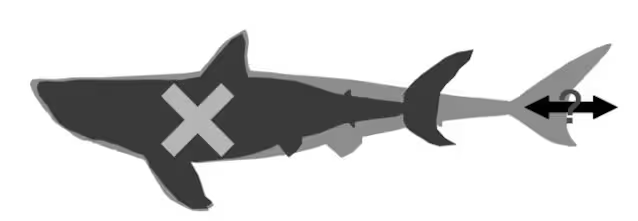
Even the form of the megalodon was recently revised. The classic image, the one that resembles a giant white shark, is considered wrong. The model proposed in 2025 instead describes an animal more slender and elongatedwith aspect ratios closer to those of one lemon shark. It is a hypothesis that has opened a heated debate among professionals, not a conclusion shared by everyone.
To give a sense of scale: the largest tooth ever found in the world measures almost 18 centimetres (the name “megalodon” literally means “large tooth”), and the most recent estimates, obtained from an incomplete fossil vertebral column and an even larger vertebra, indicate for the larger specimens a length of up to 24.3 meters and a weight around the 94 tons: values that the authors themselves present as working hypothesisnot as definitive measures. The bite is estimated to have developed a force of between 108,000 and 182,000 newtonscompared to around 18,000 for an adult white shark.
