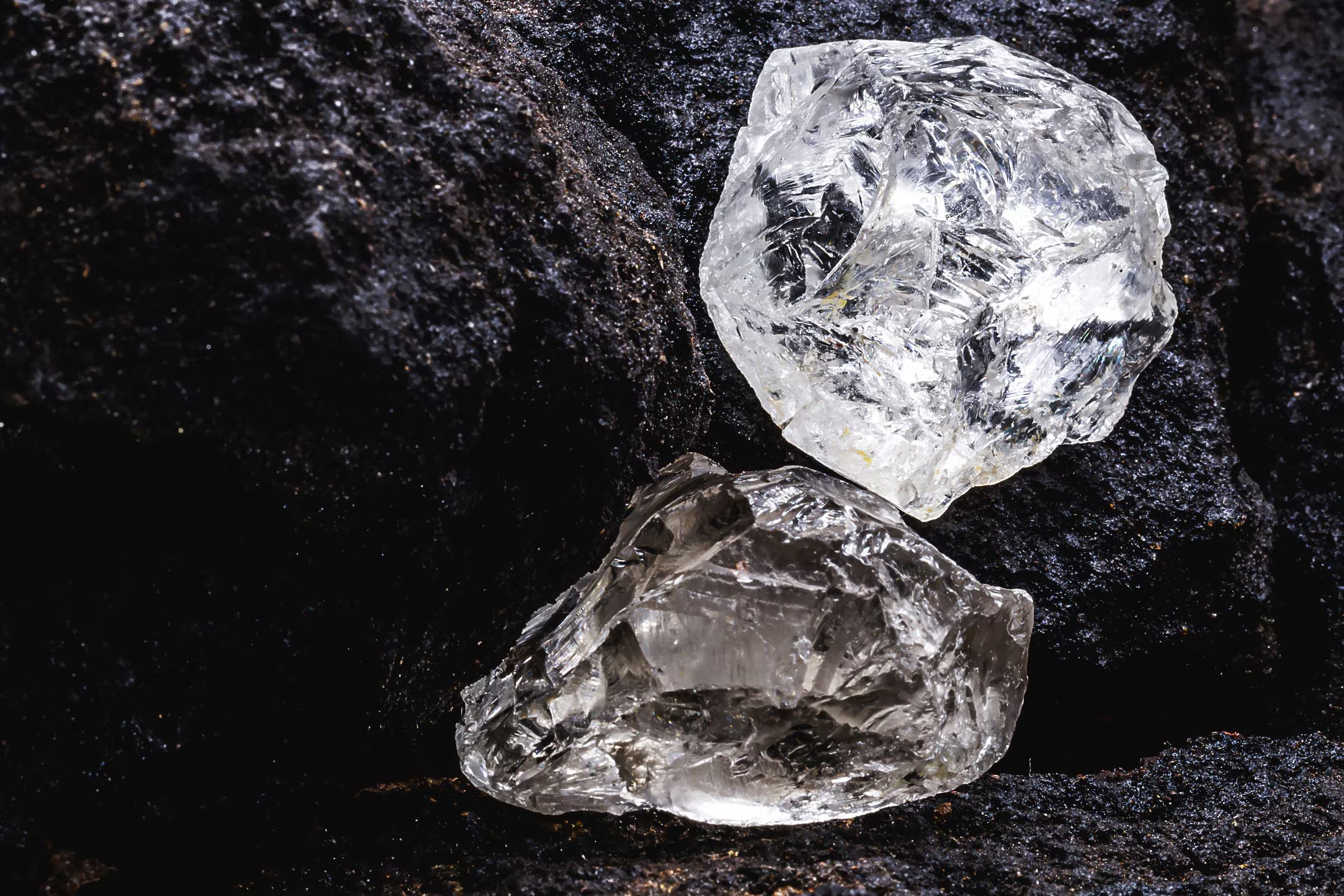
The Earth’s mantle It represents more than 80% of the volume of our planet, yet its deepest regions remain completely inaccessible to human technology. The lower mantlewhich extends from approximately 660 to 2,900 kilometers deep, cannot be reached directly: our knowledge of its composition therefore derives above all from theoretical modelshigh pressure experiments, indirect geophysical simulations and observations. Opening a window onto this otherwise unreachable part of the Earth are the so-called super-deep diamondsor sub-lithospheric.
Unlike most diamonds, which are formed in the lithosphere at about 150-200 kilometers deep, these very rare gems originate in the transition zonebetween approximately 410 and 660 kilometers, and in lower mantle. During crystallization, subjected to extreme pressures and temperaturessuper-deep diamonds can incorporate microscopic portions of the minerals present in the surrounding environment into their carbon lattice.
Their structure protects them from the transformations that they would normally undergo during the ascent, in some cases even preserving their crystalline structure. Transported to the surface by volcanic eruptions powered by kimberlitic magmas – those that give rise to diamond deposits – thus reveal themselves to be real ones geological time capsules. An example of this is davemaoite, identified in 2021 inside a diamond: a lower mantle mineral that until then had only been observed in the laboratory.
Super-deep diamonds bring previously unseen minerals to the surface in its natural state
Since current technology does not allow digging beyond a few dozen kilometers (the famous Kola well in Russia reached just 12 km), the Earth’s interior has long been studied almost exclusively through the propagation of seismic waves. Super-deep diamonds open up new possibilities for investigation. Forming at frightening pressures and temperatures, they absorb tiny portions of the surrounding chemical environment. During the subsequent ascent to the surface, the extremely resistant structure of the diamond protects them, preventing the minerals trapped inside from decomposing or changing phase and allowing them to reach our laboratories intact. It is precisely by analyzing these extraordinary samples that science was able to observe for the first time minerals never found first in nature.
Among the most relevant discoveries is the davemaoitea high-pressure form of calcium silicate (CaSiO₃) identified in 2021 by the mineralogist team Oliver Tschauner from the University of Nevada at Las Vegas. The mineral, named in honor of the geophysicist Ho-kwang “Dave” Mao, had until then only been theorized and synthesized in the laboratory, since its atomic structure becomes unstable at atmospheric pressure.
As Tschauner himself highlighted in the study published on Science:
The davemaoite sample in its natural state demonstrates the existence of compositional heterogeneity within the lower mantle. Our observations also indicate that davemaoite also incorporates potassium into its structure, in addition to uranium and thorium. Consequently, its abundance on regional and global scales affects the heat balance of the deep mantle, where the mineral is thermodynamically stable.
New clues to the composition of the mantle
The study of inclusions contained in super-deep diamonds has led to the identification of others Stable mineral phases at high pressureincluding bridgmanite, and even tiny water inclusions in the form of ice VIIa particular crystalline structure that forms only at high pressures. This evidence indicates that the water present on the surface can be dragged to depth by the subduction of the oceanic plates and reach at least the transition zone, perhaps going even further down. This is an important clue to the continuum exchange of matter between the Earth’s surface and the deep regions of the planet.
As the geologist summarized Evan Smith of Gemological Institute of America (GIA):
Diamonds are literally spacecraft in reverse: instead of bringing us samples from other planets, they bring us samples from inaccessible worlds located right beneath our feet.
These tiny samples then allow you to refine the chemical and thermal models of the mantle and to better understand how materials and elements are redistributed in the depths of the Earth. The latest techniques based on lasers and X-rays also allow increasingly smaller inclusions to be analyzed, revealing a mineralogical diversity of the mantle wider than it was possible to reconstruct through theoretical models and laboratory experiments alone.
