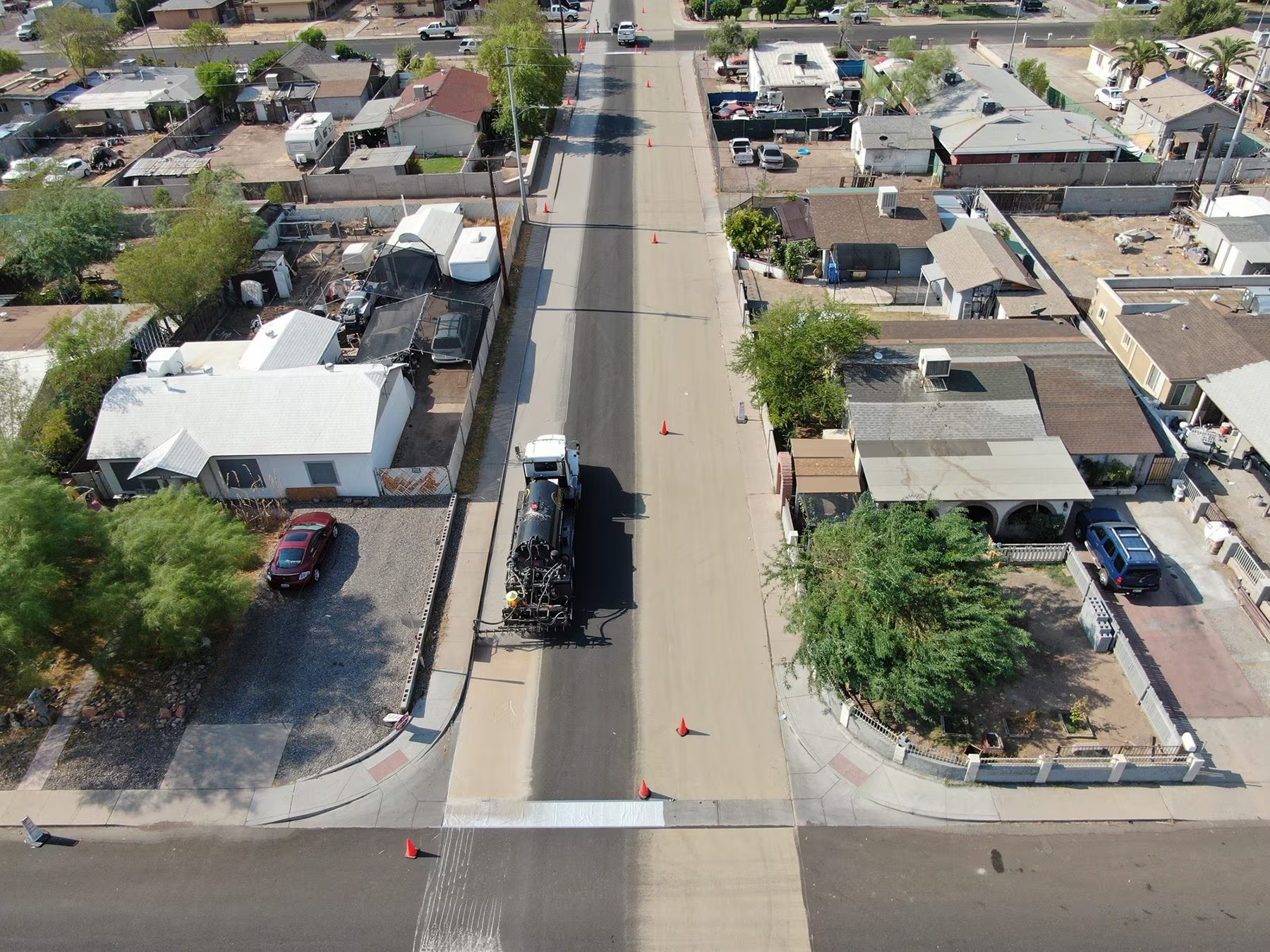
Heat waves are transforming our cities into real open-air ovens. Among the main elements that aggravate this problem we find the bituminous conglomeratecommonly called asphalt and traditionally used to build roads. It covers very large portions of the city territory, behaving like one sponge from a thermal point of view. Its heat absorption can in fact reach up to 90% of the incident solar radiation, with a consequent increase in the temperature of the road surface with final values between 60°C and 70°C. To counteract this inevitable phenomenon, the so-called cool pavementsinnovative conglomerates for road paving featuring additives, such as reflective paintswhich absorb less heat and favor its dispersion. By reducing surface temperatures, these solutions can help mitigate the heat island effect and to improve thermal comfort in urban spaces; However, there are some critical issues.
Why does asphalt raise temperatures?
What we commonly call asphalt it is, more correctly, one bituminous mixture formed by stone aggregates and a binder, i.e. bitumen. However, both due to its dark color (due precisely to the use of bitumen) and due to its specifications thermophysical propertiesthis material behaves like a sponge and retains a very high share of solar radiation. The heat stored during the day, due to its ability to absorb and retain it, is slowly released by radiation during the night hours: this residual heat is the first source of fuel for the well-known phenomenon of the Urban Heat Island, i.e. theincrease in temperatures in urban areas compared to rural ones.
How “cool pavement” technology works
Cool pavements are conglomerates for road paving that contain additives aimed at reflecting sunlight, absorbing less heat and promoting its dispersion. In particular, this technology is based on the application of high reflectance paints and coatings on existing pavements which allow the road pavement to be shielded from solar radiation and at the same time reduce the thermal absorption of the bituminous conglomerate. The physical principle underlying these paints is the modification of thealbedothat is, the reflective power of a surface. Specifically, it consists of percentage of solar radiation that is reflected compared to that which is absorbed.
While theConventional asphalt has a very low albedotypically between 0.05 and 0.10, the application of reflective paints raises this value up to 0.30 – 0.50. In essence, these paints increase the ability of the bituminous conglomerate to reflect solar radiation. Chemically, these coatings are usually formulated as aqueous emulsions, epoxy or acrylic resins. Specific compounds are dispersed inside them, such as titanium dioxide (TiO2), special polymers, hollow microspheres and nanotechnological compounds. The latter, in particular, represent fundamental additions to maximize the reflective capabilities of the conglomerate without however affecting its adhesion characteristics.
These paints are also designed to primarily reflect the wavelengths ofinfraredi.e. those that transport the majority of the thermal energy, maintaining instead a modest increase in the reflective capacity of radiation in the visible frequency spectrum, a fundamental technical measure for avoid a dangerous dazzling effect to the detriment of motorists. The real effectiveness of cool pavements has been validated in the field by important monitoring campaigns, starting from the significant reduction in surface and atmospheric temperatures recorded. Published scientific results, in fact, have certified reductions in soil surface temperature of up to 9°C, with consequent beneficial reductions in the surrounding air temperature of up to 2°C.
Critical issues and limits of cold road pavement
Even cool pavements, however, have some objective critical issues to manage carefully in the design phase. First of all the weak points is the thermal stress for pedestrians. In fact, since energy cannot disappear, but is simply not absorbed by the flooring, it it is inevitably reflected towards the surrounding environment. Consequently, the Mean Radiant Temperature (MRT) increases. This means that the pedestrian will be hit by heat in two directions: from above (direct radiation) and from below (reflected thermal radiation).
The sensation of heat perceived by the human body when walking on treated asphalt can be greater than that felt on traditional asphalt. To neutralize the negative effect of reflected radiation on pedestrians, cool pavements must necessarily be inserted within a integrated urban planning strategy. The planting of trees and green infrastructures, capable of intercepting reflected solar radiation and generating shade, cannot be replaced by the exclusive use of these paints, such as for example. in the case of the Green Corridor project in Medellin, Colombia (post X below).
A second problem concerns an aspect of nature mechanics: Several engineering studies have observed that adding layers of paint causes a consequent reduction in the surface voids of the conglomerate after installation, decreasing the surface roughness. This condition directly affects grip values, negatively impacting braking distances. Finally, it is important to point out that the thermal performance of these paints is not eternal: traffic, dirt and tire abrasion reduce the albedo over the months, generating natural wear of the treated surface layer. Recent studies have recorded a decline in its capabilities from the initial 38% to values in the order of 19% – 30% in the space of just 10 months.
