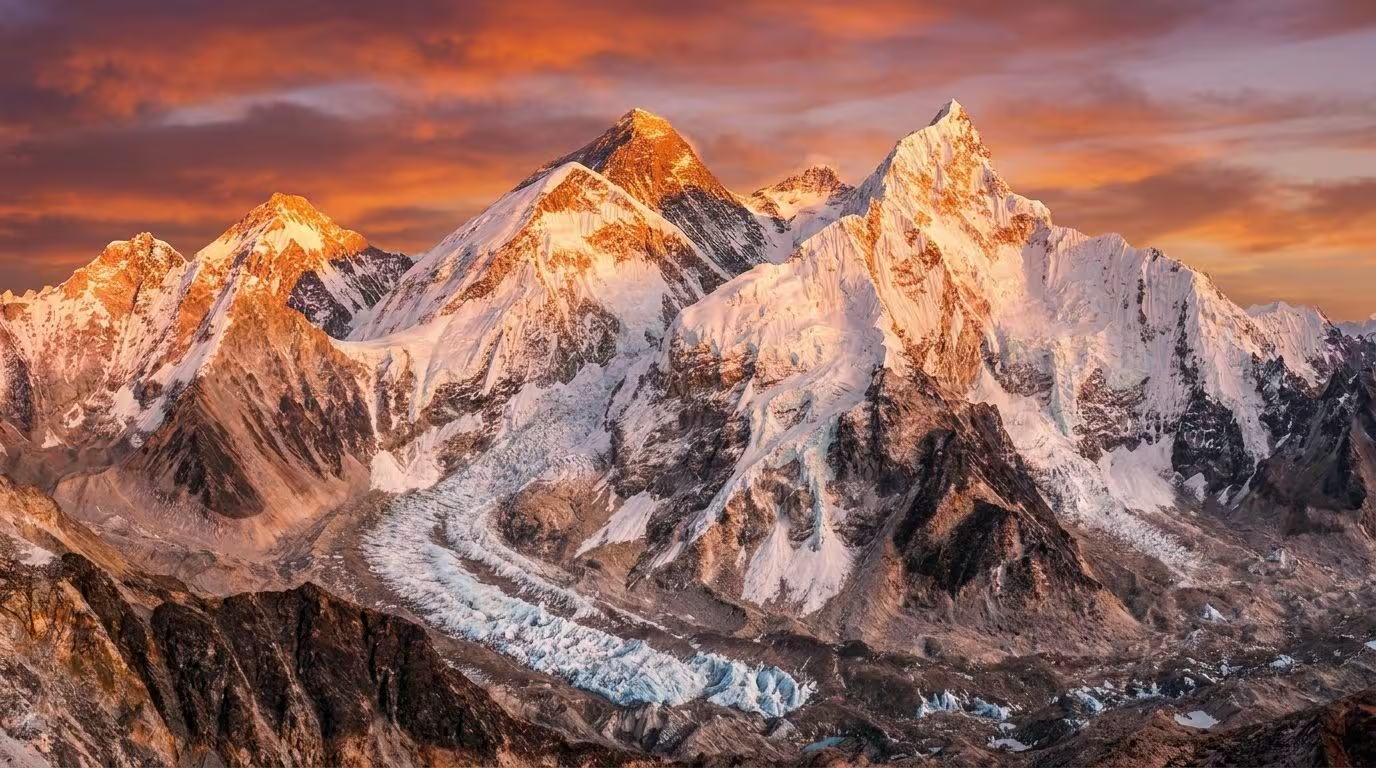
The Nepal disaster has once again drawn the world’s attention to the devastating effects of climate change on the environment and populations. Coinciding with the start of one of the most intense El Niño never recorded, one wonders whether this may have played some role in the thermal anomalies observed at over 5,100 meters above sea level onHimalayas and, consequently, in the triggering of avalanche of debris that he would have killed over 1000 people.
A certain answer, however, cannot yet be formulated both due to the lack of sufficient data and the difficulty of predicting the effects that this new “super” El Niño could have at high altitudes. However, some experts seem to agree that, as it is still in development, it is implausible give it a decisive role in the Nepal disaster.
In contrast, the observed thermal anomalies would be more consistent with the progressive increase in temperatures witnessed in recent decades and caused by human-triggered climate change.
The role of high temperatures at high altitudes
Just over a week after the Nepal disaster, the decisive role of the climate change and of temperatures well above the average seasons in the detachment of the glacier, which occurred approximately 5,200 meters altitude, which would have triggered the debris flow. Data collected by sensors located in and in the immediate vicinity of a lake a 5,100 meters altitude, about ten kilometers away, they revealed the highest water temperature of the year precisely on the day of the catastrophe and that of the highest soil of the last two years just two days earlier. It is therefore the hottest period of the year at altitude.
Dr. Hamish Pritchard, a glaciologist from the British Antarctic Survey who was the first to publish this data, said:
These high temperatures would have weakened the snowpack, filled the crevasses with water and dissolved the bonds between ice and rock that hold these glaciers in place.
The Himalayas, however, are not the only place where health-related risks increasing instability of glaciers increase with the passage of time. From the Norway at the New Zealandfrom the Chilean cordillera to Alps Italianthere are more and more glaciers around the world vulnerable due to anthropogenic climate destabilization. It seems clear, therefore, that events like the one in Nepal no longer represent isolated cases and that, over time, they could become increasingly frequent. And precisely in this period in which the effects of climate change on the environment and on society are now visible to everyone, a further concern emerges, linked to the “super” El Niño 2026-27 and its potential effects on high altitude areas.
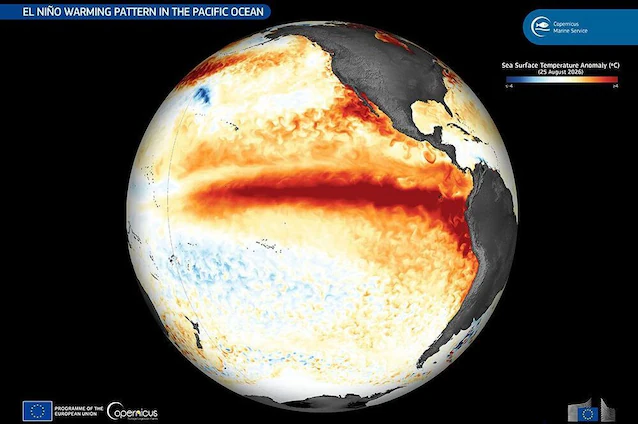
The El Niño phenomenon and its consequences in 2026-2027
El Niño-Southern Oscillation (ENSO) it is a cyclical climatic phenomenon characterized by variations in temperature waters superficial and gods winds in the’Pacific Ocean tropical. The effects of El Niño are multiple and, in many regions of the world, largely predictable.
Among these, ENSO is mainly responsible for the whitening of corals in tropical areas, the development of extensive fires in Indonesian regions, and of heavy rainfall in South America. At high altitudes, such as in the Himalayas, the effects of El Niño are not yet entirely clear. Generally, these include above-normal air temperatures in the summer following its peak and a drier monsoon season.
Kaustubh Thirumalaiassociate professor at the Department of Geosciences at the University of Arizona, in an interview given on Scientific American explained:
Analyzing the average of El Niño events recorded over the last 50 years, we observe that this phenomenon tends to bring higher than normal temperatures to the region during the boreal summer (June, July and August) and it is precisely in this period that we need to worry about melting phenomena and events of this type.
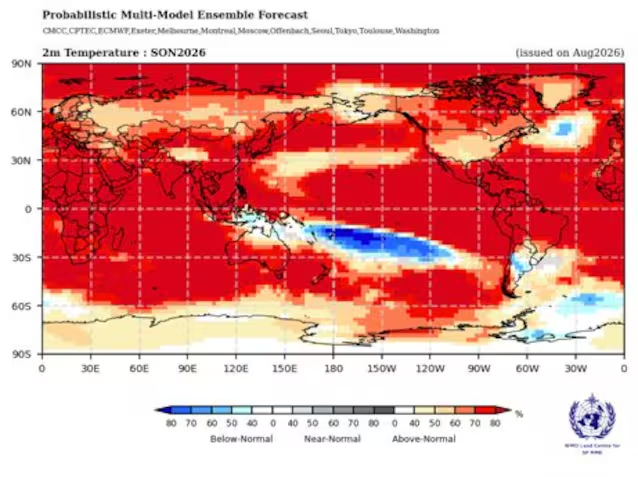
However, 2026-2027 is not considered a normal El Niño. Numerous climate models indicate that the surface temperature anomaly could reach i +3.6 degrees in the equatorial Pacific between September and November, more than 1°C higher than the 2024 event, making it one of the events strongest ever recorded in modern times, hence the journalistic term of “super El Niño”. The effects of this new event in high altitude regions therefore become even more difficult to predict.
El Niño is assuming enormous proportions before our eyes. The science leaves no room for doubt: the planet is in uncharted waters, and those waters are warming.
declared the Secretary General of the United Nations, António Guterresin a press release issued on September 3, 2026 fromWorld Climate Organization (WTO). Guterres also adds:
Sea surface temperatures are rising, temperatures continue to rise, and the world is in the danger zone for extreme weather events. The race now is between growing risks and our commitment to climate action and protecting people.
According to the latest WTO forecasts, there is an exceptionally high probability, close to 100%that ENSO persists until February 2027.
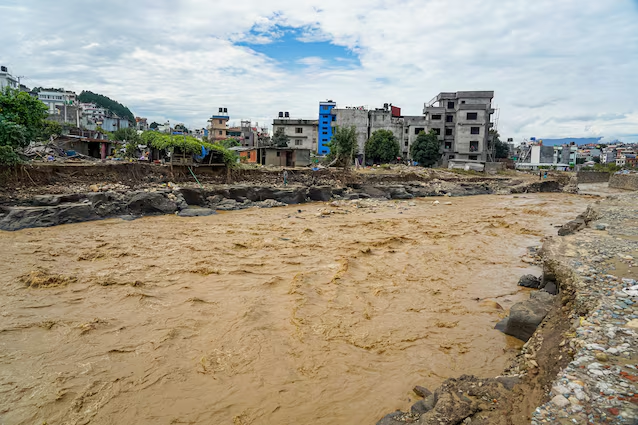
The effects of ENSO in Nepal
There is therefore a link between El Niño and the Nepal disaster? This legitimate question has come up in countless conversations and interviews over the past week. However, to date, scientists they do not have more of sufficient information to establish whether the El Niño phenomenon, in the process of forming, had any role in the Nepal disaster.
What is certain is that August 2026 was a abnormally hot montha condition that certainly contributed to destabilizing the glacier.
However, it is much less certain that the warming recorded in August is directly linked to El Niño.
he declared Mingfang Tingprofessor at the Columbia Climate School.
