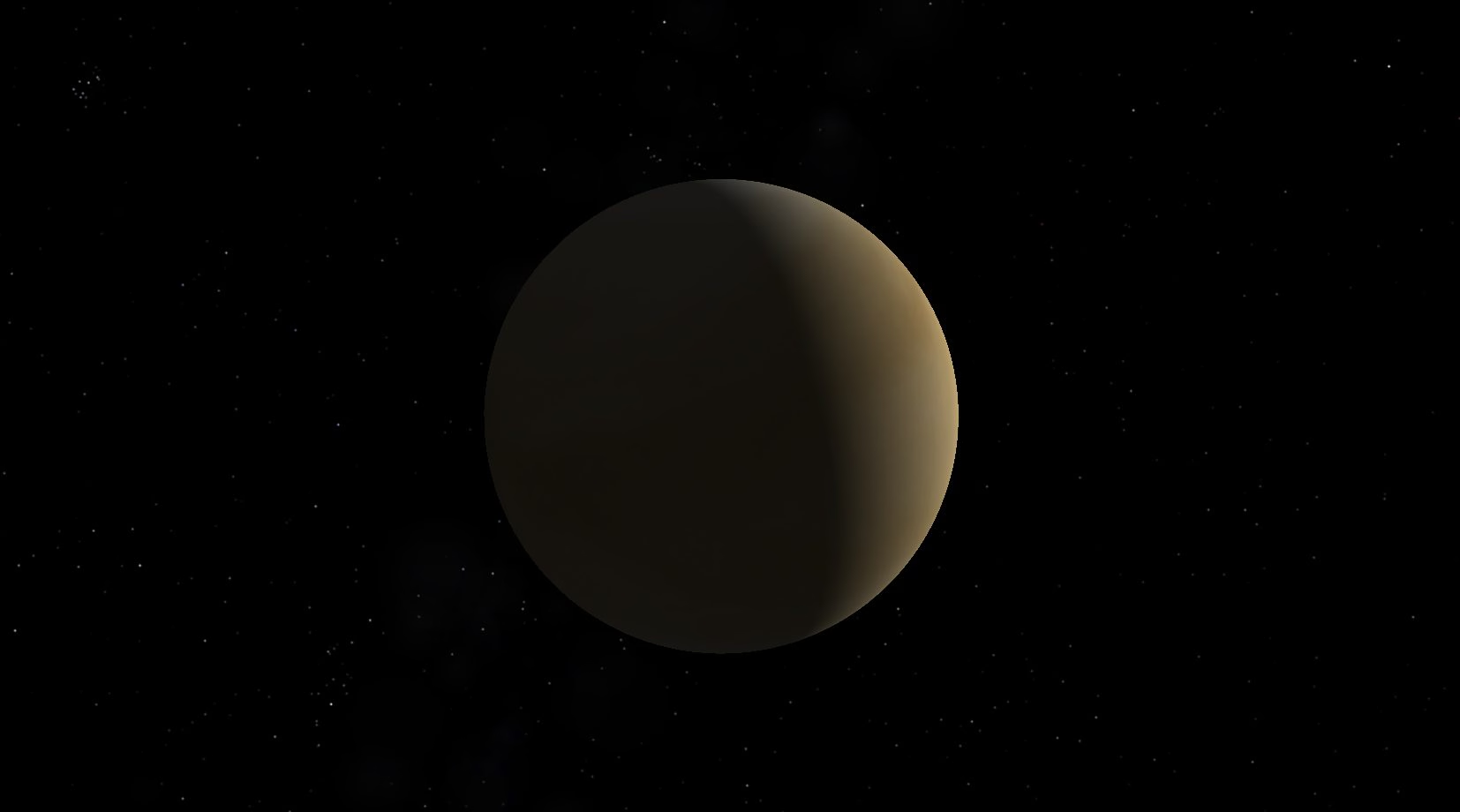
Today’s evening, Tuesday 22 September 2026, it will be the right time to observe Venus at the maximum splendor of his evening appearancewhen the second planet of the Solar System will reach an apparent magnitude in the visual V band of approximately -4.80making it by far the brightest object in the sky after the Sun and the Moon.
The actual maximum will actually happen at 07:50 Italian time on September 23rdhowever, when Venus will have already set for many hours: for this reason it is best to observe it from Italy the previous evening, when the difference in brightness compared to the maximum will be practically imperceptible.
You won’t need any tools to locate it. Venus will be easily visible with the naked eye towards the west/southwest immediately after sunsetbut the observation window will be rather short because the planet will already be very low on the horizon. In the different areas of Italy the Sun will set approximately between 7.03pm and 7.20pm and at that moment Venus will just be there 8 degrees talland then set around 20. It will therefore be necessary to choose a place with a completely clear west/southwest horizon.
The peculiarity is that, despite the enormous brightness, observing Venus with a telescope we will not see a completely illuminated disk, but a sickle. In fact, the brightness of a planet does not depend only on the percentage of its surface illuminated by the Sun. In the case of Venus, the distance from Earthhis apparent dimensions in the sky and the way its thick atmosphere covered with clouds diffuses sunlight.
When and how to observe Venus on the evening of September 22nd
To observe the maximum evening splendor of Venus you will have to look towards west/southwest immediately after sunset of the Sun. The time will vary along the peninsula, approximately between 7.03pm and 7.20pmbut the real problem will not be so much knowing the exact time as finding a place with thecompletely clear horizon. In fact, when the Sun disappears below the horizon, Venus will already be just there 8 degrees tall which, with your arm fully extended, corresponds to roughly less than the width of a fist above the horizon.
Venus will continue to sink rapidly and it will set around 8pmthus leaving one useful observation window of less than one hour. The easiest time to spot it will come a few minutes after sunset, when the sky starts to darken but the planet will still be a few degrees above sea level. With a magnitude close to -4.8However, Venus will be so bright that it will become visible already in the twilight. However, since the planet will be very low on the horizon, its light will have to pass through one much greater thickness of atmosphere than when an object is high in the sky so the actually observed magnitude will be higher, i.e. the object will appear less bright.
Mercury will also be present in the same region of the sky, approximately 20 degrees closer to the Sun than Venus and slightly lower on the horizon. In principle it will therefore be possible to search for both planets, but Mercury will represent a much more difficult target because it will be bathed in twilight and will set about 10-15 minutes before Venus.
For Venus, however, No telescopes or binoculars will be needed: to the naked eye it will appear as an exceptionally bright point. An optical instrument becomes interesting if we want to observe the shape of the planet, because with a small telescope it will be possible to clearly distinguish its shape sickle phase.
In the telescope the planet will appear like a sickle: because it has phases
Venus presents some phases similar to those of the Moon. The phenomenon is a consequence of the fact that the planet orbits the Sun at a shorter distance than the Earth. Depending on relative positions of the Sun, Venus and Earthso let’s see different percentages of the illuminated Venusian hemisphere from our star, from an almost completely illuminated disk to a very thin crescent.
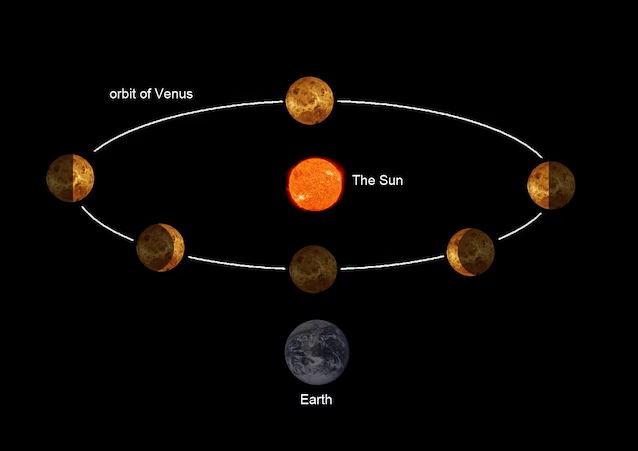
When Venus is on the opposite side of the Sun from the Earth, its illuminated hemisphere is turned almost completely towards us and the planet appears almost full. In this configuration, however, it is also very far from Earth and its apparent diameter is relatively small. The opposite situation occurs when approaching the inferior conjunctionthat is, when Venus passes between the Earth and the Sun. The planet progressively approaches us and its apparent diameter increases, but at the same time we see an increasingly smaller portion of its illuminated hemisphere. Venus then becomes increasingly larger in the telescope but also increasingly thinnermoving from a gibbous phase to mid-disc and finally to a sickle.
Around the peak of September it will only be illuminated about a fifth of the Venusian diskso in the telescope the planet will already look like a star sickle. To the naked eye, however, its apparent diameter remains too small for our eye to resolve its shape and Venus will continue to appear simply as a very bright point of light.
Because it reaches its maximum brightness today
It might seem counterintuitive that Venus is at its brightest when only a small part of its disk is illuminated. The explanation lies in the fact that the apparent brightness of Venus depends on the combination of three main factors: his distance from Earth, there illuminated portion of the disk from the Sun and the way in which the clouds of its atmosphere they diffuse sunlight.
During the summer, Venus progressively approached the Earth. As a result, its apparent diameter in the sky has increased and, for the same fraction illuminated, we receive a greater quantity of light from the planet. At the same time, however, as we approach inferior conjunction next October we see an increasingly smaller fraction of the illuminated hemisphere. Initially the increase in the apparent size of Venus compensates for the decrease in the illuminated surface we can see. However, there comes a time when the scythe becomes thin enough to overcome the effect of decreasing distance. It is precisely at the point of balance between these two effects that the planet reaches the maximum splendor.
To further complicate the situation there is theatmosphere of Venus. The planet is completely enveloped in thick clouds containing droplets of sulfuric acidwhich reflect and diffuse solar radiation very efficiently. The amount of light that is sent towards the Earth therefore also depends on theangle with which we observe the illuminated part of the planet, that is, from the so-called phase function of its clouds.
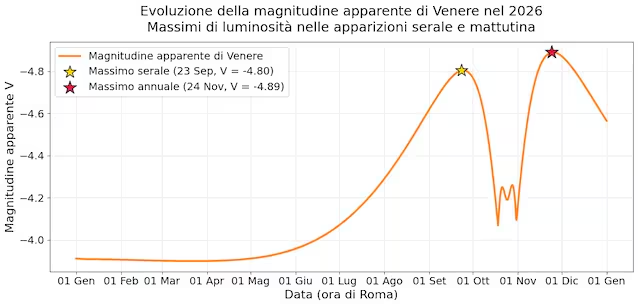
The maximum evening appearance of 2026 will occur at 7.50am on September 23rdwith an apparent V-band magnitude of approximately -4.80. However, September will not be the absolute maximum brightness of Venus in 2026. After having passed between the Earth and the Sun and having disappeared for a few weeks in the solar glare, Venus will reappear in the morning sky on November 24th at 07:00 Italian time will reach the maximum splendor of its morning appearance and also the highest value of the entire yearwith a V-band magnitude of approximately -4.89. The difference between the two maximums will however be small. The variation of 0.09 magnitudes corresponds to a difference in brightness of less than 10%, practically impossible to recognize with the naked eye.
