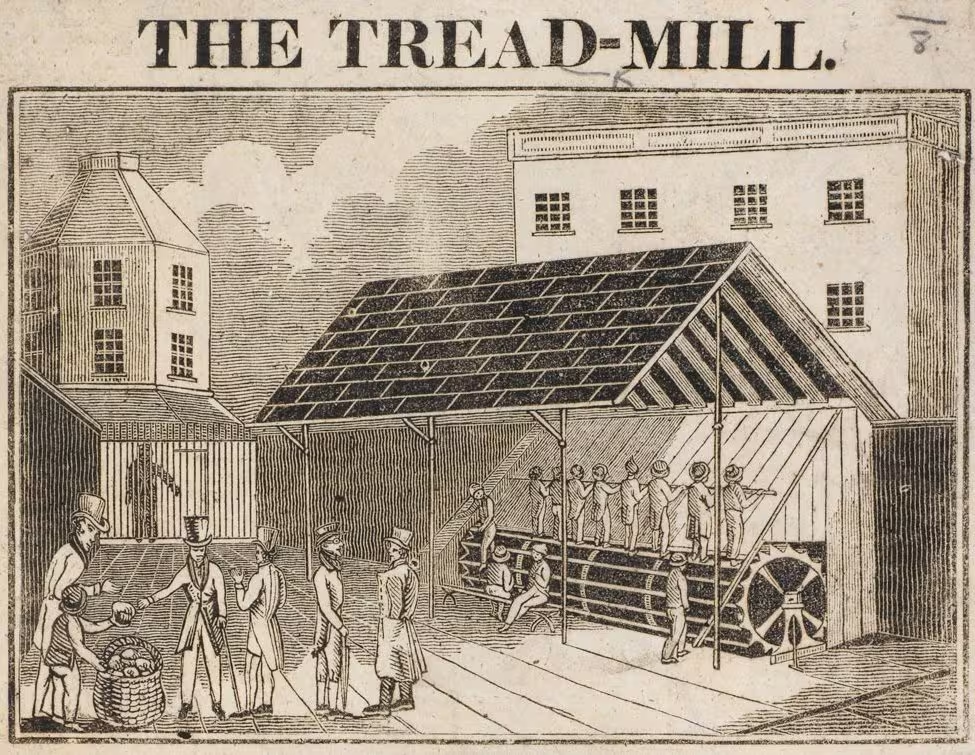
Today the treadmill it is one of the most used tools in gyms and home workouts, but its history is very different from what we imagine. His modern ancestor was not born to run or improve his physical fitness: in 1818 the British engineer William Cubitt designed the “treadwheel”a large wheel with steps that forced the inmates of English prisons walking on site for several hours a day.
The initial goal was to transform the prisoner movement into useful workfor example to operate mills or water pumps, but the device became above all a disciplinary tool based on effort and repetition. For much of the nineteenth century the treadwheel was used in prisons in the United Kingdom and the United States, before being gradually abandoned until its final elimination in British prisons in 1902. In the twentieth century, the treadmill completely changed its identity: from being an instrument of forced labor it first became a medical device for studying the functioning of the heart and then one of the most widespread tools for training and fitness.
In 1818 William Cubitt invented the treadwheel which transformed prisoners’ fatigue into energy
Before becoming one of the most used pieces of equipment in gyms, the treadmill had a completely different purpose: transform human movement into mechanical energy. Its ancestors were systems similar to mills, used already in ancient times to lift weights, move millstones or operate pumps using the strength of people or animals. It is no coincidence that the English term treadmill derives from the union of tread (“to trample”, “to walk on”) and mill (“mill”): originally it indicated a machine in which the movement of steps served to operate a mechanism, not a training tool.
These devices could have different shapes, but some worked through large wheels with steps on which people walked without actually moving forwardwith a principle similar to that of the hamster wheel. The turning point came in the nineteenth century, when the British engineer William Cubitt he transformed this concept into a tool intended for prisons. Between the 1817 and 1818 designed the treadwheela large wheel with steps designed to “re-educate” prisoners through work.
The operation was simple but exhausting, with prisoners sentenced to hard labor having to continually climb the steps of the wheel, making it turn with their own weight. In some cases the movement was used to operate water pumps or grind grain, but its primary purpose was often punishment. The larger models could be used by multiple inmates at the same time, while others, such as those in the prison of Coldbath Fields in London, they were equipped with dividers that isolated them, preventing them from communicating, forcing them to only see a wall in front of them.
According to the historian Vybarr Cregan-Reidthe real goal of the treadwheel was to create a punishment based on effort and repetitiona “useless” but extremely hard job, consistent with the Victorian idea according to which physical effort could lead to the prisoner’s redemption.
The diffusion in nineteenth-century prisons and abolition in 1902 with the Prison Act
After its introduction, the treadwheel was adopted in many prisons England, Wales And Scotlandto then also arrive in the United Stateswhere the first model was introduced in 1822 in a New York prison.
The punishment consisted above all in its extreme repetitiveness. Prisoners could spend on the treadwheel six or more hours a dayreaching in some cases up to ten hours of continuous work. One of the best-known examples was the treadwheel of Brixton prisonin London, where the machine could be used simultaneously by up to 24 inmates. The system involved continuous rotation: as one prisoner finished his shift, another took his place, allowing the wheel to continue moving for several hours.
Over time, however, problems related to this type of forced labor began to emerge. The effort required was enormous and prison food rations were often not sufficient to compensate for the energy consumed by prisoners. Many prisoners ended up on the sick lists, others died due to physical strain with the system which also began to be criticized by the prison authorities. Among the people forced to use the treadwheel there was also the Irish writer Oscar Wildeconvicted in 1895 of sodomy. During the two years spent in prison Pentonville he was subjected to forced labor and treadwheel use, an experience that contributed to the worsening of his physical and psychological conditions.
At the end of the 19th century the treadwheel began to be progressively abandoned after numerous criticisms. Already in 1889 its use in British prisons had been severely curtailed due to criticism of the inhumane conditions to which prisoners were subjected. The definitive abolition came in 1902 with the Prison Acta reform of the British prison system that officially eliminated this type of forced labor from UK prisons.
From prison to the gym: how the treadmill became a fitness tool
After being abandoned in prisons, the principle of the treadmill was progressively reinterpreted for completely different purposes. At the beginning of the twentieth century the machine began to find space in the field of medicinewhere it was used to study the human body’s response to physical effort.
In the 1913 in the United States one of the first treadmills intended for medical evaluation was patented, while in the 1950s the cardiologist Robert Bruce developed the so-called Bruce protocola test still used today to analyze the functioning of the heart during physical exercise through walking or running on a treadmill.
However, the real diffusion of the treadmill as a training tool came at the end of the 1960s. In the 1968 the American mechanical engineer William Staubafter reading the book Aerobics of the doctor Kenneth Cooper on the benefits of aerobic activity, he created the first model designed for home use.
Sources
Vybarr Cregan-Reid, “Running Wilde: Landscape, the Body, and the History of the Treadmill,” Critical Survey, vol. 24, no. 3 (2012)
David H. Shayt, “Stairway to Redemption: America’s Encounter with the British Prison Treadmill”, Technology and Culture
Shah BN, “On the 50th anniversary of the first description of a multistage exercise treadmill test: Re-visiting the birth of the ‘Bruce protocol'”, Heart 2013; Britannica BBC The New York Times Prison History
