
Jehovah’s Witnesses are a millenarian and restorationist Christian confessionpresent in over 200 countries around the world. Overall, according to the official data of the theocratic movement, there are more than nine million active preachers (250,000 in Italy), to which must be added other non-active faithful. Jehovah’s Witnesses believe in the same god as Christianity, but reject the rites and some of the beliefs of other Christian confessions. They follow strict morals regarding sex and interpret the sacred texts in a rigid manner. They are also known to reject, on the basis of certain passages in the Bible, the blood transfusions. On this aspect, however, the doctrine is evolving and transfusions have recently been accepted, albeit with some limitations.
Who are Jehovah’s Witnesses and what do they believe
Jehovah’s Witnesses are a Christian religious denomination. They follow a doctrine millennialistin the sense that they await the advent of the kingdom of God on Earth, and restorationistbecause they intend to restore original Christianity, believing that the current Churches have moved away from the original teachings of Jesus and the apostles. From the point of view of theology, they believe in an omnipotent god, whom they call Jehovah, but, unlike other Christian denominations, they do not believe in the principle of the Trinity and they believe that Jesus is not a god, but a son created by God. They believe in the Bible, which they consider inspired directly by God, and interpret it very rigidly.
To the world Jehovah’s Witnesses number approximately 9.2 million (including in the number only active preachers), of whom approx 250,000 in Italy. There are also millions more supporters of the movement, but the exact figure is not known.

The name Jehovah’s Witnesses comes from the Bible: Jehovah is none other than the name of the biblical god YHWH; the word “witnesses” comes from a passage in the book of Isaiah (43:10), in which God tells the faithful “you are my witnesses”.
Jehovah’s Witnesses they do not recognize rites such as massbut they gather in their premises, known as Kingdom Hallsfor the meetingsduring which they recite collective prayers and comment on the biblical texts.
They do not celebrate the main Christian holidays, such as Easter and Christmas, believing that they have no basis in sacred texts, and they reject the cult of images and saintsdirecting their prayers directly to Jehovah. Of the sacraments, they only admit baptism.
Proselytism: why they go house to house
Jehovah’s Witnesses are known for their proselytism: they are usual preach house to house or, even more often, by setting up stands in public places for the distribution of their publications. Also in this case, they draw inspiration from sacred texts, especially from the New Testament, in which they are found various references to door-to-door preaching and the need to make disciples.
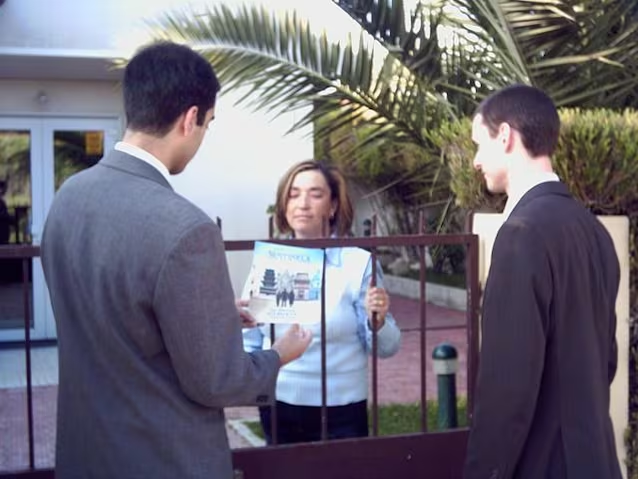
The most intrusive form of proselytism is that of home visitswhich are often rejected by those who receive them and considered an undue intrusion on their privacy. Jehovah’s Witnesses, after all, are trained to walk away, without insisting, in case of refusal. When the person they visit shows interest, they typically engage in a Bible discussion or leave literature.
Rules and prohibitions of the religious movement: blood transfusions
Following very strict morals, Jehovah’s Witnesses must comply with numerous prohibitions. For example, they cannot marry people who do not belong to the community, they cannot bear arms and serve in the military, they cannot run for office, they cannot have sexual relations outside of marriage.
One of the prohibitions that best identify Jehovah’s Witnesses is that of blood transfusions. It also derives from the interpretation of some biblical passages, which prescribe to “abstain from blood” such as Genesis 9:4, Leviticus 17:10-14 and Acts 15:28-29. Jehovah’s Witnesses believe that this prohibition also concerns the introduction of blood into the body. The issue had particular relevance on a medical and legal level in cases involving minors and emergency situations.
In Italy one thorny case occurred in 2019: the parents of a 10-month-old girl, victim of a fall, declared that they did not accept the transfusion, necessary to be able to operate, despite her daughter was in serious danger of dying. The doctors turned to the police, who in turn contacted the juvenile court. The judge, on the basis of the fact that the child’s interests have priority over the parents’ beliefs, limited the rights and allowed the little girl to be operated on and saved (the transfusion, moreover, was not carried out because it no longer proved necessary).
Recently, however, the doctrine of Jehovah’s Witnesses on transfusions has changed: on 18 September 2026 the Governing Body of the movement announced that it had lifted the blanket ban of transfusion of individual blood components (red blood cells, white blood cells, plasma and platelets). Now every believer can personally decide whether to accept or reject them. However, whole blood transfusion remains prohibited.
Brief history of Jehovah’s Witnesses
The movement of Jehovah’s Witnesses is born in the United Statesin Pennsylvania, in the 1870s, as part of the flowering of evangelical movements that preached a return to the purity of the origins of Christianity. The main promoter was the preacher Charles Taze Russellwho organized the first Bible study groups and founded the magazine in 1879 Zion’s Watch Tower (Zion’s Watchtowertoday only The Watchtower). In 1881 the more was formed Watch Tower Bible and Tract Society. In the following years the movement began to expand outside the United States, particularly in Canada and the United Kingdom. In 1900 a branch of the company was inaugurated Watch Tower Society in London.
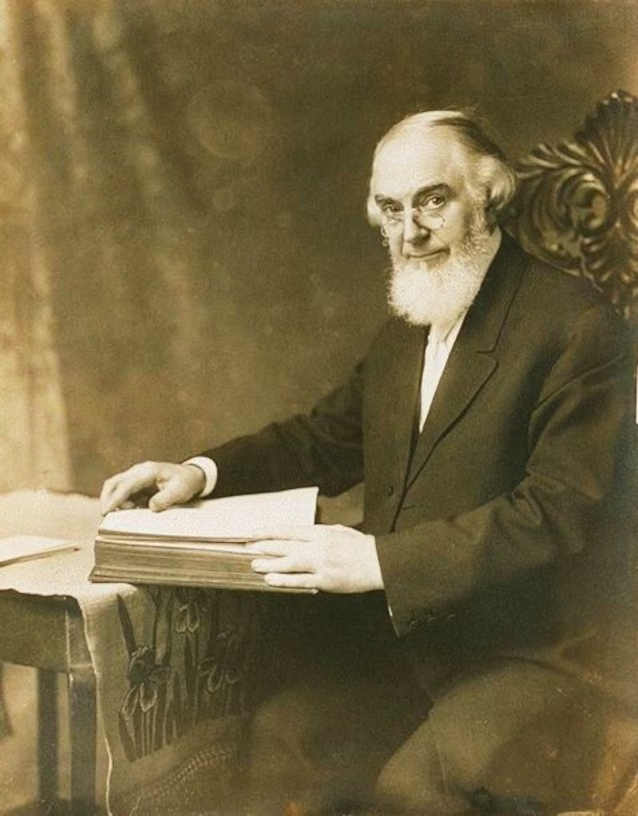
The movement was led by Russell until his death in 1916. Later the leadership passed to another preacher, Joseph Franklin Rutherfordwhich strengthened the organizational structure and intensified the preaching activity. In 1931 the movement officially took the name of “Jehovah’s Witnesses” and in the following decades promoted widespread missionary activity, equipping itself with a top-down and centralized structure
Today Jehovah’s Witnesses are present in numerous countries: in addition to the United States – where there is the largest community, with over 1,200,000 followers – large groups are found in Mexico, Brazil, in some African states such as the Democratic Republic of Congo, Nigeria and Zambia and, as we have seen, also in Italy. At the top of the movement is the Governing Body, which is based in Warwick, United States.
