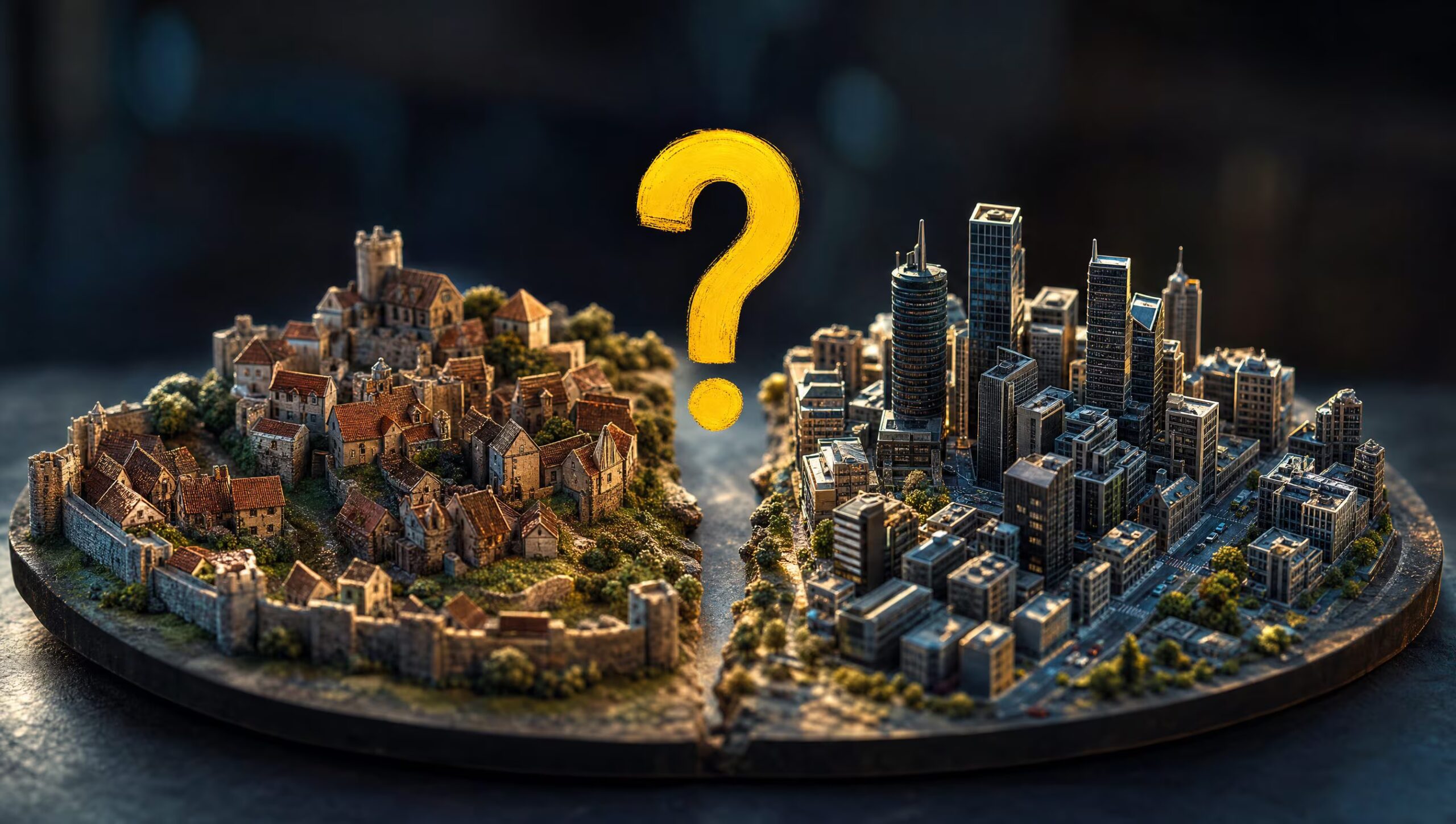
Municipality, hamlet, village, town and city are often used as synonyms, but they are not entirely so. Some terms are used in everyday language, while others have a precise meaning at an administrative level, and describe the size, history or function of the town.
In the geographical and administrative field it is not that unusual to use as synonyms words that belong to apparently similar contexts, but which in reality indicate completely different things. When we talk about a small and medium-sized town we can use different terms: village, village, fraction, common, city… But do these words really always refer to the same reality? Obviously not: municipality is an administrative concept, while country, city, village and hamlet describe the size, history or function of the inhabited centre.
The municipality
The common it is the smallest entity within the subdivision administrative which organizes the Italian territory.
To deal with the difficulties that arise from the management of such a diversified and densely inhabited reality as that of Italy, the surface of our State has been divided into administrative territorial bodies who, with more or less marked autonomy, manage the multiple needs and services in their space. We therefore have a first subdivision into regionswhich in turn are divided into provinces or city metropolitanwhich are in turn divided into municipalities.
The territory of the municipality usually corresponds to that of the largest inhabited center and the countryside and green areas that surround it.
The municipality was created to bring the level of government as close as possible to the real needs of citizens and has its own mayora advise municipal And offices who deal, for example, with roads, services, registry offices and management of green spaces.
The hamlet
When we think about fractions we always think of small, secluded and quiet places.
The reality is actually not very different. This is because a fraction is a inhabited center that belongs to a municipality but it is separated from its main nucleus. It may include houses scattered throughout the area, streets, shops and its own services, but it is not an autonomous body: although recognized at an administrative level with its own regulatory framework, it always remains part of the municipality to which it belongs. In Italy there are in fact many municipalities made up of a main center and various hamlets.
In sporadic cases the hamlets can be part of several municipalities: this is the case of Storka hamlet of less than 500 inhabitants divided between three municipalities (Pojana Maggiore, Roveredo di Guà and Montagnana) in three different provinces of Veneto (Vicenza, Verona and Padua).
The village
Let’s now come to village. At least once in our lives we have all visited an enchanting hilltop village, or read about its inclusion in the list of the most beautiful villages in Italy.
Unlike the previous two, however, the word borgo does not have a real administrative value and the meaning that this word can take on is quite varied. The term has in any case origin historicaland was mainly used to indicate a medium-sized town centreoften born around a castle, a large city or near an important location. Today we talk about villages above all to indicate inhabited centers with a long historywell delimited from a geographical point of view, often surrounded by walls because they were born in the medieval or Renaissance era, and known for their value historical, architectural or landscape. A village can therefore be a municipality or a hamlet in itself or be part of a municipality or a larger hamlet.
The country
Country is a word in common language and, even in this case, we do not refer to a precise administrative category. Broadly speaking, a country always includes a territory regulatedwell delimited by borders and ordered in a complete political-administrative body. It is used to indicate a small or medium-sized town, especially when it has a compact character and its own identity. The word country can therefore become synonymous with municipality, hamlet, city (or part of it, as in the expression “I take a walk in the country”), but it can also become synonymous with State: “Italy is our country”, but be careful not to use it as a synonym for nation!
The city
That of city it is an extremely broad concept, which takes on different nuances based on the context, language, culture and legal system of a State, and which in Italy is used both as a generic term within everyday language both as a term with a very specific administrative meaning.
Usually, by city we mean a stable settlement medium and large in size, characterized by areas different (residential, commercial, industrial…), one high population density and organized around an ecosystem of services And functions economic, political, social and cultural that make it work. Usually, the first difference we think about if we talk about a town or city concerns the size: the town is usually a smaller and less populated reality than the city.
Unlike what is usually thought, however, the attribution of the title of city to a municipality does not occur automatically upon reaching a certain threshold of inhabitants, but constitutes a title honorary granted by President of the Republic and promoted and regulated by article 18 of the Consolidated Law on Local Authorities (TUEL – Legislative Decree 267/2000).
There are actually no precise geographical parameters to obtain the title, but a municipality can become a city thanks to particular aspects of historical, artistic, civic or demographic importance. To obtain the title of citya municipality must first submit a request, accompanied by information demonstrating its importance. The request is then examined by the competent state bodies. If it is accepted, the President of the Republic officially confers the title of city with its own decree.
