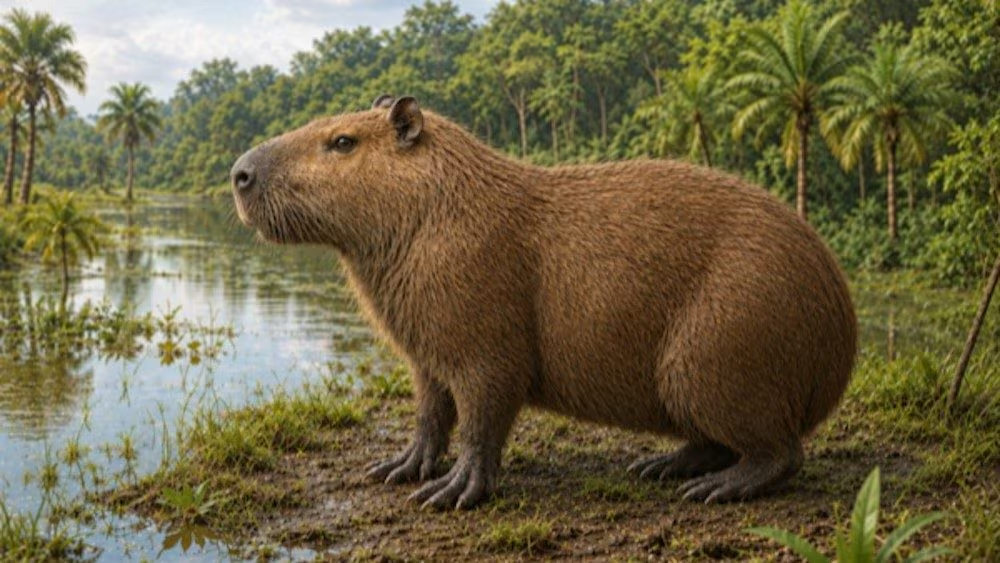
Yakamys sirindhornae, a new species of prehistoric rodent from the Eocene, was discovered in Thailand about 35 million years ago. The size of the teeth, a fossil molar and incisor, indicate that it may have weighed around 30 kg, suggesting that gigantism in rodents evolved long before the large South American Neogene species.
A fossil molar and incisor found in southern Thailand have allowed paleontologists to describe a new species of rodent lived between approx 35 and 34 million years ago. Is called Yakamys sirindhornae and, although it is known only through these two teeth, their dimensions suggest a exceptionally large animal for the time. According to scholars’ estimates, in fact, this mammal could reach 30kg of weight.
Described in a recent study published in Scientific Reports, Y. sirindhornae represents one of the oldest and most solid proofs that the gigantism in rodents had already appeared in the Eocene (the period from 56 to 33.9 million years ago), long before the gigantic South American rodents, whose best documented examples belong above all to the Neogene (between approximately 23 and 2.6 million years ago) and al Pleistocene (between 2.6 million and 11,700 years ago). These include exceptional forms such as Josephoartigasia monesi And Phoberomys pattersonifor which body masses of have been proposed several hundred kilogramsas described by a paper published on Science in 2003. Among the oldest rodents, however, animals of such large dimensions are documented much more rarely.
To estimate the body mass of Y. sirindhornaepaleontologists measured the dimensions of the incisor and second lower molar and applied seven different ones allometric equationsi.e. models that relate tooth size to body weight in modern rodents. The different formulas returned values between approximately 21 and 47 kilograms, with an average of 31.6 kg and a median of 28.6 kg – which is why the authors use approximately 30 kg as an indicative estimate of the animal’s mass.
However, this is a value to be taken with caution. In fact, the same researchers underline that reconstructing the weight of an extinct animal starting from its teeth involves a margin of uncertainty considerable, so much so that the different models produce estimates that are quite distant from each other.
Furthermore, the anatomy of the molar and above all the microstructure of the enamel of the incisor allowed the researchers to attribute Y. sirindhornae to Ischyromyidaeone of the first major evolutionary radiations of rodents. This group was widespread mainly in North America and Europe, while the Asian fossil record is much scarcer and mainly composed of species of small size. For example, the molars of Hulganawhich it previously represented one of the largest Asian members known members of the group, they measure less than half in length and width compared to those of Y. sirindhornae.
However, it remains to be understood why this large rodent has reached such an unusual size. In rodents, gigantism is often associated with insular environmentswhere the reduction of competition or predators can favor an increase in body size. In the case of Y. sirindhornaeHowever, neither the geography of the time nor other fossils found in the region indicate that the region was an island.
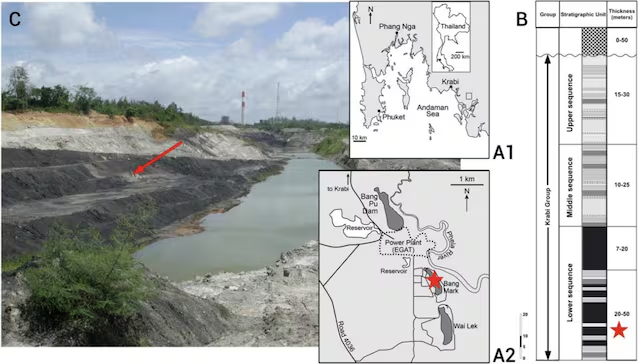
His remains instead come from lake sedimentssuggesting that the animal lived in a landscape also characterized by the presence of lakes. According to the authors, an environment linked to the lake shores – possibly with an at least partly semi-aquatic lifestyle – could have guaranteed abundant food resources and contribute to the evolution of greater size. Clearly, however, this is only a hypothesis: with the few remains available it is not possible to establish whether or not Y. sirindhornae was actually semi-aquatic nor what role the environment had in its gigantism.
But Y. sirindhornae it may not have been the only large Eocene rodent in this part of Asia. In the same study, in fact, the authors report the discovery of a large fossil incisor in Myanmarslightly older and dating back to the middle Eocene, whose dimensions exceed those of the other rodents described so far in the region. The finding, however, it has not yet been formally described nor identified from a taxonomic point of view, so it is not possible to establish which group it belonged to. New fossils will be needed to understand whether rodents of this size were isolated cases or a more widespread component of the Eocene Asian fauna.
Sources
Chaimanee, Y., Marivaux, L., Millien, V., Yamee, C., Tian, P., & Jaeger, J. J. (2026). A giant Eocene ischyromyid from Southeast Asia reveals the early evolution of rodent gigantism. Scientific Reports, 16(1), 34523. Sánchez-Villagra, M.R., Aguilera, O., & Horovitz, I. (2003). The anatomy of the world’s largest extinct rodent. Science, 301(5640), 1708-1710.
