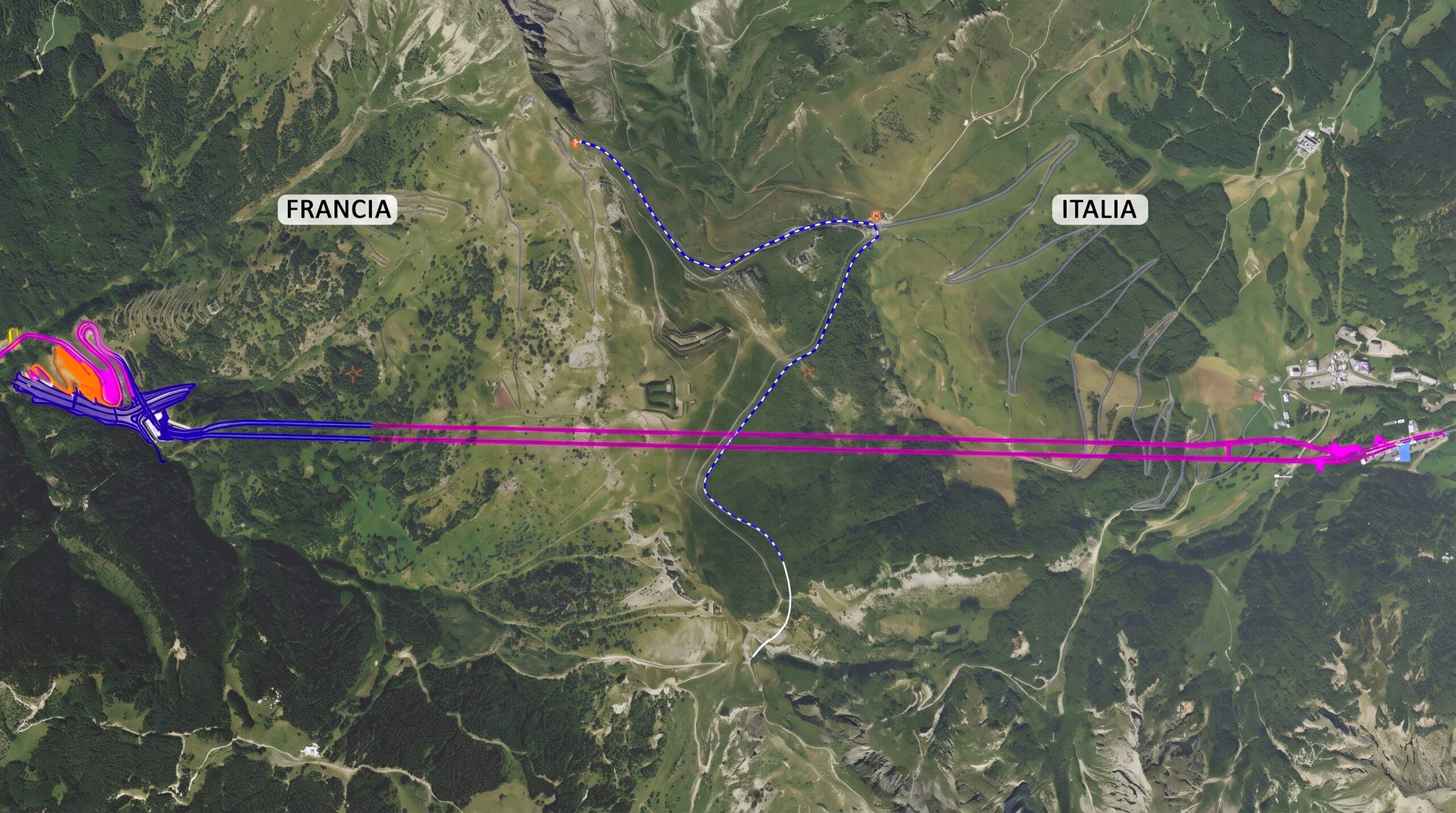
With a joint Italian-French investment of around 350 million euros, the Colle di Tenda Tunnel is undergoing a modernization project: the historic 1882 tunnel will be flanked by a new parallel tunnel of around 3.2 km at over 1,280 meters above sea level.
The Colle di Tenda tunnel it is the only road tunnel that connects Italy and France: all the other connections (Frejus, Mont Blanc and Ventimiglia) are in fact motorway crossings. The infrastructure, located between the valley Vermenagna in Piedmont and the Roya valley on the French side (at altitudes between 1,280 And 1,321 meters above sea level), was the protagonist of a recent modernizationwith a investment total updated by approx 350 million euros.
The intervention consists in the construction of a new gallery of approx 3.2kmparallel to historic tunnel inaugurated in 1882 (3,182 meters long), and in the subsequent enlargement of the latter, with the aim of obtaining two separate barrels, one for each direction of travel.
There new tunnel was opened to traffic on 28 June 2025restoring the cross-border connection interrupted in 2020 after the serious damage caused by Storm Alex.
The project, however, it is not yet finished: after the total closure from September 21st to October 29th 2026, the connection is back accessible from 30 October 2026, with traffic regulated in alternating one-way and with time limitations.
Description and characteristics of the project
The Colle di Tenda tunnel is located along state road 20which crosses the border between Italy And France. There historical galleryinaugurated in 1882it’s long 3,182 meterswith entrances located at altitudes of approximately 1,320 meters on the Italian side and 1,280 meters on the French side.
The project of modernization provides a system consisting of two parallel gallerieseach intended to host the traffic in one direction only: the new barrel for vehicles heading from Italy to France and the historic one, once enlarged, for vehicles coming from France.
The new gallery features a wide road platform overall 6.50 metersdivided into one 3.50 meter travel lanea lane of emergency from 2.70 meters and a 0.30 meter dock. The same configuration is planned for the historic tunnel at the end of the adaptation works.
One of the main engineering difficulties was the arrangement of the access roadsespecially on the French side. In October 2020, the Storm Alex it has in fact caused serious damage to the infrastructure of the Roya valley, causing among other things the collapse of the historic viaduct on the RD6204 departmental road and of the bridge over the Cà ditch, built as part of the project.
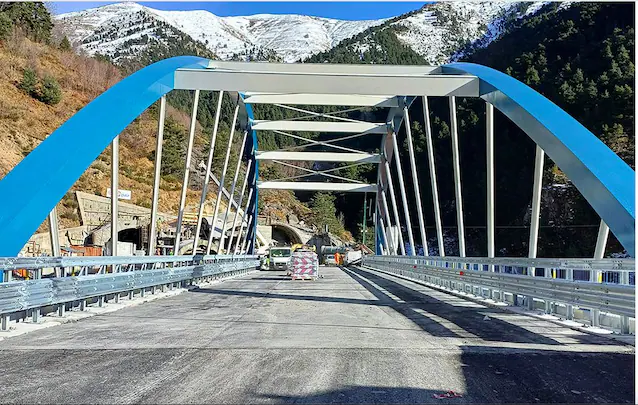
To restore the connection it was necessary to modify part of the original project, intervening on the tunnel entrances and on the external roads. Among the most significant works is the construction of a new 66 meter long steel bridge over the Rio della Cànear the French entrance.
The interventions also required the creation of geotechnical support and consolidation works, such as reinforced lands, bolted bulkheads and nailed wallsnecessary to improve the stability of the slopes involved and reduce the risk of failure.
The safety systems of the new tunnel
A central aspect of the project concerns safety, especially in the event of accidents or fires inside the tunnels.
The final configuration includes 13 bypasses connecting the two pipesof which 10 pedestrian and 3 vehicularwhich will allow us to improve the possibilities of evacuation and access for emergency vehicles.
They are also expected 18 SOS niches for each archdistributed approximately every 150 meters, fire stations and 3 rest areas.
The technological system includes mechanical ventilation systems, LED lighting, automatic fire detection, air quality monitoring, surveillance cameras and circulation management devices.
There is also aredundant power supplycoming from the Italian and French networks, designed to increase the reliability of the systems and reduce the risk of interruptions in the event of faults.
350 million euros for modernization
From an economic point of view, the tunnel modernization project has undergone changes, slowdowns and cost increases over time. The the overall economic picture was updated to approximately 350 million eurossupported through Italian and French funding.
According to the Ministry of Infrastructure and Transport, the construction of the new tunnel, including external works and interventions made necessary after the 2020 flood, involved an investment of approximately 210 million euros.
For the enlargement and adaptation of the historic tunnel, an investment of approximately 140 million euros.
The construction and operation of the tunnel represent a lever of strategic importance for the GDP and the commercial mobility between Piedmont and Lombardy and the French region of Provence-Alpes-Côte d’Azur.
As of November 2026, the new barrel is already open to circulation, but the expansion works of the historic gallery have yet to begin. In particular, traffic in the new tunnel is still regulated as one-way alternatingwith opening time slots and traffic restrictions.
Land security and environmental impact
The construction of an infrastructure in a mountain context such as that of Colle di Tenda requires particular attention to stability of the slopes, water management and the impacts of construction activities.
On the French side, especially after the flood events of 2020, geotechnical consolidation, hydraulic arrangement and adaptation of the road system were necessary. These works have the objective of reducing the risks associated with land instability and erosion phenomena in the areas concerned, without however being able to completely eliminate the risk of hydrogeological instability.
Inside the new tunnel, mechanical ventilation systems and sensors for gas and particulate detection allow monitor and manage air conditionscontributing to user safety. In particular, ventilation plays a fundamental role in managing smoke in the event of a fire.
However, these systems do not, in themselves, lead to a reduction in emissions produced by vehicles: their main function is to control air quality and manage safety conditions within the infrastructure.
From the point of view of emissions carbon dioxide (CO₂)the restoration of the direct connection may bring an advantage to motorists who, during the closure of the tunnel, had to take longer alternative routes. All other conditions being equal, a reduction in kilometers traveled can in fact translate into lower fuel consumption and related emissions for the individual journey.
However, it is not possible to say that the entire infrastructure automatically leads to an overall reduction in CO₂ emissions. To evaluate the environmental balance it would be necessary to also consider the actual traffic flowsany waits at the entrances, the consumption of the systems and the emissions associated with the construction and maintenance of the works.
The main result already achieved is therefore: restoration of the direct road connection between Italy and Francewhile the completion of the twin-tube project aims to further improve the safety and regularity of traffic through the Alpine pass.
