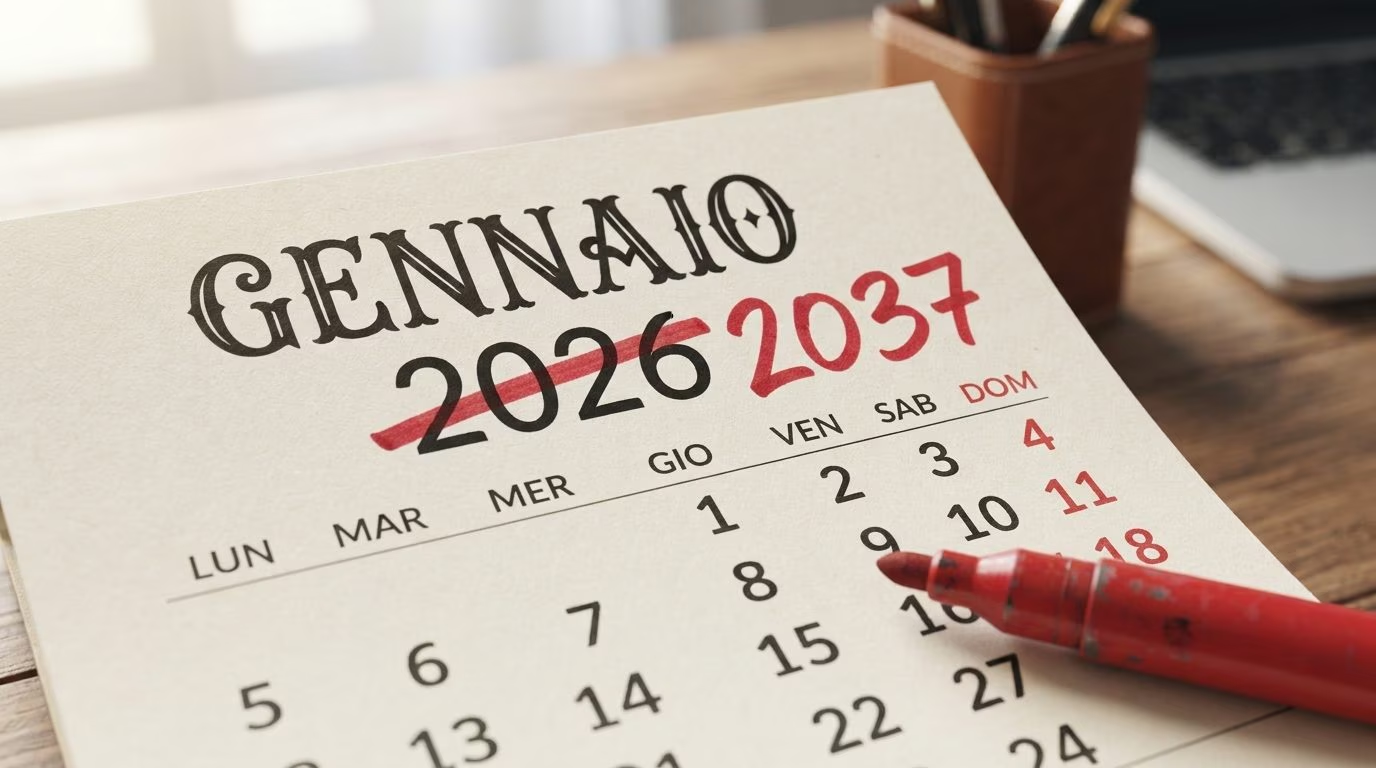
An identical calendar generally repeats every 28 years, but for non-leap years the interval can be as long as 6 or 11 years, depending on how many leap years fall in the period. There is therefore no rule valid for all cases: it is necessary to consider the succession of normal and leap years and verify that the dates fall on the same days of the week.
The 2026 And started on Thursday while the 2027 will begin on Fridaywith one phase shift Of 1 day and the association between dates and days of the week would not be correct. To recycle the calendar of 2026 it takes a year to start Thursday, but the first year that satisfies this condition is the 2032 which, unlike the 2026it’s a leap year and it lasts 366 days instead of 365so it’s not good.
To recycle the calendar of a given year, in fact, you need a year of the same duration and which at the same time begins with the same day of the week. For the 2026then we have to wait 11 yearsuntil 2037but it is not a general rule and in other cases the wait can last from 6 to 40 years: it’s a question that has to do with the rest from the division by 7 and with the alternation of leap years And normal In the Gregorian calendar.
The Gregorian Calendar provides that every 3 normal years, Of 365 daysthere is 1 leap yearOf 366 days. The years leap year I’m the multiples of 4like the 2020 and the 2028with the exception of multiples of 100 That Not they are divisible by 400, therefore the 2000 was leap yearbut the 1900 no. Let’s see how the duration of a year, divided into weeks and days, is the basis of the phase shift that occurs between one year and the next for both normal and leap years.
A normal year is composed of 52 weeks And 1 dayIndeed 365 ÷ 7 = 52 with rest Of 1and for this reason it ends with the same day of the week with which it began forcing the following year to begin with the next day of the week. The 2026 it’s a normal year that started Thursday and it will end Thursdaytherefore the 2027 will start and end with Friday.
The leap yearshowever, are composed of 52 weeks And 2 daysIndeed 366 ÷ 7 = 52 with rest Of 2and this causes a phase shift of 2 days instead of 1. The 2028 it will be a year leap year That will start on Saturday but It will end on Sunday and consequently the 2029 will begin Monday.
With this information, starting from a year whose calendar we know, we can determine the duration and starting day of the years that follow or precede it. Just calculate 1 day lag for each normal year and of 2 days for the leap years. For example:
- The 2026 it started by Thursday ed And normal, Therefore
- The 2027 will begin Friday and it will be normal, Therefore
- The 2028 will begin Saturday and it will be leap year, so yes he will miss Sunday And
- The 2029 will begin Monday and it will be normal …
The image below shows the sequence of years since 1960 al 2076 with the relevant day of the week at the beginning of the year, colored according to that day and with the leap years highlighted. The image shows a certain geometric regularity and allows, based on the colors and boxes, to identify the years that share the calendar including the 2026 and the 2037, 11 years later.
In other cases the leap is shorter, for example we can recycle the calendar of 2025 already in 2031only afterwards 6 yearsas well as in 2027 we can recycle the calendar of 2021.
For the leap yearsas you can see from the image, the jump is longer and you have to wait 28 years old so in 2028 we will be able to recycle the calendar of 2000. This rule, however, does not apply to all leap years, in fact in the past, around 1900, there were leap year calendars which were repeated even after 40 years.
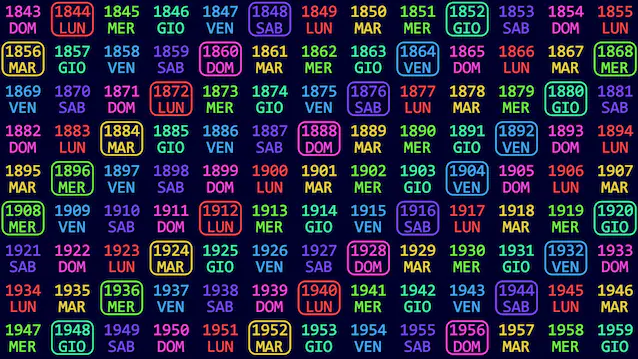
As you can see from the image above, the year leap year 1872 it started by Monday and after 28 years also 1900 it started on a Monday, except that the 1900 it wasn’t a leap year (falls within the exceptions of multiples of 100 but not of 400) and to find the first calendar equal to that of the 1872 you have to wait until 1912, 40 years later. Always riding the 1900 we find the two strange cases of the calendars ofnormal year 1890 and of theleap year 1896both recyclable later 12 yearsthe first in 1902 and the other in 1908.
In general, the sequence with which the different calendars alternate is not entirely regular and in fact repeats itself identically only every 400 years and this gives us the certainty that each calendar, for sure, can be recycled every 400 years: in 2027 we can use a calendar of 1627. The sequence of possible calendars, highlighted as in the images above, can be consulted in a video that lists them all, from 1583 until 3052.