New research conducted at Princeton University’s Department of Civil and Environmental Engineering opens a promising path towards a new generation of cementitious materialswhich can be used to create more resistant, safe and long-lasting buildings and infrastructures. At the basis of this innovation there is not a new cement or a new mixture, but it study of the structure of mother-of-pearl: the internal material of shells, surprisingly strong despite being composed of intrinsically fragile elements, just like the matrix that makes up concrete. In this article we explore the principles and outcomes of this interesting combining research biomimicry and civil engineering.
The idea behind the research: concrete and shells
What do concrete and the shells we find in nature have in common? An intrinsic flaw: both are made up of extremely fragile material. As we know, concrete, made up of cement, water and aggregates in a correct mixture of specific design, it cannot withstand tensile stressesand must in fact make use of metal armor drowned in the casting to guarantee the structural performance necessary to make it become a building material.
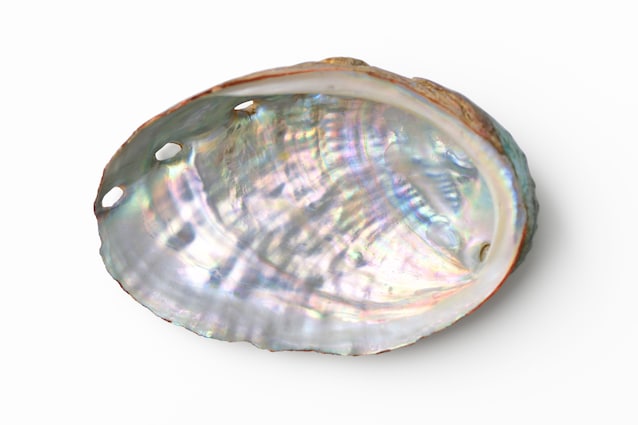
Shells, inside, are made of mother of pearl (or nacre), material mainly made up of aragonite, a very fragile mineral. Yet, unlike concrete, which has no reinforcement, shells have a macroscopic behavior much more resistant and tenacious. The secret lies in theirs internal microstructurethat is, geometric composition rather than chemical composition. We can therefore compare the structure of mother-of-pearl to that of a microscopic brick wall: small, extremely rigid elements, made of aragonite, are held together by a soft glue, made up of an organic matrix
If an external stress affects the resistance of this structural scheme, the rigid elements they slide between each other due to a significant deformation of the binding matrix. The main consequence of this deformation condition is that the structure has internally more dissipative capacity and manages to reduce localized energy intake which – otherwise – would cause a crack to formwhat we typically see in current concrete. The result is an increase in ductility of the system which would guarantee the concrete a better performance than what we are used to today.
The developments of the study: 17 times more resistant
To reproduce this geometric conformation within a cementitious material, the researchers used a technique laser engraving on thin sheets of cement paste. With the laser they created a series of hexagonal brickssimilar to what is present microscopically in mother-of-pearl. These sheets, thus engraved, were then overlapped by inserting a very thin layer between one layer and the other PVS elastomera highly deformable material that plays the role of the natural organic matrix. In this way they created three prototypes:
- a “layered” version without engravings;
- a version with engraved hexagons, still connected to each other;
- a version with physically separated hexagons as individual elements.
All samples were tested in bending until fractureto evaluate the response under stress. The experimental results confirm the initial hypothesis: redesign the internal architecture of the concrete its mechanical behavior completely changeswithout having to touch its chemistry. The most promising sample, the third on the list, showed a fracture toughness increased by more than 17 times (parameter that measures the ability of the material to prevent the propagation of lesions). The crack is in fact forced to follow tortuous paths and consume much more energy to advance. Furthermore, the material is not only more durable, but also more ductileand therefore less subject to sudden breakages.
For a typically fragile material such as concrete or in general a cement paste, it is a radical change. Mechanical resistance appears comparable to traditional cement pastes, despite the addition of deformable layers and the separation into hexagons.
The importance of Princeton University research
Concrete is the most used building material in the world, but its intrinsic fragility is a limit. For decades we have been trying to improve its performance – think about fibre-reinforced concrete, i.e. obtained with the addition of fibers and polymers – but the progress is modest, since a significant loss of strength or durability. The work of scientists at Princeton University is important because it lays the foundation for the concrete redesign: not by intervening on the chemistry of the cement, but on the geometric mix of the doughinspired by the internal structure of shells, which – according to the study – represents a natural solution. The applications are still in the experimental phase and have not involved real-scale prototypes, where the use of the material becomes truly impactful. However, the results emerging from the preliminary research appear promising and encourage us to continue along this path.
