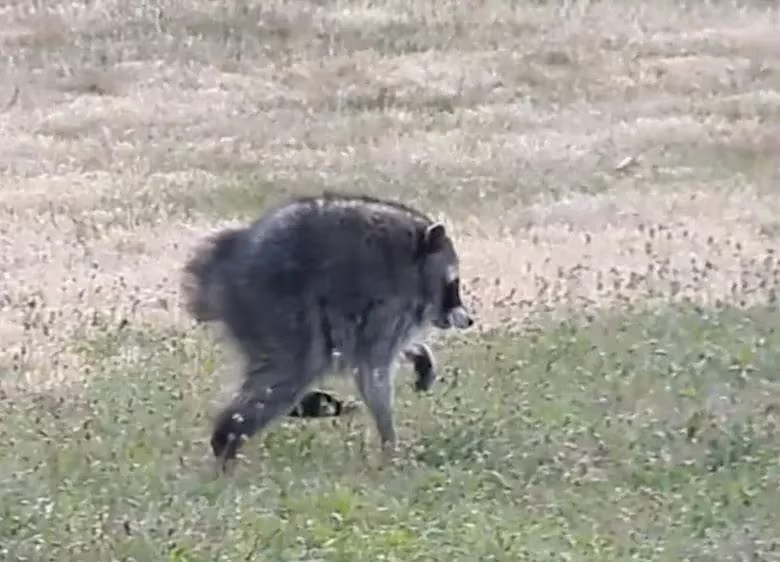
An unusual one raccoon with a squat shape and no neck, renamed “Jimothy“, has become the viral mascot of the summer of Seattlein the state of Washington. Behind its curious appearance there is the short spine syndrome (Short Spine Syndrome), a rare recessive genetic anomaly that also affects dogs and prevents the correct development of spinal columncausing compression and fusion of the vertebrae. For now, no one has been able to visit Jimothy clinically, so any diagnosis remains, for now, based only on remote observation. Despite the malformation, the animal it moves and climbs easily with his four legs and seems to be in good health. However, zoologists warn that the real danger to its survival is thehuman interactionthe excessive attention resulting from his celebrity on the web risks making him lose the necessary distrust towards urban dangers.
What is short spine syndrome and genetic causes
There short spine syndrome is a rare genetic condition caused by a recessive gene defective: for it to manifest itself, the animal must inherit two copies of the altered gene, one from each parent. This is why cases like Jimothy’s are so uncommon: the chances of two carriers of the same defective gene meeting and reproducing are already low in themselves, as explained by the ecologist Julian D. Avery from Penn State University, interviewed by Popular Science.
In short spine syndrome, the “segmentation” process of the spinal column is not completed correctly and the vertebrae remain “softer” than normal and over time tend to compress and in some cases fuse together, as also reported for dogs affected by the same condition. The result is a shortened, compressed or partially fused column, which gives the animal that stocky shape and no neck.
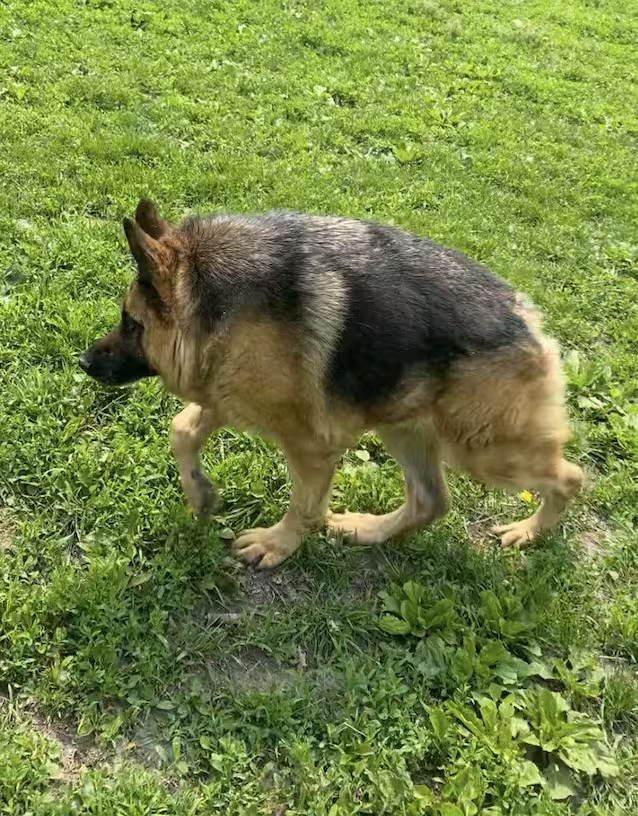
He is an example of this Almost The Greata German shepherd rescued from the streets and went viral in the US in 2016 while looking for an adoption. Despite having his organs compressed in his abdomen, he lives without pain, becoming the symbol of the circa 30 dogs in the world now documented with this rare syndrome (there were just 14 at the time of his rescue).
How the mutation affects the animal’s organs and life
The consequences of this condition are variable and may include compression of the abdomen and ribcage. However, in the case of the Seattle raccoon, ecologist Avery believes that Jimothy’s brain and internal organs are not compromised, predicting a completely normal life for him.
And the videos seem to confirm it. The animal climbs, searches through the vegetation and moves with relative ease. Also thanks to the species to which it belongs, raccoons (Procyon lotor) are extremely animals adaptablecapable of managing in very different contexts, from forests to urban centres. Also veterinarian Marcie Logsdon of Washington State University, cited by Smithsonian Magazineunderlined how the fact that the animal got there is already in itself a sign of successful adaptation.
Not all opinions are equally optimistic, other veterinarians interviewed by the American media, such as Brian Collins of the Cornell College of Veterinary Medicine, have raised doubts about the fact that a compressed column could limit the agility necessary to escape predators or city traffic over time, and therefore shorten the animal’s life expectancy in the wild.
The real danger is not the disease, but the interaction with humans
If there is a real risk for Jimothy, according to zoologists, it is not his spine but the tendency of the locals to “love him too much” closely.
“When people start feeding wild animals, they start to roam unsafely,” warns Avery. A raccoon accustomed to human presence loses part of its natural distrust of dangers and becomes more vulnerable precisely because of that confidence acquired, not its form.
Also the Washington Department of Fish and Wildlife urged the public to leave Jimothy alone, noting that the animal appears to be doing well on his own, without needing assistance, despite the congenital anomaly.
The story of “Jimothy Summer”: from discovery to web phenomenon
The “Jimothy phenomenon” began on July 13, 2026, when Kiana Hall captured that unusual silhouette moving under a car near a Goodwill store in Seattle’s Ballard neighborhood. Only when the animal turned, showing the typical black “mask” on its face, Hall realized he was in front of a raccoon, albeit one with a decidedly out of the ordinary shape.
From there the video exploded, garnering millions of views and transforming Jimothy into a small cultural phenomenon, dubbed online “Hot Jimothy Summer“. Google even dedicated a Easter eggs to the phenomenon: typing «Jimothy» in the search bar activates an animation in which the raccoon crosses the screen from one side to the other.
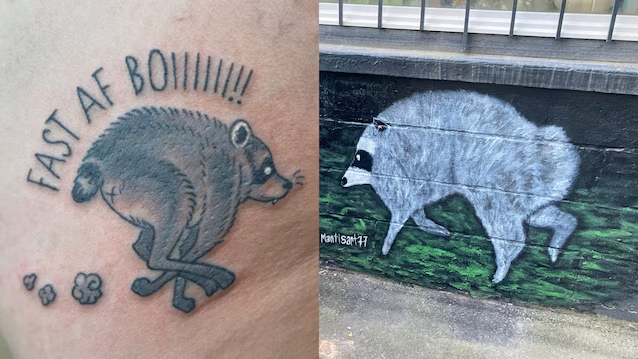
The Ballard community responded with a mural dedicated to the animal and some residents have done so tattoo his silhouette.