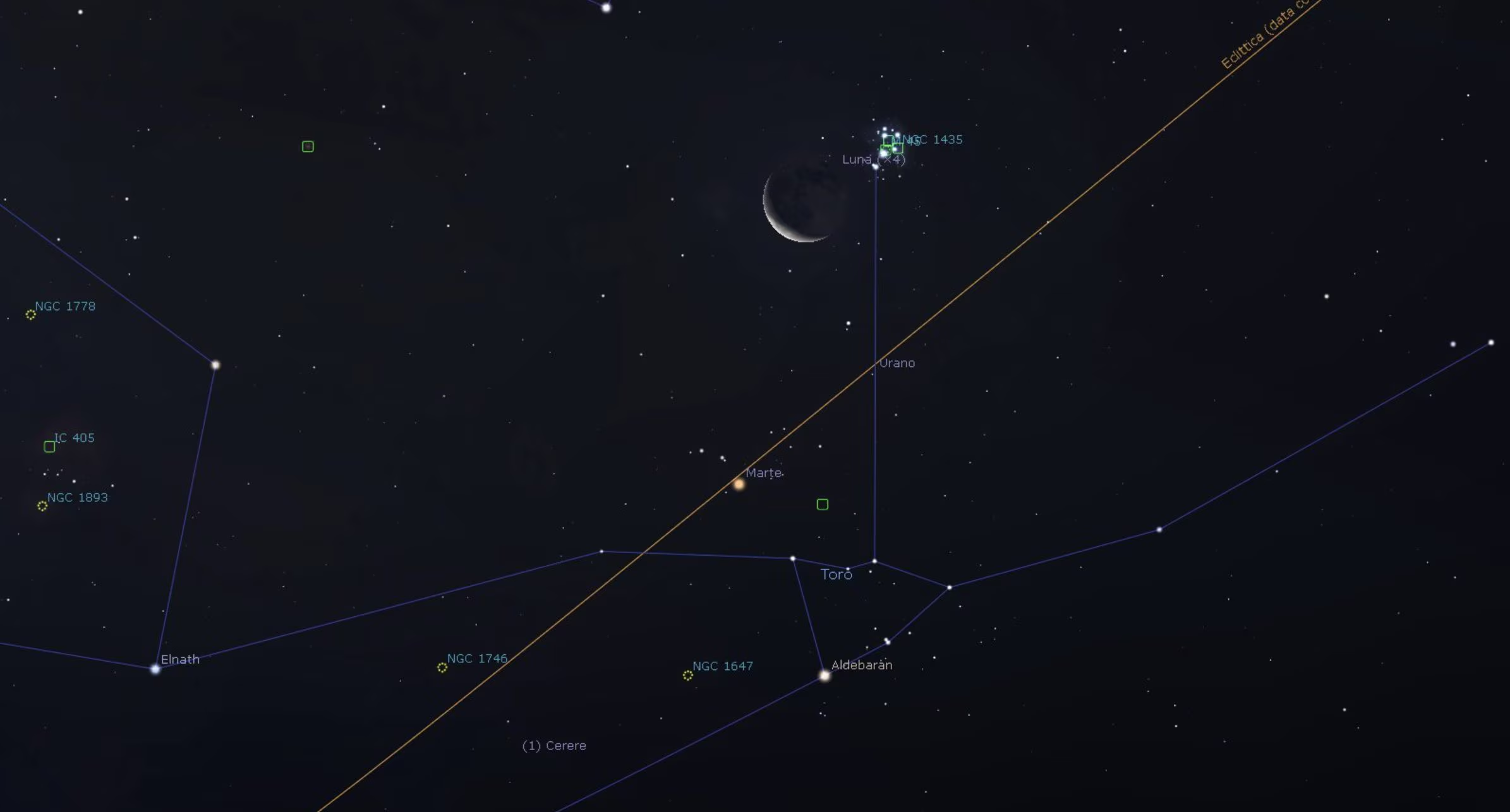
In the early hours of July 11, 2026, heaven will give us one astronomical spectacle: just before dawn, watching towards the eastit will be possible to admire a conjunction between a thin crescent of Moon waning and the star cluster from the Pleiades (the so-called “Seven Sisters”), followed by the planet Mars and from the star Aldebaranin the constellation of Taurus.
In reality, they will also join this “celestial parade”. Saturn (moved more towards the south-east) e Uranuswhich will not be visible. Unlike the alignment of the planets last June, this astronomical event will have a observation window rather limited. There
conjunction, in fact, will occur between 3.30am and 4.30am in the morning: once the Sun rises, the light from our star will dim celestial objects. Let’s see in more detail what will happen in our skies.
What time to observe the alignment in the skies of July
The main event will take place in night between 10 and 11 July 2026: the perfect observation time is in the early morning hours before sunrise, between 3.30am and 4.30am approximately (Italian time). Whoever is awake will then be able to address it looking eastwhere a thin waning crescent Moon will act as a “guide” to locate the rest: Mars will immediately appear nearby as a small reddish dot, while a little further up you can see the Pleiades close to the Moon.
Saturnunlike what you might think, will not have to be searched at a separate time. The ringed planet will rise already around 1 am and by 03:30 it will already be clearly visible in the skyeven if it will be more shifted towards south-east compared to the small group Moon-Mars-Pleiades. According to NASA, Saturn will be the brightest of the planets involved in this parade.
As dawn gets closer (in Milan, for example, the Sun will rise around 5.47), the twilight light will gradually begin to “HIDE“the weakest and least luminous objects. The advice is to look for a place with a clear horizon towards the east and, if possible, away from the artificial lights of the city.
What we will really see: Uranus visible only with the telescope
To recap, to the naked eye they will be perfectly visible three celestial objects: the scythe of Moonin its waning phase, Mars (recognizable by its typical reddish hue, although it will appear as a rather small dot) e Saturnwhich will result the brightest between the planets involved and will be easily identifiable higher in the sky.
Even the Pleiadeshowever, they can be glimpsed with the naked eye as a delicate grouping of light near the Moon, especially if you are in a place with little light pollution.
The planet that will remain excluded from naked eye observation is Uranus. The “ice giant” will be found in the same region of the sky, a few degrees from Mars, but NASA itself has specified that it will not be very bright: to see it you will necessarily need a binoculars or a telescope. After all, Uranus has a magnitude of approx +5.8 and, despite being in a favorable position in the sky, it remains al limit of human visibilityeven in the best conditions. If you have binoculars handy, however, it’s worth a try: the proximity to Mars (visible to the naked eye) could help you orient yourself to locate it.
