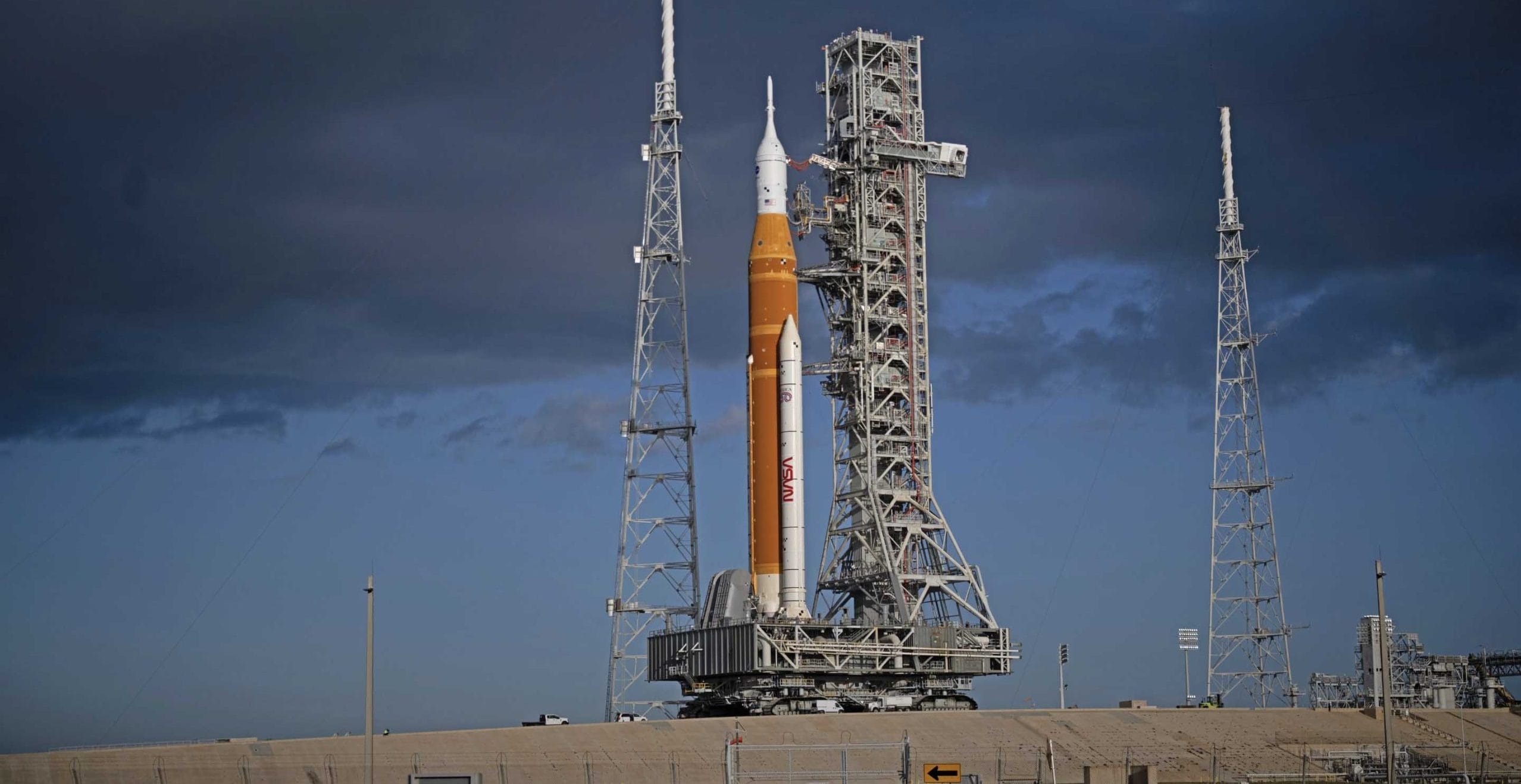
There is less and less left until the launch of Artemis IIwhich could happen on April 2, 2026 at 00:24 Italian (18:24 April 1 local time) in a 2-hour launch window. NASA mission will return humans to orbit around the Moon after more than 50 years. The SLS rocket is ready on launch pad 39B of Kennedy Space Center and the mission crew (Reid Wiseman, Victor Glover, Christina Koch and Jeremy Hansen) arrived at Cape Canaveral for launch preparations after two weeks of quarantine. At the moment the only impediment to the launch could be the weather forecastwhich is considered to date 80% in favor. In case of postponement, the next launch window will be 1.22am on April 3 (7.22pm local time on April 2), or the following days until April 6.
Artemis II: the return of man around the Moon
The attention for the mission is very high: it is the second chapter of Artemis lunar programthe first use of the Orion capsule into space with humans on board, the first astronauts to leave low Earth orbit since 1972 and return near the Moon since the Apollo program.
The mission will last 10 days and involves a close flyby of the Moon with the aim of testing all the systems and maneuvers of the Orion spacecraft with a crew on board. The mission will end with a splashdown in the Pacific Ocean. The culminating moment will be the entry of the mission into orbit around the Moon, a fundamental prerequisite in view of the actual moon landing which will take place with Artemis IV, no earlier than 2028. The next mission, Artemis III, will instead be a test in Earth orbit of the lunar descent system.
Because the future of the program is uncertain
However, the enthusiasm is overshadowed by some shadows that are weighing on the American space agency’s program. After the decision of postponement of the next moon landing from Artemis III to Artemis IV, NASA has indeed announced a structural reorganization of the program, due to difficulties in containing the costs of the program (exacerbated by federal cuts to the NASA budget), but also to delays in the development of key components of the program, such as the lunar descent systems entrusted to SpaceX and Blue Origin.
The ax of the cuts fell in particular on Lunar Gatewaya space station in lunar orbit that was supposed to be a “spaceport” for the construction of a future lunar base (which is the main goal of the Artemis program). However, last week the Gateway program was officially put on stream standby and now NASA will have to devise an alternative plan to establish a human settlement on the Moon without this infrastructure.
What we know is that NASA intends to achieve this goal over the course of three phases distinct: the first, which goes from now until 2028will see rovers and scientific instruments sent to the Moon, a sort of “robotic reconnaissance” of the moon landing site. Then there will be the second phase, from 2029 to 2032where the first ones will take place semi-habitable infrastructure on the Moon which will be the basis for subsequent human missions. Then there will be the third phase, from 2032 onwardsin which facilities will be completed to allow continuous human permanence on the Moon.
However, details on how NASA will achieve this goal in practice are unclear at the moment. If we add to this that reorganizing a program during construction is never a good sign, we can conclude that at the moment the future of Artemis is quite uncertain. But there is no doubt that both NASA and the US are highly motivated to succeed in this new space venture before its main rival, namely China, does.
In short, the stakes with the Artemis program are very high, but at the moment all this will have no influence on the mission that is about to begin. For now, therefore, all we can do is wait for the launch of Artemis 2, and enjoy what in all respects can be considered a crucial mission in the history of space exploration.
