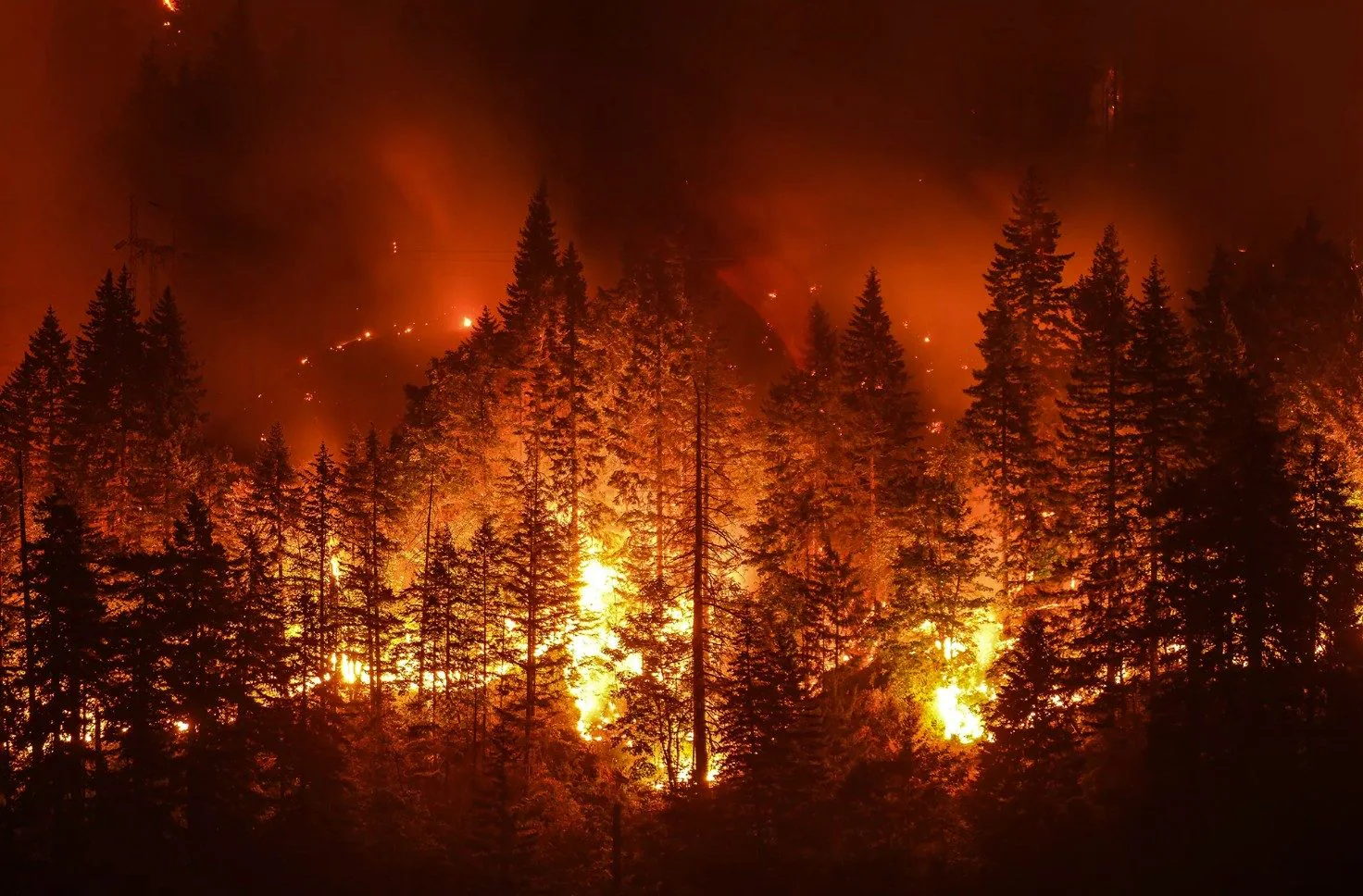
In Italy they were burned 12,590 hectares of surface areaThe 26% more of the average recorded in the same period between 2006 and 2025: between 1 January and 8 July 2026 the There were 112 forest fires detected, compared to a historical average of 65. These are data from the Burnt Areas database EFFIS, the European satellite fire monitoring system, and report that the 2026 season opened weeks earlier than normal. Behind the climatic advance, however, there is also a factor that the satellite does not see: the main causes are anthropic and the climate only facilitates the spread of the fire.
How many forest fires there were in Italy in 2026 according to EFFIS data
The clearest signal comes from the week of May 6, 2026when they are 820 hectares burned in a single day in Italy: the highest value ever recorded for that week from 2006 to today, against an all-time high of 321 hectares. From the end of March to June, the weekly burned area almost always remained above the historical average, a trend that is not normally observed before July.
The fires are almost double those of 2024: the triangle Sicily, Calabria and Campania
To understand whether 2026 is an isolated episode or the confirmation of a trend, the reference point is the ISPRA report on forest fires 2025, the last year recorded in full. In 2025 they were hit by fire 965 km² of surface in Italyalmost double compared to 2024. It is the fifth highest value since 2006surpassed only by 2007, 2017, 2021 and 2023.
The geographical data confirms a stable pattern: Sicily, Calabria and Campania together represent 71% of all forest area burned in Italy in 2025. Sicily leads the ranking for the fourth consecutive year, with over 500 km² of total surface area affected by fire. Another relevant fact concerns the protected natural areas: over 30% of the total burned area, and 38% of the forest area, falls within parks and reserves which are the green lung of our country.
Cosenza and Enna, the provinces with the most burned surface area
If we focus on the provincial data, Cosenza it is the province with the most hectares burned in Italy, 15.04 km², but the data comes from the sum of 165 different fires, over 70% of which are under 10 hectares. Ennasecond with 12.19 km², reaches the same order of magnitude with just 26 events: few fires, but on average much more destructive.
In terms of trends, ISPRA does not detect, at a national level, a statistically significant increase between 2018 and 2025. Three regions are exceptions: Basilicata, Calabria and Puglia with a certain increase in the forest area burned every yearrespectively 0.83, 4.79 and 1.34 km².
A phenomenon that does not stop at the Italian border
The same early season is observed on a European scale. In the same period of 2026, between January 1st and July 8th, the entire The European Union recorded 1,079 fires against an average of 476 in the same period of the last twenty years: 127% more.
The The Mediterranean remains the European region most exposed to the phenomenonand interface fires, those involving border areas between forest and homes, have already caused victims in Portugal in 2017 and in Greece in 2018. But to really understand where a fire starts from, the most important data is not meteorological.
Intentional, negligent or natural: what the data say about the causes of fires
The ISPRA report estimates that in Italy natural causes – lightning, spontaneous combustion – account for approximately 1% of fires; in Europe about 4%. Everything else has anthropic origin, and is divided into two categories that the Department of Civil Protection precisely defines: fires negligentlinked to cigarette butts, unextinguished fires, residues from agricultural activities or poor maintenance of power lines; and those maliciousset voluntarily for the interests of property speculation, out of revenge for measures such as the establishment of protected areas, or out of pyromania.
The phenomenon is quantified by Ecomafia report by Legambientebased on monitoring by the Forestry Carabinieri: the first consolidated data is from 2024 but it helps to frame the topic. They were 3,239 crimes related to forest and vegetation fires were contested, down 12.2% compared to 2023, with 459 people reported and 14 arrested. Looking at forest fires alone, those of an arson nature account for 1,197 out of 2,612 crime reports, almost half, and in 95% of cases they remain unknown: that is, the person responsible is almost never identified. Legambiente also highlights two structural factors that amplify the risk upstream of the single trigger – the abandonment of rural areaswhich causes unmanaged biomass to accumulate, e the growth of the interface areas between forest and homes – while the climate crisis, with heat waves and prolonged drought, acts as a multiplier rather than a direct cause.
