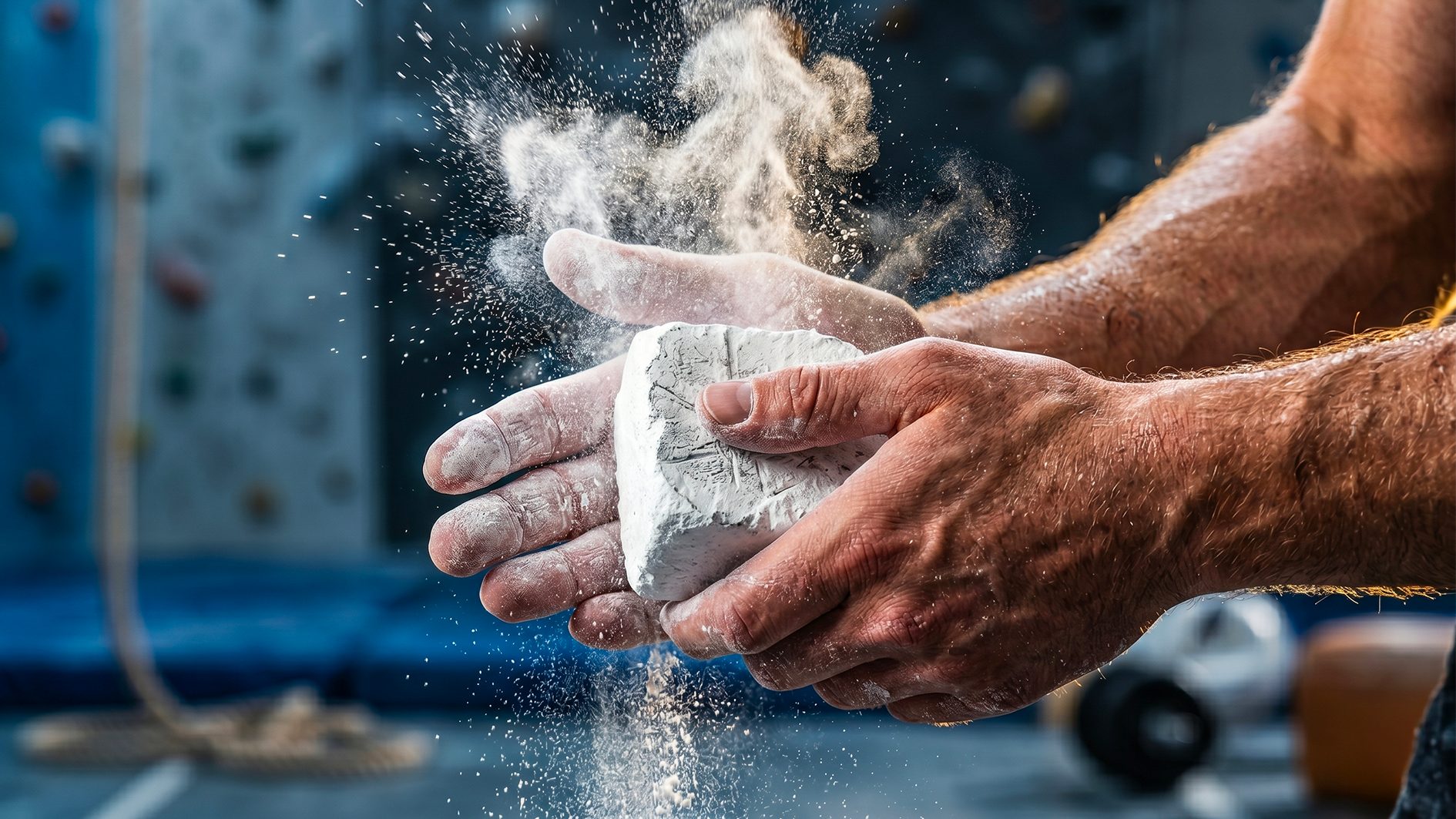
If you have ever watched an artistic gymnastics or sport climbing competition, you will have noticed a almost ritual moment: the athlete dips his hands into a white tray, rubs them together, and throws himself onto the apparatus or the wall. That substance is called chalktechnically magnesium carbonateand has become an almost indispensable tool in dozens of sports disciplines. But how does it really work? And how did it end up on a climbing wall?
What really is magnesium carbonate that athletes use
The magnesium used in climbing and artistic gymnastics is not the metal, but the magnesium carbonate (MgCO₃), a white and inert mineral which, thanks to its crystalline structure, absorbs humidity and increases friction between hand and surface.
The name “magnesite” is the name of the natural mineral, mainly present in nature in China and Türkiye. Ground into powder form, it is used in many sports: artistic gymnastics, climbing, shot put, pole vault, weight lifting and many others. It is also worth dispelling a common confusion: despite the English name “chalk”, magnesite has nothing to do with chalk, which is a different material made up of hydrated calcium sulphate.
What it is for and how it works: the physics of adhesion
The mechanism is intuitive: when we sweat, the skin becomes clammy and loses friction, making it much more difficult to maintain a grip on a bar or wall. Magnesium carbonate works through a porous structure which offers a high surface area, ideal for trap moisture in the interstitial spaces between the crystals. These micro-pores absorb the sweat present between the hand and the tool and guarantee a significantly better grip.
However, theexcessive accumulation of chalk on holds over time can have the opposite effect to that desired, creating a slippery film and reducing friction. This is why the most careful climbers use it brushes to clean the sockets after each session.
The first sport to use chalk was artistic gymnastics, but it was thanks to an American gymnast, John Gillthat chalk has also arrived in climbing. Gill introduced the use of chalk to climbing in 1954: before him, when climbers had sweaty hands, they wiped them on their trousers or took some dirt and rubbed it between their palms. From that moment there was no turning back.
How many shapes does chalk have (and why it’s not all the same)
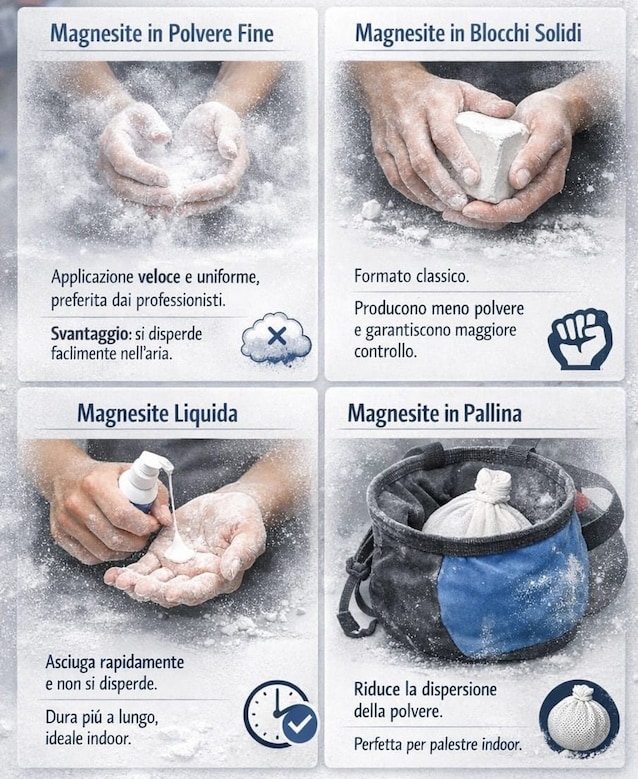
Not all chalk on the market is identical, and choosing the right format depends on the context. There are various types on the market: fine powder, granular, solid, liquid and gauze balls.
There fine powder It’s a favorite professionals for the speed of application, but it has an important disadvantage because it disperses easily in the airwith the risk of being breathed in and clogging the filters of heating and cooling systems. For this reason it is often prohibited in indoor gyms, and formulations are preferred in ball or liquid.
THE solid blockson the other hand, are the most classic form: they are rubbed directly on the hands, they produce less dust than loose powder and are still widely used in artistic gymnastics.
A more recent solution is the liquid magnesitea suspension of magnesium carbonate in alcohol which, once applied, dries quickly and does not disperse into the air. It tends to last longer between applications, which is why it is very popular in gyms and indoor competitions, even if it is less immediate to reapply during activity.
