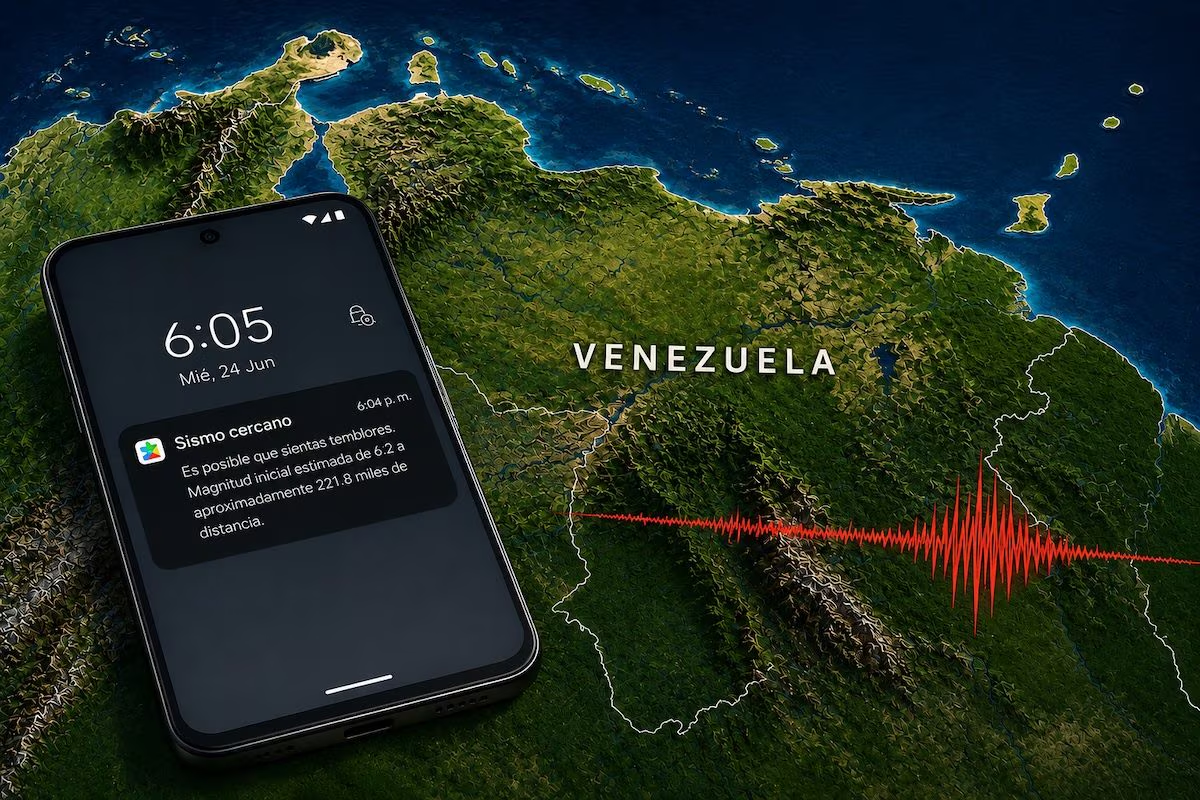
A few seconds before the most intense tremors of earthquake that hit Venezuela on 24 June 2026 reached numerous areas of the country, millions of Android smartphones they received an alert notification on their mobile phone. For many it was the first contact with a little-known technology, but already active in dozens of nations, but not in Italy: Android Earthquake Alertsthe system developed by Google which uses accelerometers integrated into smartphones to detect an earthquake as soon as it begins and warn those in the affected areas.
Unlike what you might think, Android Earthquake Alerts he is unable to predict an earthquake. Its strong point instead lies in recognize the very first seismic waves and take advantage of the short time interval that separates them from the more destructive ones to send an alert to users. In many cases it only lasts a few seconds, but it can be enough to move away from windows and dangerous objects, stop risky activities or seek shelter. As regards yesterday’s earthquake, updates from the international press currently confirm a heavy toll with 589 dead and almost 3,000 injured.
How Google alerted millions of people during the Venezuela earthquake
The earthquake recorded in Venezuela, one of five unrelated seismic events that occurred within 24 hours, was one of the most recent cases in which Android Earthquake Alerts went into operation on a large scale. After identifying the seismic event, the system automatically sent notifications to Android devices present in the areas that would have been reached by the most intense waves.
The mechanism is completely automatic and does not require the installation of dedicated applications. On compatible Android devices the service is integrated into the operating system and remains constantly listening using the accelerometerthe sensor that normally serves to detect the orientation of the phone, the movement and rotation of the screen.
It is good to point out that the smartphone does not independently recognize an earthquakebut what it does is simply pick up an anomalous vibration. It is the comparison with data from thousands of other devices that allows Google’s algorithms to establish whether it is truly a seismic event.
When a single smartphone registers an anomalous vibration, no alert is generated. The oscillation could in fact have been caused by an accidental impact, by the device falling or even by the passage of a heavy vehicle. Only when thousands of phones in the same area detect movement almost simultaneously compatible with an earthquake, the data is sent to Google servers. Here the algorithms compare geographical position, instant of detection and intensity of the vibrations to verify that it is truly a seismic event and not a series of false positives. Once the earthquake has been confirmed, the system estimates the epicenter, magnitude and wave propagation, so as to identify the areas in which to send notifications.
How Android Earthquake Alerts works
The idea behind the system is as simple as it is effective: transform smartphones into a giant network of distributed sensors. Each contributes a small amount of data collected by the accelerometer, while the processing is carried out by Google’s servers, which analyze the information received within a few moments. To limit data traffic and reduce the amount of information transmitted, smartphones send only one signal to Google’s servers when the accelerometer detects a compatible vibration with an earthquake. It will then be the comparison with the reports coming from thousands of other devices to confirm whether it really is a seismic event.
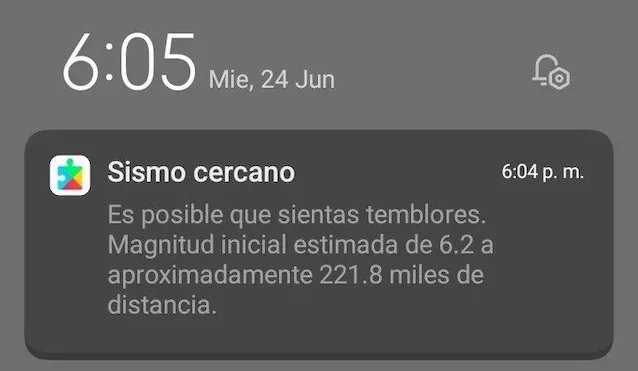
Once the seismic event has been validated, the algorithms estimate the epicenter, the magnitude and the propagation of the seismic waves, so as to identify the areas that will be affected by the most intense tremors. At that point, notifications are sent to devices along their route. Not all alerts are the same: one is shown for less intense events information notification (Be Aware Alert)while when a strong shock intensity is expected, the switch comes into operation more invasive notification (Take Action Alert)which can appear in full screen, beep even if the phone is in silent mode, and prompt the user to take cover immediately.
The objective of the project it is not to replace traditional seismic monitoring networksbut alongside them, especially in countries where the coverage of professional seismographs is limited or not sufficiently widespread. The solution also takes advantage of an important advantage: today there are billions of Android phones already equipped with the necessary hardware. It is therefore not essential to install new sensors in the area, because part of the infrastructure is already in the pockets of users.
Because the smartphone can warn you before the strongest tremors arrive
The operation of Android Earthquake Alerts is based on a well-known feature of seismic wave propagation. When an earthquake occurs, the first ones are generated P waves (primary)which travel faster but generally cause less intense effects. Then come the S waves (secondary)slower but responsible for most of the perceived oscillations and damage to buildings.
The accelerometers present in smartphones are able to detect the passage of P waves. Since these reach the sensors before the S wavesthe system has a short margin of time to process the data and send notifications to users who are furthest from the epicenter.
The time gained varies based on the distance from the earthquake and the speed of wave propagation. In some situations it can be just a few seconds, while in others it can reach several tens of seconds. Also a few seconds early can make the differenceallowing you to stop dangerous activities, secure machinery or allow people to quickly seek shelter.
How reliable the system is and where it has already been used
Google introduced Android Earthquake Alerts in the United States in 2020, and then progressively rolled it out to numerous other countries. Between 2021 and 2024 Android Earthquake Alerts detected over 18,000 earthquakesissuing alerts for more than 2,000 events and sending a total of approximately 790 million notifications. Today the system is operational in 98 countries and reaches approx 2.5 billion peoplerepresenting one of the largest consumer-based seismic warning systems ever built.
The accuracy of the platform has improved over time thanks to the ever-increasing number of mobile phones involved and the evolution of algorithms, which are increasingly effective in distinguishing a real earthquake from vibrations caused by other causes. Naturally There are some limitations. Android Earthquake Alerts cannot predict when an earthquake will occur, and its effectiveness depends on the presence of a sufficient number of smartphones near the epicenter, as well as on the ability of the algorithms to quickly estimate wave intensity and propagation. As also proven by the 2023 earthquake in Türkiye, the system has been progressively perfected over time. Furthermore, in areas very close to the point where the earthquake originates, the most intense waves can arrive too quickly for the system to be able to send a warning in advance.
However, the case of Venezuela shows how a network made up of devices already present in the area can become a valuable tool for civil protection. Using a sensor that every smartphone already has, Google has managed to create an alert system capable of exploiting a few seconds of advantage to warn millions of people, highlighting how technologies created for a completely different purpose can find concrete applications in protecting the population.
