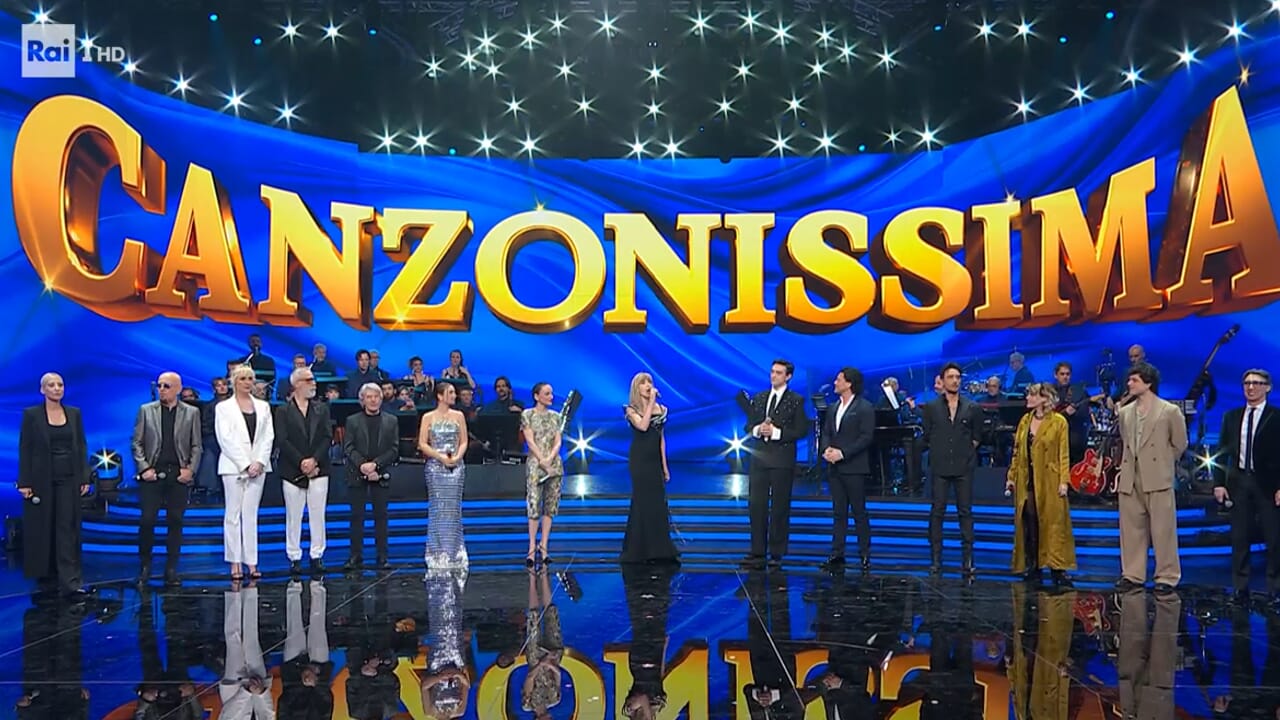
“Canzonissima” and Milly Carlucci’s inability to emancipate herself
The problem with “Canzonissima” is above all one: it is an immense bandwagon that resembles many others already seen, always by Milly Carlucci. If the original fear was to dust off an old title and revive something that worked on TV more than half a century ago – in the face of modernity – the regret, after watching the Rai 1 programme, is rather that of not finding any details or clues linked to that prestigious show.
In fact, the replica effect takes on another meaning at this juncture, with the product transformed into yet another spin-off of “Dancing with the Stars”, in terms of setting, writing and aesthetics.
Carlucci’s big limitation, the victim of a painful involution right in the most mature phase of her career, is no longer being able to conceive anything that is not similar to her most beloved creature, which the presenter proudly wears tattooed on her skin.
And so, having finished “Dancing”, for the spring period Camilla Patrizia first tried the path of the “Masked Singer”, then of the “Talent Catcher”. Until resurrecting a title belonging to the prestigious museum of the small screen. With the risk and result of outraging him.
Each experience contains traces of the others. Systematically. Characters that reappear cyclically, atmospheres, mechanisms. An eternal déjà-vu that does not spare “Canzonissima”, clearly transformed into “Singing with the Stars”.
The study, the shots, the role of the jury, the exhausting duration, but especially the long clips that anticipate the individual performances. Everything is recurring, in a sort of perfect continuation of the “Dancing” method. Therefore, the singers talk about themselves, open the doors of their private lives, shifting the spotlight onto them. It’s just a shame that Carlucci herself had underlined on the eve of the show that the broadcast is not a competition between the artists, but between the songs. A move to justify the intermittent participation of some guests, who don’t have the slightest desire to start competing.
In a visual context of a local broadcaster (unfortunately the suggestions are those), “Canzonissima” therefore loses its meaning, its sense, its reason for existing. In over 200 minutes (net of advertising breaks) we witness a show that seems like a perpetual readaptation, even in the midst of promotion, with the guest clearly taking on the appearance of a ‘dancer for a night’.
Watching “Canzonissima” for an over 60 is equivalent to being in front of a complete stranger who insistently reiterates that he was your friend as a child and for an under 50 it means being in the presence of a program that is a mere copy of a thousand summaries, which lacks the purpose to reach the end. And let it not be said that this can be found in identifying the most beautiful song. More beautiful than what and, above all, for whom.
“The preparation of this program took place between Christmas and March 21st,” Carlucci confessed to “Tv Talk”. As if it were an alibi and not a responsibility. Because, at the end of the fair, the perception that was returned regarding such an imposing brand is that of a stopgap.
