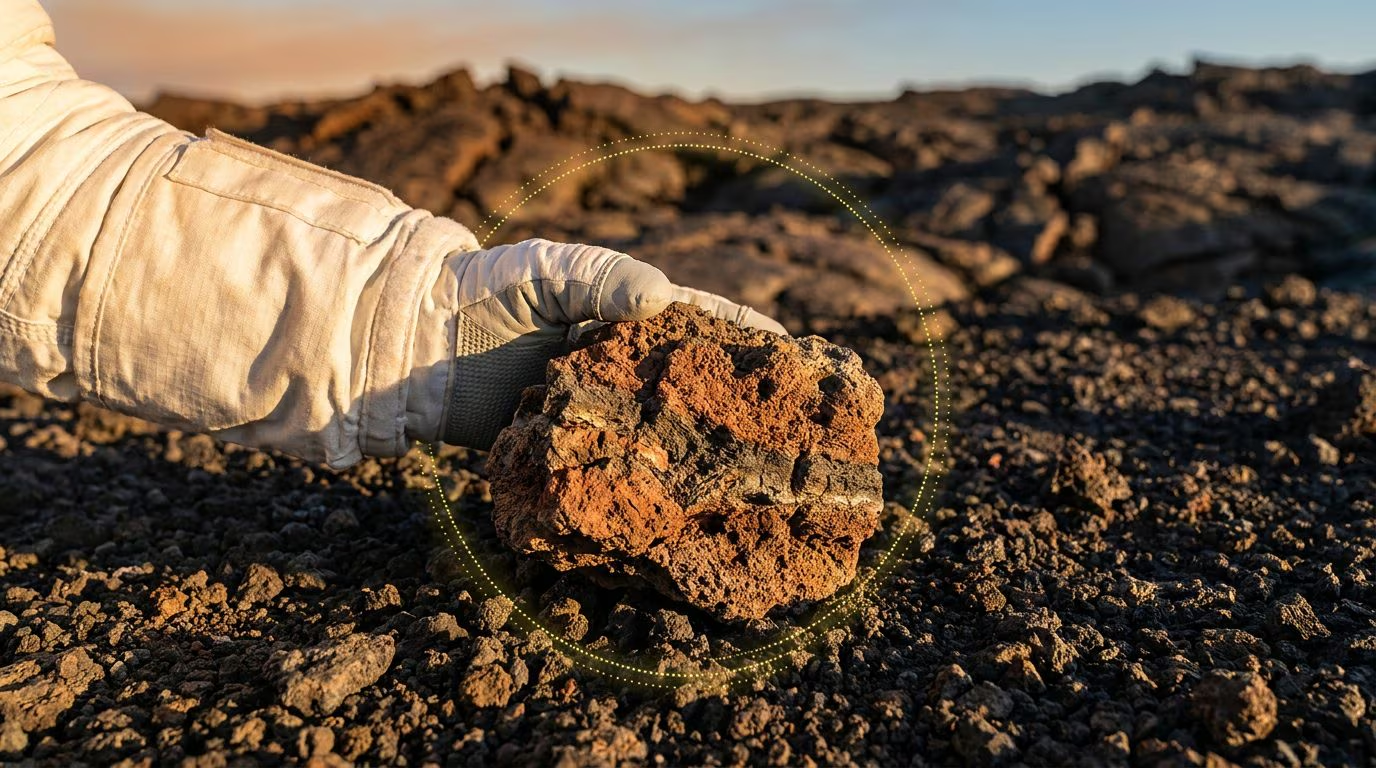
When we think about theastronaut trainingwe probably imagine space suits, simulations of weightlessness and tough physical training. However, preparing for a mission that involves landing on the Moon, or in the future on Mars, also means knowing how to interact with a new territory, which astronauts will have to be able to explore. In fact, they will have to orient themselves, observe the landscape, recognize interesting rocks and geological structures and choose which samples to collect. But how do you prepare to geologically explore another world without being able to go there?
In fact, some of the best places to do this are right on Earth and are called terrestrial analogues (Terrestrial Analogues). Deserts, volcanoes, impact craters, canyons: on Earth there are environments that present characteristics comparable to those we observe on the Moon, Mars and other bodies of the Solar System. A terrestrial environment can be considered analogous due to the shapes of the landscape, the rocks that compose it or because it preserves the effects of a specific geological process. It is by studying processes that we can observe directly on Earth that we are able to formulate hypotheses about what we see millions of kilometers away.
And this is why some of these places have also become real gyms for astronauts. One of the programs that uses this type of training is PANGAEA (Planetary ANalogue Geological and Astrobiological Exercise for Astronauts)developed byEuropean Space Agency (ESA). Since 2016, the program has brought astronauts from ESA, NASA and cosmonauts from the Russian agency Roscosmos to various European geological environments to teach them the basics of planetary geology and astrobiology.
From Lanzarote to the Lofoten Islands: training on Earth
One of the places chosen for astronaut training is Lanzarotea volcanic island located in the Canary Islands. Here lava flows, volcanic cones, craters and deposits produced by eruptions are particularly easy to observe thanks to the arid climate and limited vegetation.
Volcanism, in fact, is not an exclusive characteristic of the Earth. On both the Moon and Mars we find enormous regions shaped in the past by volcanic activity. A particularly curious example are i lava tubescavities that can form when the surface of a flow solidifies while the lava inside it continues to flow. When the flow ends an empty conduit may remain. Structures attributable to lava tubes have also been identified on the Moon and Mars.
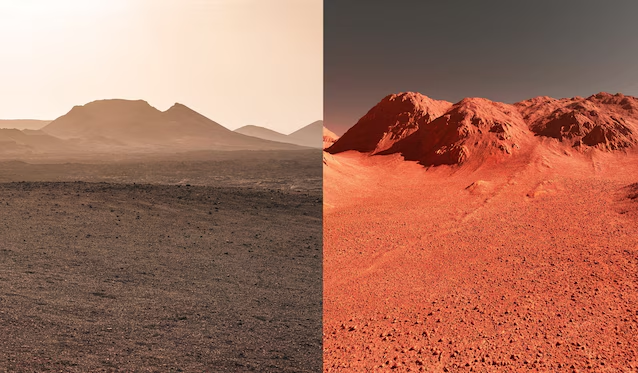
Another fundamental feature of extraterrestrial surfaces are impact craters. On Earth they are relatively rare and often modified by erosion, while on the Moon and Mars they represent much more evident elements. In the Ries craterin Germany, astronauts can observe rocks, breaches and structures produced by the impact of an asteroid which occurred around 15 million years ago.
In the Bletterbach canyonin the Dolomites, it is the sedimentary layers that are used to learn to read the history of an environment. Here astronauts can observe successions formed in ancient river and deltaic environments, along with minerals such as gypsum, and compare the processes that gave rise to them with those recognized on Mars. But the shapes of the landscape are not the only useful feature for being able to read the Martian or lunar territory. Another important aspect concerns the type and composition of rockswhich can tell us a lot about the processes that a rock has undergone to become what we see today. One of the most curious examples is found in Lofoten Islandsin Norway. Between mountains, fjords and landscapes shaped by glaciers, at first glance they don’t look like the surface of the Moon at all. Yet right here large masses of anorthosite emerge, a rock that constitutes an important component of the crust of the lunar highlands. Glacial erosion and limited vegetation have left these rocks particularly exposed, allowing us to observe very well the structures and relationships between different rock units. This is why Lofoten is one of the sites used by PANGAEA for training on the geology of the lunar crust.
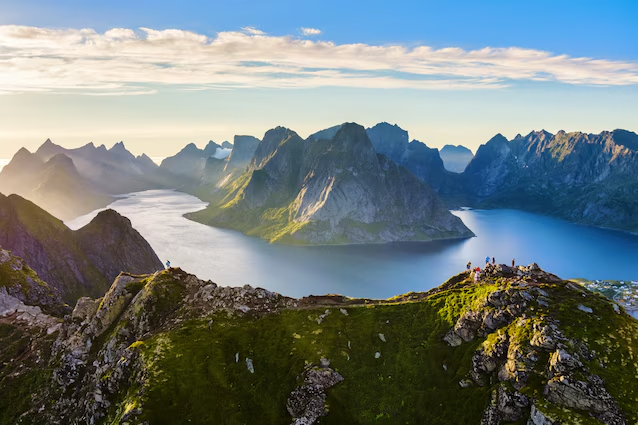
A terrestrial analog, therefore, does not necessarily have to resemble another planet: it must contain something that allows us to understand it better.
Being a geologist on another world, how does the training work?
During a future exploration of the lunar surface it will not be enough to reach a certain location, pick up a rock and bring it back to Earth. The geological context in which a sample is found is fundamental to being able to interpret it. In essence, they have to develop what we might call a geological eyethat is, learning to look at a landscape not only for what it is, but for the story it can tell. In the most advanced phase of training, astronauts undertake geological traverses. At the beginning they are accompanied by instructors, but progressively they become more autonomous until they find themselves faced with an area they have never visited and which they know mainly through satellite images and geological maps.
They have scientific objectives, a planned route, a limited time and can only collect a certain number of samples. During the crossing they describe what they observe and communicate with a team of scientists located at a distance, the so-called science backroom. Photographs, observations and information on the samples allow specialists to follow the exploration and help the crew with decisions. Even the ability to describe well what is in front of you therefore becomes part of the training: if scientists cannot see an outcrop directly, they must be able to understand it through the information sent by the astronauts.
Turning astronauts into geologists: from Apollo to Artemis
The idea of turning astronauts into geological observatories is not new. During the program Apollo of NASA, which took place between 1961 and 1972, astronauts participated in numerous field campaigns and received hundreds of hours of geological training.
Today, programs like PANGAEA carry forward the same principle, adapting it to future missions to the Moon and, one day, to Mars. Because preparing for the exploration of other celestial bodies does not only mean learning to live and work where the atmosphere, gravity and environmental conditions are completely different from ours, but it also means being ready to find yourself in front of a territory never seen before and being able to read its history through its shapes and rocks.
To date, the next concrete target of human exploration is the Moon. With the mission Artemis IVscheduled for 2028NASA aims to return astronauts to the lunar surface for the first time since the Apollo missions. Two crew members will spend about a week in one of the candidate regions near the lunar South Pole, where they will carry out field geology, sample collection and observation of the lunar environment.
And this is why, before setting foot on another world, astronauts continue to train by doing something that geologists have always done: going to the ground, observing and trying to understand what happened.
