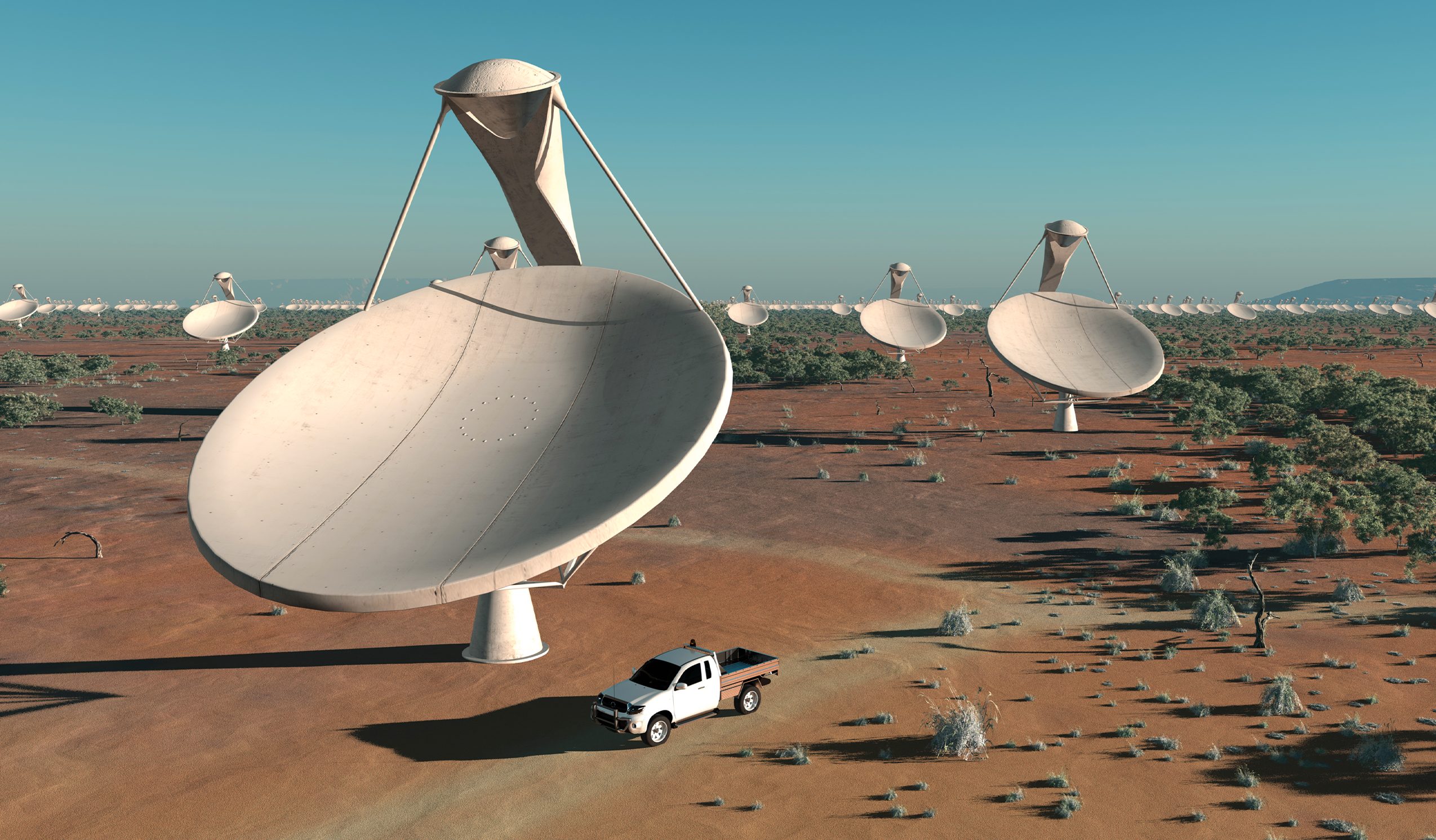
The Square Kilometer Array (SKA) it is not just a radio telescope, but one of the most ambitious engineering feats in human history. Divided between the desert of Karoo (South Africa) and the region of Murchison (Australia)this project aims to create a collection surface equivalent to one square kilometre, operating on frequencies ranging from 50MHz to the 15 GHz (with future expansions). It’s about 50 times more sensitive than the best current radio telescopes and is capable of mapping the sky 10,000 times faster than any existing tool.
What is a radio telescope
Even before delving into the detailed description of the project, let’s try to understand together what a radio telescope is. This is one astronomical instrument designed to capture and perceive radio waves coming from space. Unlike traditional optical telescopes, which “see” visible light (the same that our eyes perceive), radio telescopes detect much lower frequencies, which are completely invisible to humans. The project, in this case, has been divided into two main arrays, SKA-Low And SKA-Midwhich function as a single giant interferometer.
The project description
Let’s start with the description of the SKA-Low. Located at the Inyarrimanha Ilgari Bundara, it is dedicated to low frequencies (50–350 MHz). It is made up of 131,072 antennas periodic-logarithmic dipole (similar to metallic Christmas trees) approximately high 2 meters. In turn, the antennas were grouped into 512 stationseach containing 256 antennas. As many as 50% of the stations are concentrated on an area measuring 1 square km, while the others extend along three spiral arms for a maximum distance (baseline) of up to 74km.
The project has no moving parts. Pointing is done via electronic beamformingmanipulating the digital signal delays between individual antennas. As regards the SKA – Mid, this is located in the Karoo, and is capable of managing medium frequencies (350 MHz – 15.4 GHz).
The structure includes a total of 197 parables (dish). Of these, 133 are new SKA antennas from 15 meters in diameter, which integrate with the 64 pre-existing antennas of the telescope MeerKAT (from 13.5 m). Parabolas extend over a maximum distance of up to 150km.
This immense and extremely complex structure is capable of managing thousands of terabytes of data that will certainly need to be managed. This is where the “super” digital brain of the entire project comes into play: the Observatory’s supercomputer (SDP – Science Data Processor), which will be called upon to manage 8 terabits of data per second (Tb/s), it will have a computing power of approx 135 Petaflopshaving nothing to envy of the most powerful super computers in the world, also used for other purposes. This immense digital brain will be able to produce approx 710 Petabytes of scientific data ready for use every year.
Socio-economic impact of the project
A project of such an advanced technological level will be able to have an important impact from an economic and social point of view. First of all, numerous new jobs will be created: The project, in fact, involves the involvement of more than 100,000 people 500 engineers And 1,000 scientists from 20 countries. In South Africa, they were disbursed beyond that 1,000 scholarships (HCD program) to train a new generation of astrophysicists, engineers and technicians.
Even a World Bank study, cited in relation to the development of broadband in Africa for the SKA, suggests that any increase in 10% of broadband connectivity can generate growth in1.3% of GDP in host countries.
About the80% of the construction budget, relating to the investments necessary to carry out this project, returns to member countries in the form of contracts for high-tech companies specializing in optical fibers, cryogenic receivers and civil infrastructure.
10,000 times faster
SKA will be so powerful that it will be able to detect an airport radar signal on a distant planet 50 light years. It’s basically about 50 times more sensitive than the best current radio telescopes. It is capable of mapping the sky 10,000 times faster than any previous tool. Just think that in order to connect the antennas to the central processors, thousands of kilometers of optical fiber will be used, enough to go around the Earth twice.
