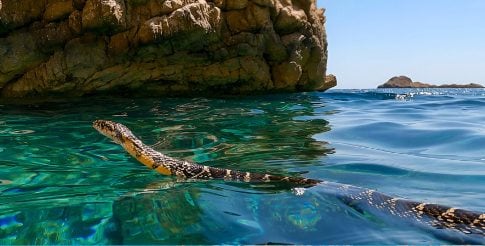
On the coasts of IbizaThe horseshoe snake (Hemorrhois hippocrepis) – a land snake accidentally introduced to the island at the beginning of the 2000s – has started swimming in the open sea to colonize the small surrounding islets. This migration seriously endangers the survival of Pithyusae lizard (Podarcis pityusensis), an endemic species already classified as “endangered” by the IUCN. A recent study published in the journal documents this alarming behavior Ecologywhich certifies that the natural barrier of salt water is no longer sufficient to stop the advance of the predator. What began as a slow, silent invasion has turned into a race against time to save the last evolutionary lines of a unique reptile in the world.
How did a land snake get to the island?
The story of this invasion begins in the early 2000s, when the horseshoe snake was accidentally introduced to Ibiza through the importation of olive trees and ornamental plants from the Iberian Peninsula. It is a snake native to mainland Spain and North Africa, where it lives as an active predator that feeds on lizards, small mammals and nestlings. Its ideal habitat is the Mediterranean scrub and rocky, sunny areas, but it also adapts to rural areas.
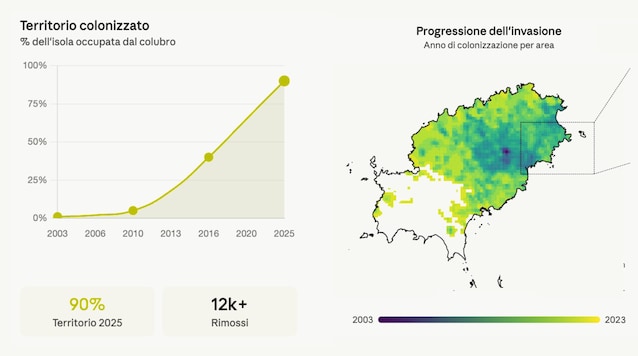
In Ibiza, however, the snake found itself in a dream situation: no natural predators and an enormous abundance of easy prey, in particular the Pithyusae lizard (Podarcis pityusensis), who had lived on the island for thousands of years. The result was explosive proliferation. After the first sightings in 2003, the snake population grew exponentially: in 2010 it occupied less than 5% of Ibizain 2016 it had risen to 40%, and in 2025 it reached 90% of the island’s territory. Despite the removal of more than 12,000 snakes since 2016, complete eradication is considered impossible.
Why snakes throw themselves into the sea: the case of Santa Eulària
Until recently, scientists hoped that at least the lizard populations on the surrounding islets were safe, protected from sea water. I study it on Ecology proves the opposite. On the islet of Santa Eulària (just 4.67 hectares), researchers set 12 traps in September 2023. In 13 visits until May 2025 they were captured 58 snakes with an estimated density of 12.4 specimens per hectare. In parallel, the lizard censuses show a vertical collapse: in 2016, lizards had been counted 72in September 2023 only 2 and from October 2023 onwards, none. The population is considered completely extinct. And this is not an isolated case, the lizard has already disappeared from at least 10 islets, and the snakes have colonized between 12 and 15 of them.
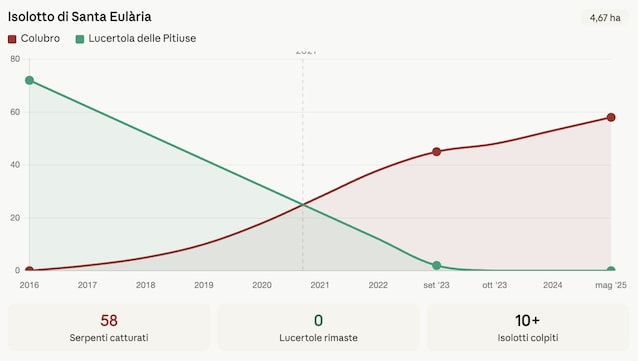
As he explains Oriol LapiedraCREAF researcher, “At the beginning of the expansion it took eight to ten years for the lizards to disappear, but now, when it reaches a point on the other side of the island, the time for complete eradication is two to three years.”
What drives a land snake to dive into salt water? The answer, to date, is still not certain. I study it on Ecology proposes two main hypotheses: the first is that it is a consequence of intraspecific competition triggered by the exhaustion of prey, while the second hypothesis is that invasive lineages may have developed a greater propensity for exploration compared to native populations. It is an open question, and the authors of the study themselves underline that investigating it will be fundamental to better predict the dynamics of diffusion of invasive predators.
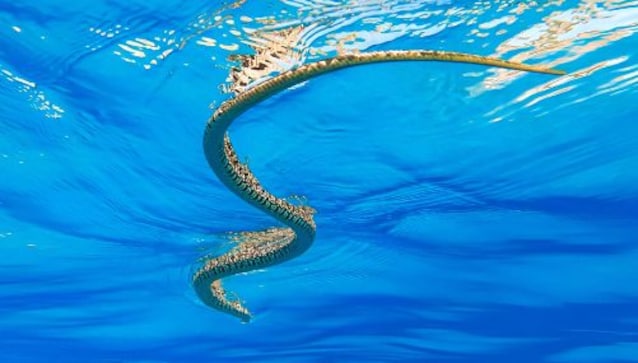
What is certain, however, is that the phenomenon is not accidental. The researchers collected 14 independent sightings of snakes in the open sea around Ibiza between 2015 and 2025. 77% occurred within 200 meters of the coast (with one extreme case at 3.2 km), all in calm weather conditions: these are not animals dragged offshore by a storm, but active and voluntary dispersal.
Each islet is a unique evolutionary line
On Ibiza, Formentera and the 39 surrounding islets, thousands of years of genetic isolation have produced over 30 significant evolutionary units of the Pitiusa lizard, many with unique colors (green, blue, black, grey). When a snake reaches one of these islets it erases an evolutionary line that exists nowhere else.
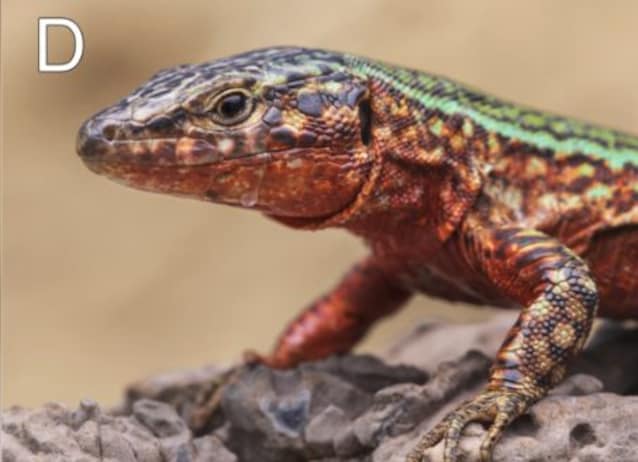
The Pitiusa lizard, having long been the only terrestrial vertebrate on the islets, plays a key role in the ecosystem. It controls insect populations, contributes to pollination and disperses seeds. Its disappearance can have cascading repercussions on the entire ecosystem. For this reason, arescue operation: specimens from the most at-risk populations are transferred to the Barcelona Zoo, which already hosts individuals from different areas. Lapiedra described the situation as a sort of “Noah’s Ark“.
As reported El Paisthe international press reported the news in alarmist tones, and there were reports of tourists considering canceling their holidays. It is important to underline that the horseshoe snake is an ophidian aglyphdoes not have specialized teeth to inoculate venom and therefore its bite is not poisonous and does not represent any danger for humans.
