What are the imaginary numbers? They are those numbers which, when squared, give a negative result. These numbers, together with the real numbers, make up the complex numbers and if it seems strange to you that the square of a number can be negative, you are in good company: imaginary numbers, used for the first time in the 16th century by Cardan to solve equations by extending the set of real numbers and are obtained by multiplying a real number by theimaginary unitindicated by the letter thethey were fully accepted as numbers only in the 19th century. Let’s see how these numbers work, why they were invented and when they were fully accepted by mathematicians.
What they are and when a number is imaginary
What is the square root of 4? It is equal to 2, since the square of 2 is 2 × 2 = 4. And the square root of 9? It is worth 3 since 3 × 3 = 9. But what is the square root of the negative number -1? We can assume that it is -1, but if we try to multiply -1 × -1 we get 1, and the same happens if we try the same operation with 1.
As much as we try we cannot find a number that when squared gives how result -1or any other negative number, this is because, by the sign rule, however we multiply a number by itself the result will be always positive.
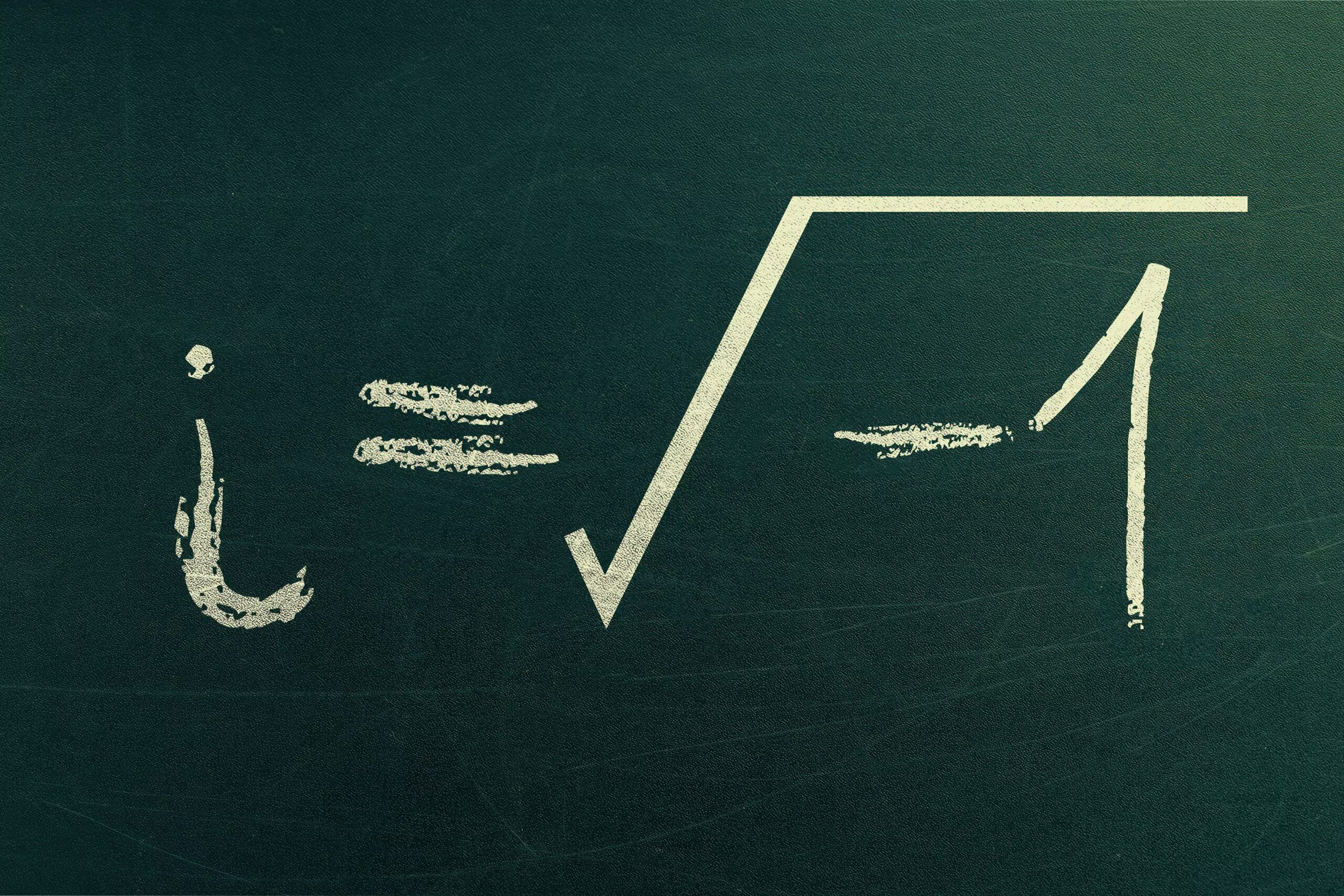
At this point an invention of mathematicians comes to our aid, namely the imaginary number the which owes its name to the 18th century mathematician Euler defined as:
that number which when squared is -1, that is the × the = -1in other words the it’s there square root of -1.
Starting from this number, the imaginary numbers which are all those
numbers that when squared give the result a negative real number – i.e. a decimal number.
These numbers can be constructed from the number the multiplying it by all possible real numbers. For example 2the (which would be 2 × i), 3the, -5the, 2.7the they are all imaginary numbers.
Let’s see what happens if we try to calculate the square of one of these numbers using the normal rules of operations:
2the ×2the = 2 × the × 2 × the = 2 × 2 × the × i = 4 × the × the = 4 × (-1) = -4
As we can see the square of 2the is -4, so the square root of -4 is actually 2the.
Operations between these numbers are done using the normal rules of algebra dealing, in simple terms, with the letter the as if it were aunit of measurement and remembering that the × the = -1.
In the case of addition and subtraction between two imaginary numbers the result is also an imaginary number for example 4i + 8i = 12i and 5i – 3i = 2i. On the contrary, in the case of division and multiplication simple real numbers are obtained, for example 6i ÷ 3i = 2 and 5i × 3i = 15 × i × i = 15 × (-1) = -15.
When instead let’s add it up imaginary numbers to real numbers we get what are called complex numbers (which contain both real and imaginary numbers), for example 5 + 3i it is a complex number and its imaginary part is said to be 3, while 5 is its real part. Complex numbers are oneextension of real numbers which includes imaginary numbers, a bit like rational numbers are the extension of natural numbers (those used for counting) which also includes fractions.
Why do these mathematical entities exist and what are they for?
“The use of imaginary numbers ranges from the extraction of the square roots of negative quantities up to the mathematical formulation necessary to describe electromagnetism, electrical engineering, fluid dynamics and quantum systems. But where do the imaginary numbers and therefore the complexes? And why were they invented?
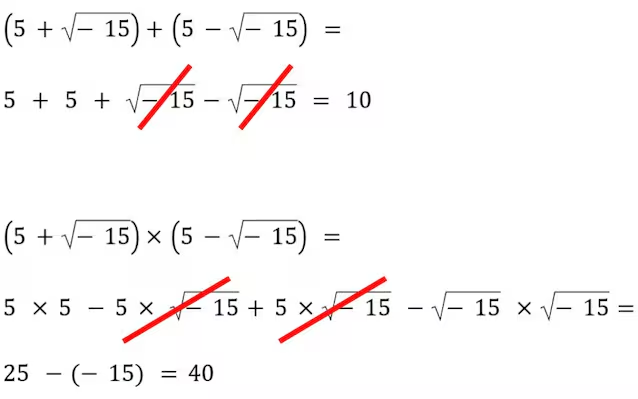
In the 16th century the Italian mathematician Girolamo Cardano he came across this type of numbers in an attempt to find two numbers that when added together made 10 and multiplied together made 40. Cardano found that the solution was given two numbers, the number made up of 5 added to the square root of -15 and the number made up of 5 minus the square root of -15, where “square root of -15” means “that number which when squared is -15”.
These two numbers added together give 10 and multiplied together give 40, the calculation can be done by pretending that the square root of -15 is a number like all the others as far as the rules of operations are concerned.
Cardano saw the square roots of negative numbers as useful devices for solving mathematical problems, but not applicable to the real world, as evidenced by his statement:
“Thus progresses arithmetical subtlety whose goal, as they say, is as refined as it is useless.”
Despite this, Cardano found himself having to use imaginary numbers also for solve the equations of third degree, therefore using them as a tool to make an important contribution to the advancement of mathematical knowledge, in that case the imaginary numbers turned out to be useful, even if not in the concrete sense of the term.
The imaginary numbers, which owe their name to Descartes (17th century) who believed they were only numbers that could be imagined but which did not exist in reality, were therefore born as a sort of artifice useful for solving equations, but they were not fully accepted by mathematicians for several centuries. The illustrious physicist and mathematician Isaac Newton compared these numbers to those problems that did not have a physically or geometrically real solution, while his equally illustrious rival, Gottfried Wilhelm von Leibniz, referred to the number the as a
that amphibian between being and non-being that we call the imaginary root of negative unity
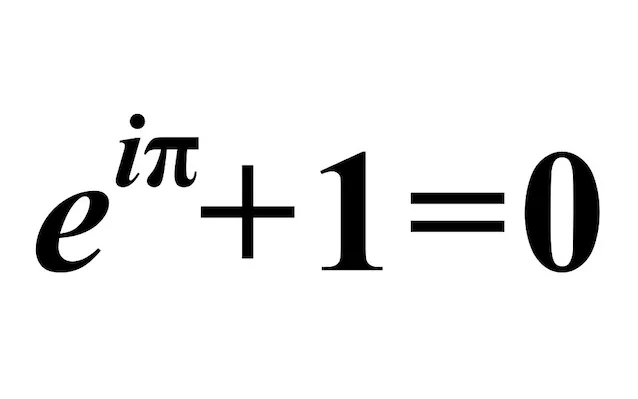
The complex numbers, and with them the imaginary numbers, found full acceptance among mathematicians onlybeginning of the 19th century when a way of representing them on the Cartesian plane was developed and spread (thanks to the work of the Dane Caspar Wessel, the Swiss Jean-Robert Argand, and the German Carl Friedrich Gauss). Since then these numbers have become a full part of mathematics and other more concrete sciences, such as physics, so much so that the number the it is also found in Euler’s identity, which is considered the most beautiful equation in the world (see figure below), and which is linked to the study of concrete phenomena such as exponential growth and wave phenomena.
0 it is the only number that simultaneously belongs to both the set of real numbers and that of imaginary numbers.