@PDChina
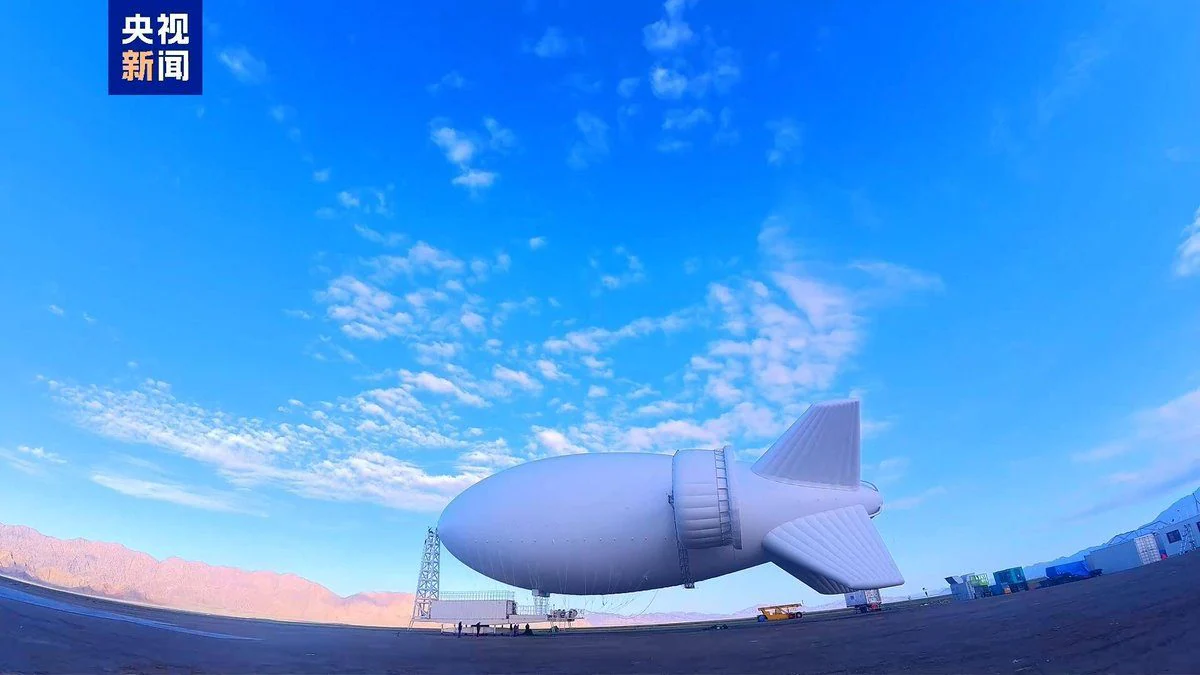
The flying wind turbine S4000developed by the Chinese company Sawes Energy Technology in collaboration with Tsinghua University and the Aerospace Information Research Institute of the Chinese Academy of Sciences, successfully completed its first flight sequencedemonstrating the ability to produce electricity at an altitude of approximately 4000 meters above sea level. The experimental campaign, conducted at a base located in the north-west of Chinaallowed the functioning of the platform to be verified in the field in real operating conditions. The result represents a further step in the development of high-altitude wind power and opens up new prospects for the production of electricity in remote areas or areas that are difficult to access by traditional energy infrastructures.
What is S4000 technology
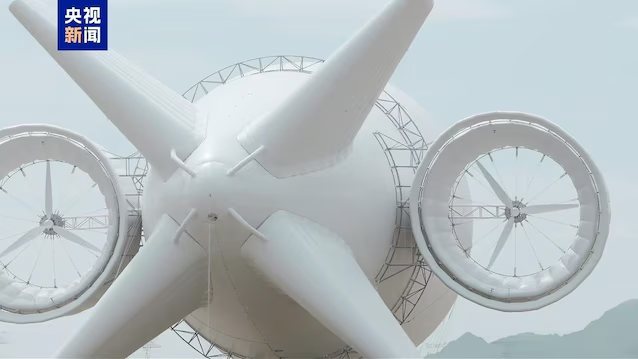
The S4000 is an airborne wind platform consisting of a large airship filled with helium. Once the operational altitude has been reached, set approximately at 4000 meters above sea level, the lift generated by the helium allows the structure to remain suspended in the atmosphere and to support a system composed of micro-wind generators ultralight. These devices exploit the kinetic energy of atmospheric currents to produce electricity, which is subsequently transmitted to the ground through a high voltage cable. The latter, at the same time, performs a second fundamental function, keeping the platform connected and anchored to the ground. The S4000 represents aevolution of the previous S2000 model and integrates a series of design updates aimed at increasing the operational performance of the system, improving its reliability and optimizing the connection with the electrical infrastructure on the ground.
The interest in this technology derives above all from the possibility of exploiting a band of the atmosphere in which wind conditions can arise more favorable compared to those present near the earth’s surface. In fact, as the altitude increases, the influence of the roughness and obstacles present in the atmospheric boundary layer tends to reduce, allowing, in certain conditions, to intercept currents characterized by higher wind speeds on average and by a greater availability of wind resources. Since the power theoretically available in the wind is proportional to the cube of its speed, even relatively small increases in flow speed can result in significant changes in potentially exploitable energy. This theoretical potential, however, does not necessarily coincide with the actual production of the platform, which depends on several factors, including the aerodynamic characteristics of the generators, the control strategies and the losses related to the energy conversion and transmission processes.
From experimentation to engineering optimization of the S4000
There experimental campaign involved the entire operational sequence of the S4000, including the phases of ascent, stabilization And maintenance of the quota, the verification of electricity generation capacity and, finally, the come back in and the recovery controlled of the ground platform. All the performance objectives have been successfully achieved, confirming theoverall reliability of the system in complex and extreme high-altitude environments. The result takes on particular relevance from the perspective of the constant development of the technology, since it constitutes an important passage from the experimental validation phase to the subsequent stage of engineering optimization.
Advantages of flying wind turbines
The success of the S4000 testing is part of an international context characterized by a growing interest in the development of airborne wind systems for electricity generation. Compared to conventional wind farms, these configurations present potentially interesting characteristics such as the possibility of operating at higher altitudes and reduce dependence on both orographic conditions and available infrastructure at the installation site. In this regard, one of the main application perspectives concerns the possibility of using flying wind platforms for decentralized generation of electricity, in remote areas or areas difficult to access to traditional electricity networks. These are, for example, desert and mountainous regions, island territories or areas where energy infrastructures are limited or have been damaged by calamitous events.
