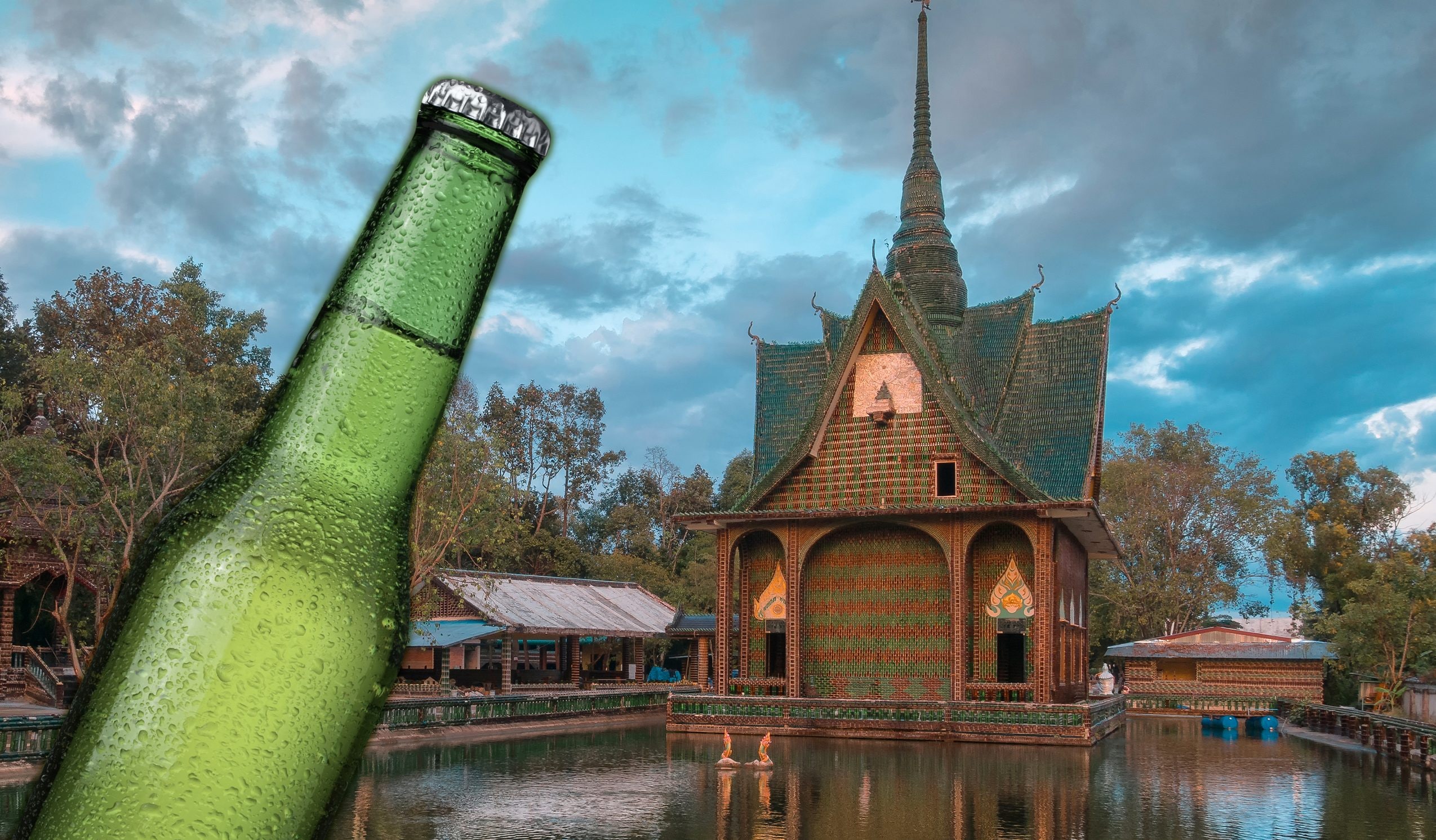
In Thailand there is a Buddhist temple built using beyond a million green and brown glass bottles. Is called Wat Pa Maha Chedi Kaew and is located in the province of Sisaket, near the border with Cambodia about 600 km from Bangkok. One of a kind, it features walls, columns, roofs and decorative devices made using empty drink containers recovered from the environment – mainly beer bottles of the Heineken and Chang brands – together with the related metal caps. Born in the eighties as ecological initiative of the monks, the temple is a very particular example of reuse of materialsas well as an international tourist destination.
The temple of bottles: where it is and how it was born
The Wat Pa Maha Chedi Kaew temple is located in the rural area of the Khun Han district, in the Thai province of Sisaket, about 600 kilometers from Bangkok and not far from the Cambodian border. The name by which he is best known in the world, Temple of a Million Bottlesanticipates its fame and peculiarities of architecture, but is also a simplification. In fact, it takes over when the number of bottles is already enormous and rounds the figure; already between 2008 and 2009, in fact, some sources speak of “over 1.5 million” of bottles, effectively updating the estimate.
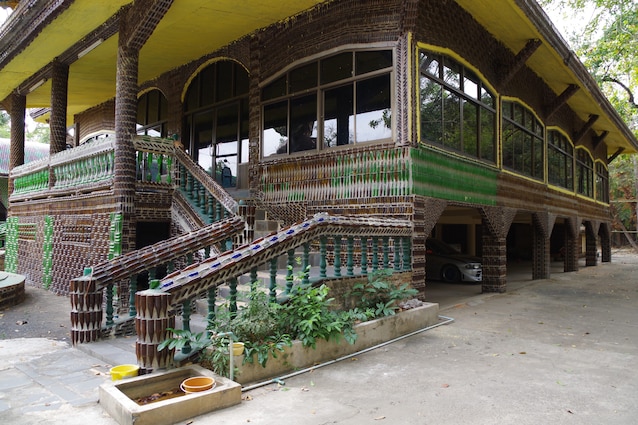
Its story begins in 1984, when local monks begin collecting bottles to decorate their shelters: a practice born from desire to clean up the territory from glass abandoned in the countryside and which soon attracted new donations, first from the inhabitants and then from the neighboring provinces, leading to the perfecting of the method and progressively adapting it to the construction. The application thus extends to the construction of main temple – the first of the complex which will require about two years of work from 1984 to 1986 – and about twenty other buildings completed over time with the arrival of new bottles. The collective initiativewhose concrete response to the problem of waste is linked to the spiritual dimension, thus giving shape to an architecture that is immediately recognizable and unique in its kind, as well as an emblematic example of creative reuse.
How it was built: structural and technical aspects
The temple, naturally, is not supported on bottles alone: these perform both a constructive and decorative function, but the stability of the whole is probably guaranteed by a concrete core and from the adoption of Malta. Once collected and sorted, the green and brown bottles come incorporated into the walls as cladding and filling elementsfinding use, horizontally and vertically, on walls, pillars, window frames, handrails, walkways, roofs and gutter lines. THE metal caps and bottle bottomsinstead, are used to create figurative mosaics and to give rhythm to surfaces and floors, further contributing to the ornamental apparatus of the complex. The architecture essentially takes up the forms and characters typical of local traditionbut rereads them by adopting a completely unusual material.
In addition to the main temple, they belong to the complex a chedi or small stupa, prayer rooms, the water tower, the monks’ homes, the baths and the crematorium. THE’ubosoti.e. the ordering room, is located in the center of a scenic setting body of water and can be reached via a small bridge. Next to it are also the wiharnthe space dedicated to meditation, in addition to the bell tower and the sculpture of a Buddha decorated with recovered glass: structures that, together, constitute the main points of interest.
Curiosity and environmental impact
Among the curiosities related to Wat Pa Maha Chedi Kaew, the ethical-religious paradox: although in the Buddhist discipline the alcohol consumption is generally discouragedmuch of the metal caps and glass bottles used in the temple come from beers such as Heineken, Singha and Chang (although there is no shortage of energy drink containers, including Red Bull). This contrast finds its coherence precisely in the light of the Buddhist vision that invites to material non-attachment et al non-waste. Reuse thus transforms consumer objects into a shared good – in this case a sacred place – reinterpreting the material from an ethical and environmental perspective. According to Buddhist belief, the latter can in fact be shaped and re-signified: a concept that also embodies a certain attention to context and environmentin harmony with an ethic of responsibility and awareness.
Finally, a curiosity of a more technical nature concerns the direct reuse of glass containers; the latter tends to have a better energy footprint than recycling with remelting, because it simply avoids the industrial remelting process at high temperatures. An important study conducted by researchers at National Renewable Energy Laboratory confirms the theory, demonstrating that this is actually the preferable solution in terms of energy, although glass, it is worth remembering, is a infinitely recyclable material without loss of quality.
