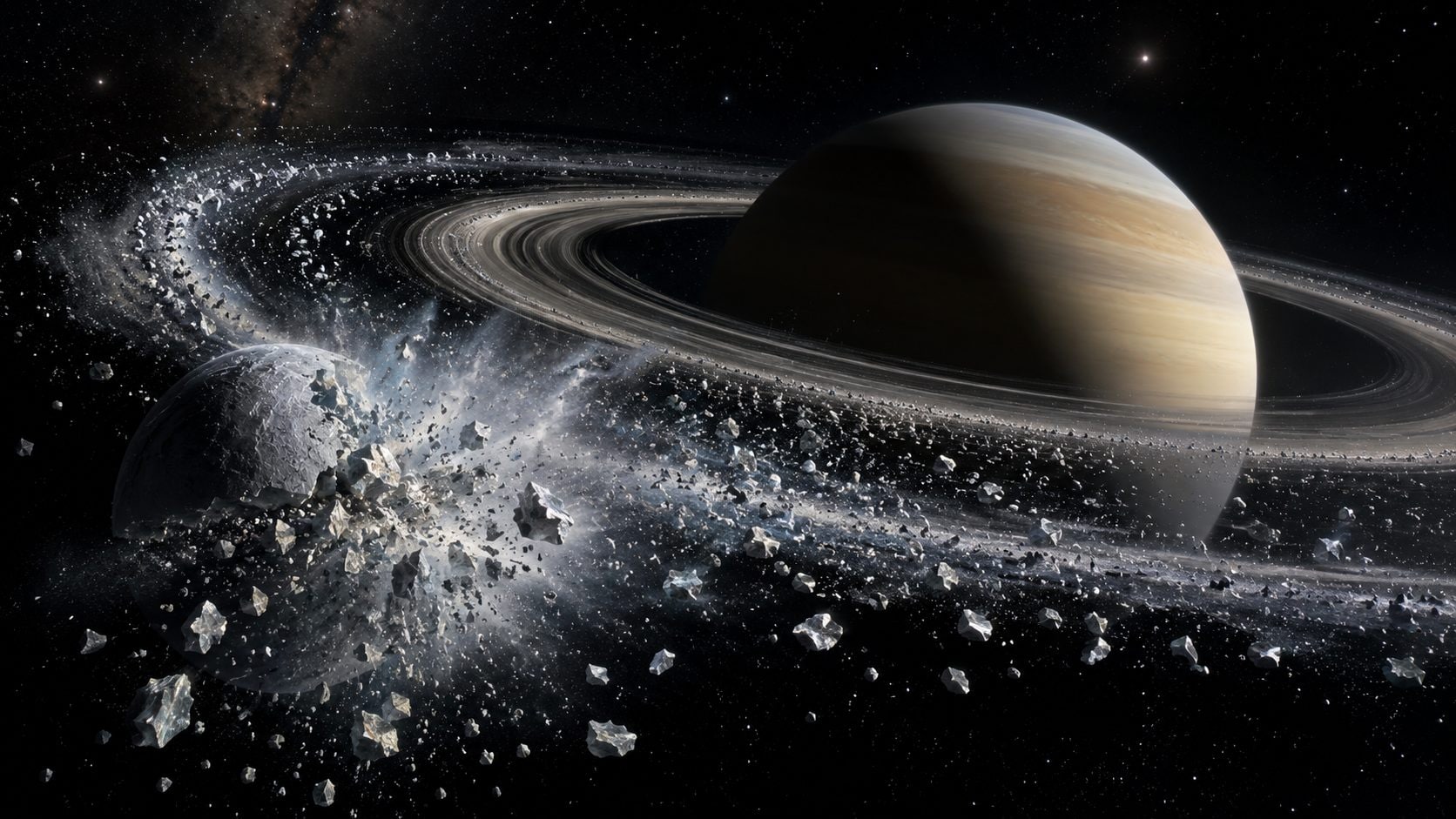
The most iconic feature of the planet Saturn, its ring systemmay have formed from destruction of one of its natural satellitesrenamed by astronomers with the name of Chrysalis. Although this hypothesis has been circulating since 2022, what shed new light on the genesis of the iconic rings was a recent article published by researchers from the University of California Santa Cruz. In this study, researchers conducted advanced numerical simulations of gravitational interaction between Saturn And Chrysalissimulated as a body of dimensions and from composition similar in Iapetusanother satellite of Saturn. Simulations have shown how Chrysalis’ close pass by Saturn is capable of generate tidal forces intense enough to literally tearing off the outer layers of the satellitemainly made up of icethus going to form the rings of the planet. The simulations would also be in agreement with theage of the rings (about 100-200 million years) and other features of Saturn such ashigh obliquity and the orbital resonance with Neptune.
The Chrysalis hypothesis as the origin of the rings
The hypothesis that the iconic ring system of Saturn is the result from the destruction of one of its satellites was proposed in 2022 by Jack Wisdomprofessor of planetary science at MIT in Boston. The hypothesis calls into question not only Saturn, but also his own satellite Titan and the nearby planet Neptune. According to Wisdom, for billions of years, Neptune and Saturn have been in an orbital resonance which caused, among other effects, the iinclination of the axis of rotation of Saturn. However, the outward movement of the moon Titan has destabilized the system Saturnian, carrying another of its moons, the hypothesized Chrysalis, to get too close to the planet and to reach the distance at which the tidal forces they are so intense that cause the destruction of a celestial body. Assuming that Chrysalis had the same size and composition as other Saturnian satellites, such as Iapetusthe disintegration process would have caused a cloud of ice debris and rocks which later became the iconic rings of the planet. The hypothesis fits well with theestimated age of the rings of Saturn, approx 100-200 million yearsand with theirs prevalent composition of water ice.
What the new study adds
The hypothesis proposed in 2022 remained for several years a simple theory which showed characteristics compatible with observations of Saturnian rings. Unfortunately, since we do not have a time machine to observe the event live, our best chance of confirming this theory is to conduct accurate numerical simulations designed to reproduce the ring formation process.
The team led by Yifei Jiao used a particular type of numerical simulationscall hydrodynamicsto try to confirm or refute the theory. In his simulations, Jiao used two different initial conditionsone in which Chrysalis is from similar composition to Iapetus and one in which its composition is similar to Dio, another satellite of Saturn. In both cases, the simulation started with Chrysalis in a parabolic orbit at a distance of 200 times the radius of Saturn. In the simulation, the satellite reached a distance from the planet between 1 and 1.5 Saturnian radiiwhich is the limit of destruction of icy bodies in parabolic orbits due to tidal forces.
Simulations have shown how the tidal forces are strong enough to remove mass from the frozen mantlebut insufficient to break down the rocky core of the satellite. The frozen material has been removed divided into two populations: one part has gained enough energy to escape Saturn’s gravitywhile the other lost orbital energy by migrating to a semi-minor axis orbit which then caused the ring formation. The rocky core of Chrytsalis, however, experienced only a modest change from its initial orbit, thus raising the question of what was the ultimate fate of the rocky core. According to the researchers, the nucleus of Chrysalis may have suffered multiple meetings with Saturn, losing additional ice and increasing its overall density. The end result may have been either the impact with Saturn or the escape from the planetary system.
