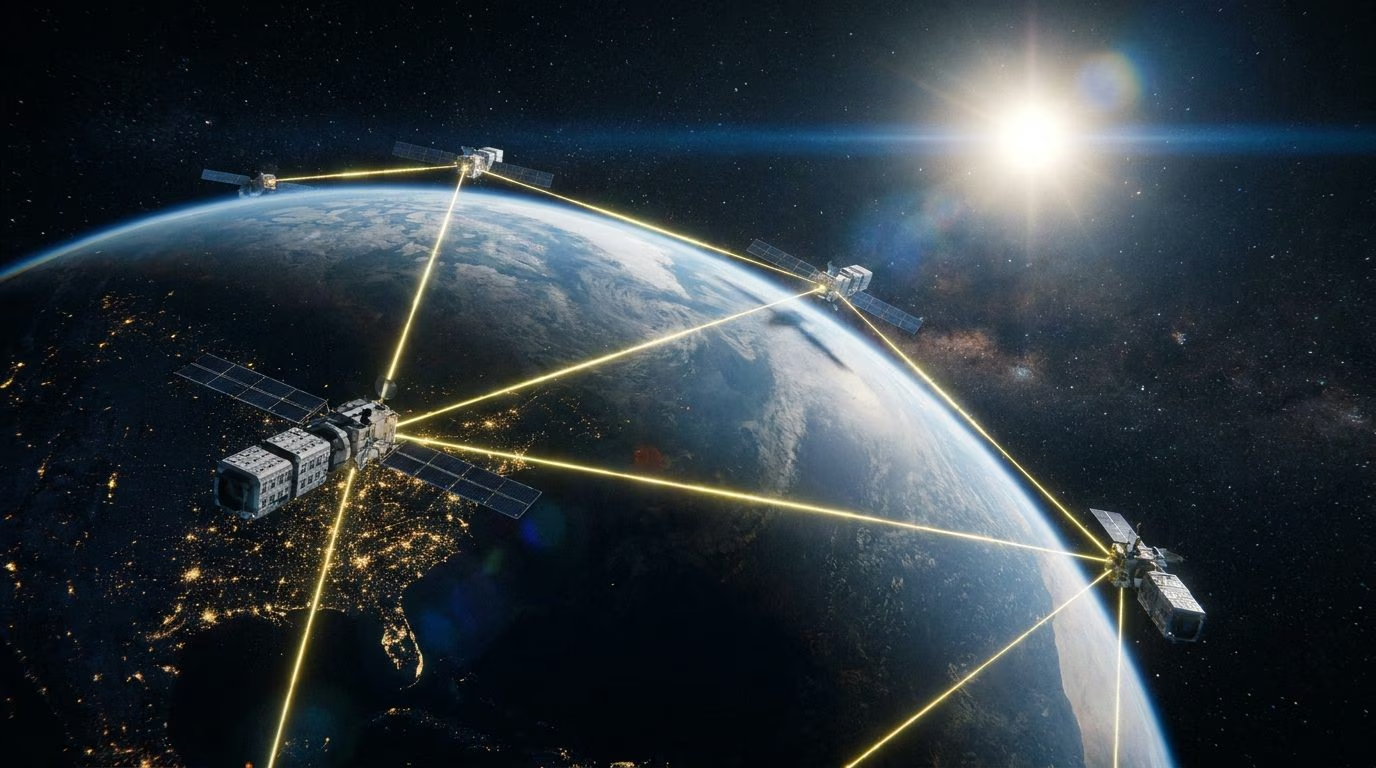
SpaceX has recently unveiled plans to put 1 million satellites into orbit as data centers dedicated to the training and use of AI. It would be a real one satellite megaconstellation which would dwarf the other currently operational constellations (SpaceX’s Starlink has around 10 thousand active satellites).
A few months ago the company had in fact incorporated xAI (the artificial intelligence startup founded by Elon Musk which developed the LLM model called Grok) in an operation that led to the merger of space infrastructure with those for the development of artificial intelligence models. Bringing the infrastructure for training artificial intelligence models into orbital space would offer the enormous advantage of having a practically unlimited source of energy: the solar radiation. It would also solve the heat problem: land-based data centers consume enormous amounts of water and energy to cool processors. This operation, however, would not be without risks.
The real benefit is 24-hour solar power
They arrive on Earth from the Sun as a whole approximately 170 million Gigawatts per second of radiation convertible into electrical energy. To give an estimate, the largest modern nuclear power plants produce on average about 1 Gigawatt per second. With this power, on average, it is possible to supply electricity to a city of around one million inhabitants.
The main advantage of operating in orbital space is represented precisely by the possibility of having continuous access to the energy of the Sun to power and cool the IT structures of data centers, also overcoming the limitation of day and night alternation of solar power plants deployed on the earth’s surface. The training and use of AI models require dedicated computing infrastructures made up of thousands of GPU (Graphic Processing Unit) in parallel that operate continuously 24 hours a day. These graphics processors are used to run the machine learning algorithms that we use every day when we chat with ChatGPT or Gemini.
Globally, data centers as a whole consume approximately 2% of total electricity which is produced by power plants all over planet Earth. Terrestrial data centers depend on local electricity networks and the construction of their systems often clashes not only with the cost of electricity bills and the limits of ecological impact (the enormous quantities of water used to cool the computing servers), but also with considerable difficulties in obtaining permits and regulations dedicated to data management which depend on individual state legislation.
The extra-atmospheric orbital space, on the other hand, does not have sovereign regulation and is therefore untied from every form of possibility national regulation. Bringing data centers into space would therefore not only guarantee an infinite energy source but would circumvent a considerable amount of bureaucratic and administrative difficulties.
The megaconstellation in numbers and the costs of orbital launch
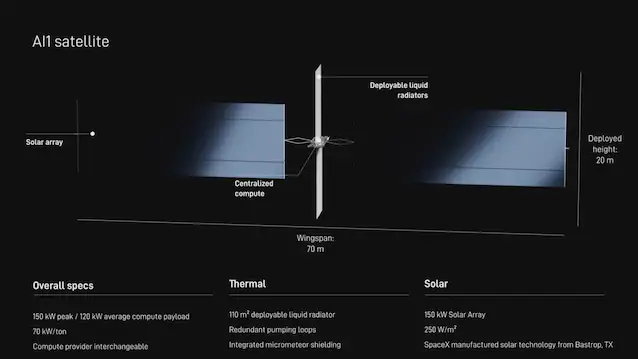
However, the engineering and operational difficulties of maintaining a megaconstellation of data centers in orbit are considerable. The first generation of these satellites, called AI1 by SpaceX will host the Nvidia’s latest generation GB300 GPU which represent the state of the art in terms of energy efficiency.
A GB300 consumes approximately 1400 watts (approximately the size of a home kitchen oven) and each individual AI1 satellite should comprise 70 to 80 units. To power all these processors and the cooling system’s electric heat pumps, it is estimated that they will be needed photovoltaic panels long overall 70 meters and 20 meters highbut this will greatly depend on the technology used for the individual solar cell modules and the maximum efficiency achievable.
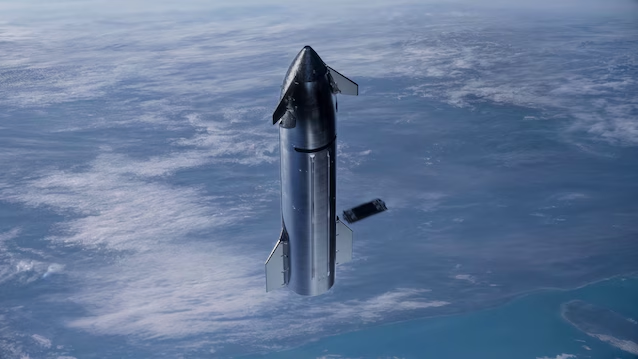
SpaceX’s biggest challenge, however, will be that of lower the cost of launches to bring payload into LEO orbit (Low Earth Orbit), the orbital shell located between 200 and 2000 km altitude where approximately 85% of currently active satellites reside. Today the commercial cost to launch material into space with a SpaceX Falcon Heavy is approximately 1500 dollars per kilogram. In order to make space data center infrastructure competitive with those on the ground, the cost should drop to around $500 per kilo. However, Elon Musk expects to reach the $100 mark once the Starship rocket becomes fully operational.
Some estimates indicate that they will be necessary 7,000 to 10,000 Starship launches over a 10-year period to make the megaconstellation of one million satellites fully operational, with a total investment cost for SpaceX of between 60 and 90 billion dollars. This figure seems to coincide precisely with the value of 75 billion dollars raised by SpaceX in the IPO a few days ago.
An orbiting artificial superbrain
The megaconstellation will work as if it were a single unit. In fact, the satellite data centers will not be isolated entities, but will communicate with each other and with the Starlink network via multiple broadband laser connections which will allow the exchange of data between the different satellites. Each satellite would become a node of a vast computing network and would be connected to at least 4 other satellites.
This computing architecture would create a real Orbiting global supercomputer dedicated to training and using AI models. The main difficulty consists in keeping the laser pointing system aligned between the various satellites operating at different altitudes. It is not yet clear how this will be done in a constellation operating hundreds of thousands of satellites.
In the documents presented by SpaceX, the entire fleet of data centers will be distributed within a range between 500 and 2,000 km altitude. The satellites will operate within orbital micro-shells extremely narrow, each at most 50 kilometers thick.
The problem of Kessler syndrome
But what will it mean to operate a million satellites in low Earth orbit? There Kessler syndrome (theorized by NASA scientist Donald Kessler in 1978) describes a destructive domino effect which would be triggered in the event of an accidental collision between two satellites in a crowded and saturated orbital space.
A collision between two objects generates thousands of fragments and these fragments, moving at 28,000 km/h in low Earth orbits and by hitting other satellites, they would create a chain reaction of continuous collisions. The result would be a cloud of space debris that would completely envelop the Earth. Although many of these fragments would naturally be deorbited and incinerated by high temperatures during reentry due to friction with the upper atmosphere, at altitudes above 500 km the air is so thin that the drag effect is negligible.
Estimates from model simulations demonstrate that fragments and debris orbiting in LEO orbits above this limit would remain in space for hundreds of years. A dense, permanent cloud of tens of millions of debris out of control at high altitudes would prevent any other satellites from entering orbit at those altitudes and would create a potentially impassable barrier to launching space missions beyond Earth orbit. It would become extremely risky (if not impossible) launch human missions to the Moon or Marssince any rocket exiting Earth orbits would have to pass through a veritable minefield of very high-velocity projectiles.
SpaceX will have to demonstrate that it has the capabilities to operate a huge constellation and eliminate any risk of possible collisionallowing its satellites to be able to carry out automatic evasion maneuvers and without the intervention of operators on the ground.
