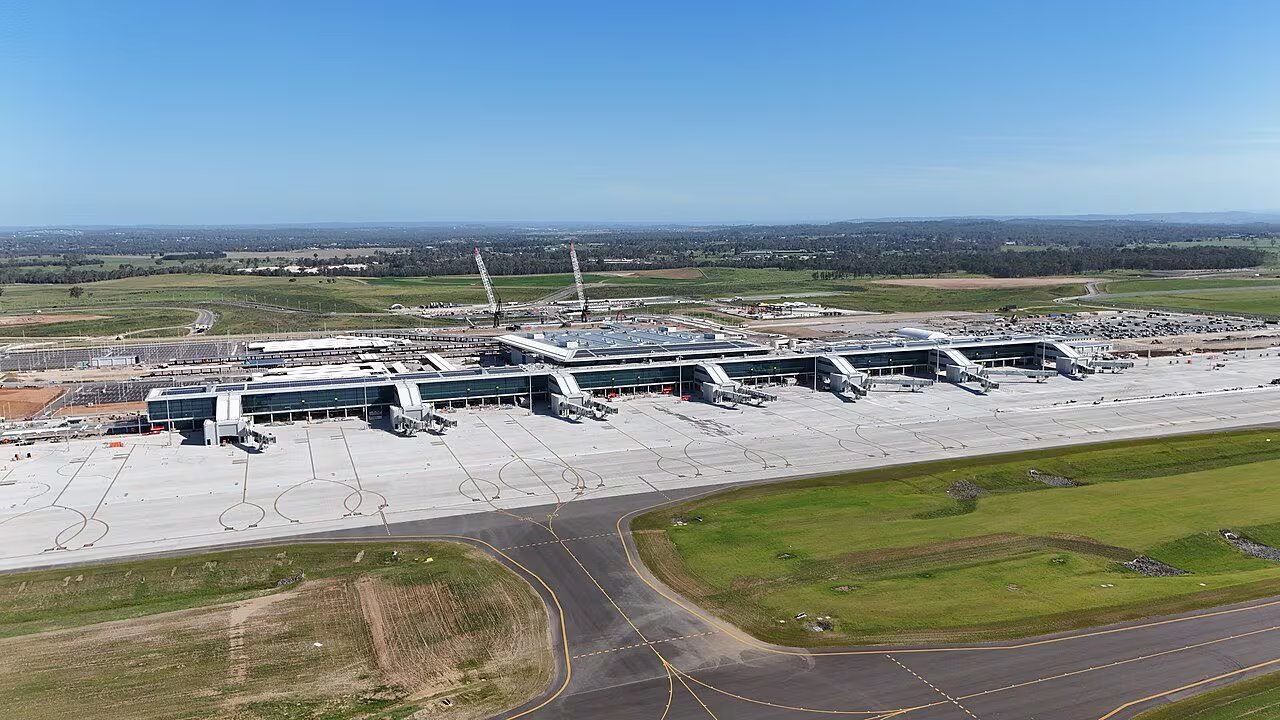
The Western Sydney International Airport represents one of the most impressive infrastructural works made in Australia over the last fifty years. The project, which should be finished by on the 25th October 2026aims to decongest Sydney’s Kingsford Smith hub by introducing a facility without flight time limitations (24/7 operations) and conceived according to a scalable modularity criterion.
Destined to become a mega hub, with a total area of approximately 1,780 hectares, the airport will be built in Badgerys Creek, about 50km from Sydney.
The Western Sydney International Airport project
The entire airport will be built on one surface total of 1,780 hectares, at Badgerys Creek. The implementation of the works was organized in geometric and functional phasescompleting the main airside and landside civil and structural procurement packages.
From an engineering point of view, the preliminary implementation of the project required the designers to carry out deep geotechnical monitoring, due to the purely clayey nature of the substrate. It was therefore necessary to go further and model 25 million cubic meters of land. In this sense, therefore, the optimization of the excavation/fill balance has allowed the in situ reuse of siltstones and shales as generalized structural filling, eliminating the need to dispose of the construction site results in an appropriate manner or to provide virgin borrowed material.
As for the runway, this was created in Code-F configuration (suitable for Airbus A380 and Boeing 777X class aircraft). The main runway has a length of 3,700 meters and a width of the load-bearing section equal to 60 meterssupported by stabilized margins to significantly limit the risk of Foreign Object Debris (FOD).
Regarding the runway pavement, on the airside they were extended further 390,000 m² of floorings. For the high-speed junctions (rapid-exit taxiways) and the aprons, it was decided to adopt a rigid structural concrete pavement with distributed reinforcement, calibrated to resist high static point loads (up to Pavement Classification Number – PCN greater than 100). The tracks instead use a bituminous conglomerate modified with high modulus polymers (PMB) to resist tangential stresses during braking and acceleration.
The Stage 1 passenger terminal it is made on a covered surface of approximately 90,000 m². From an architectural and structural point of view, the building has large free spans arranged through spatial steel trusses to guarantee an optimal level of internal distribution mobility. The landside will be connected with the Sydney Metro – Western Sydney Airport underground line (operational only from 2027), equipped with a fully operational transport capacity of up to 7,740 passengers per hour per directionsupported by a railway viaduct and road bridges with main spans calculated for future widening a 4 lanes in each direction.
The environmental impact of the new Australian airport
The design of a 24-hour airport required stringent limits in terms of acoustics, hydraulics and, above all, energy sustainabilitywhich are imposed and regulated byEnvironment Protection and Biodiversity Conservation Act of 1999.
The designers, during the conception phase of the project, were asked to manage waterproofing of large portions within the 1,780 hectare lot. The objective was achieved by designing a drainage system based on the principles of hydrological invariance. THE local waterways (Badgerys Creek and Oaky Creek) have been protected through the construction of flood lamination and retention basins. These basins, in turn, are equipped with oil separators and coalescence filters for the treatment of rainwater coming from laybys, where the risk of contamination by hydrocarbons (Jet-A1) is statistically higher.
The absence of night curfew was one of the most important engineering challenges and required engineers to proceed with predictive modeling of the noise impact based on ANEC (Australian Noise Exposure Concept) metrics and action profiles N60 (number of events above 60dB(A) in 24 hours) and N70 (above 70 dB(A)).
The economic impact of the project
The economic context of Western Sydney is characterized by a prevalence of blue-collar profiles (32% of total jobs compared to 22% of the metropolitan average). The introduction of the airport Business Precinct (including logistics hubs, advanced cargo areas and hotels) aims to convert this trend:
- Peak construction phase: At this stage they have been generated well 3,180 full-time equivalent (FTE) jobs at the Greater Sydney level, of which the84% located in the strictly western sector.
- Initial operational phase: The start of operations of this airport hub will generate 8,730 direct jobs within the airport perimeter, with an integration of further ones 4,440 FTEs induced by the development of related commercial and logistics parks.
- Long-term performance: Macroeconomic estimates predict that the operation of the WSI will be able to generate an incremental economic output of between 9.2 billion and 15.6 billion of Australian dollars for the Western Sydney region alone by 2050, extending the benefit to the entire economy of the State of New South Wales up to a value between 15.7 billion and 25.6 billion dollars.
