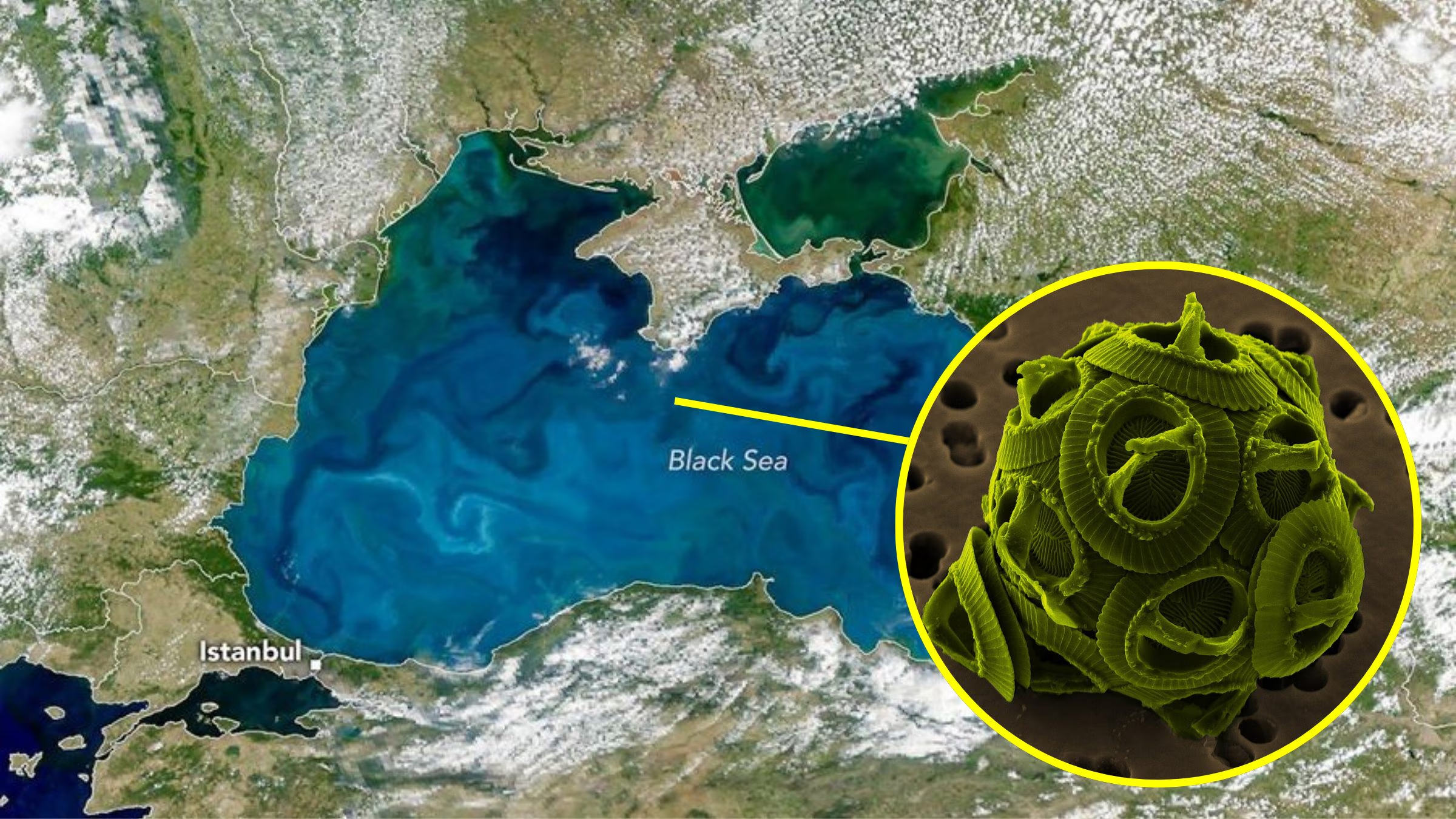
The satellite PEACE of NASA (acronym for Plankton, Aerosol, Cloud, ocean Ecosystem) immortalized the waters of the Black Sea in all their splendor… turquoise. Every year, in spring and summer, the Black Sea stops being black: its dark waters transform into an explosion of milky blue thanks to the blooming of phytoplankton, visible even from the space. This is not pollution or an optical effect, but the signature of billions of microscopic organisms that crowd the surface of the water to the point of changing its color, coccolithophores. Specifically it is about Emiliania huxleyi (also called Gephyrocapsa huxleyi), the most abundant coccolithophore species in the oceans. The image is from 22 June 2026, but the phenomenon had already made its appearance a month earlier: on 27 May 2026, an astronaut on board the International Space Station photographed the Bosphorus (the strait that cuts through Istanbul connecting the Black Sea to the Sea of Marmara) transformed into a trail of turquoise spirals on both sides of the canal.
A new study just published in the scientific journal Diversity by researchers from the Institute of Oceanology of the Russian Academy of Sciences reveals that something in the behavior of these organisms during the two-year period 2022-2023 has shown changes and the implications directly affect the carbon cycle of our planet.
The Black Sea that changes color in spring and summer: what are coccolithophores
The phytoplankton it is the set of microscopic plant organisms that live floating in the surface waters of the oceans. Like land plants, they capture CO₂ through the photosynthesis. Unlike land plants, some of them have found a rather creative architectural solution: they cover themselves with scales of calcium carbonate (CaCO₃). These organisms are called coccolithophoresand their calcium carbonate plates (coccoliths) give the surface water that typical milky-blue color visible from satellites. NASA experts estimate that these organisms release more than 1.5 million tons of calcite per year, making them the main producers of calcite in the ocean. While most phytoplankton thrive where cold currents bring nutrients to the surface from the depths, coccolithophores are an exception. Their ideal habitat is in fact made up of calm surface waterswith mild temperatures and low in nutrients.
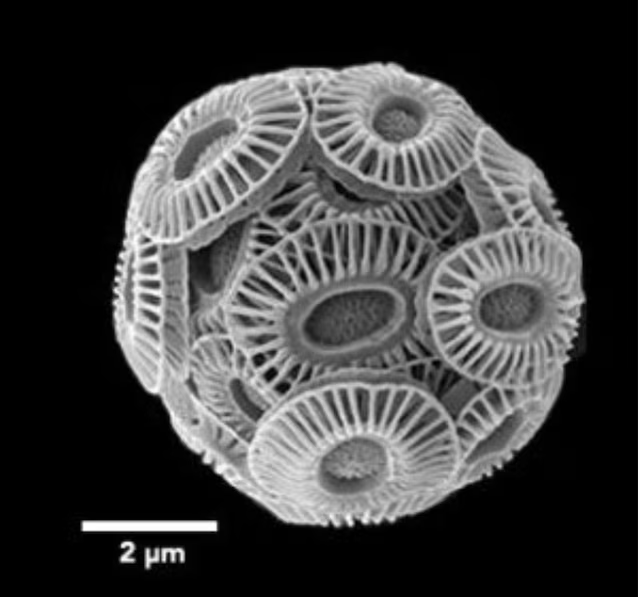
In the Black Sea, two main “teams” of phytoplankton coexist which alternate during the year following a very specific seasonal rhythm. Coccolithophores dominate in late spring and early summer: they prefer warm, stable waters with little turbulence. The diatomswith exoskeleton in silicon instead of football, which take over in summer and autumn. It is interesting to note that diatoms tend to darken the water (brown-brown), a characteristic that goes well with the name of this sea.
The two “teams” represent two different carbon capture mechanisms that the researchers call respectively carbonate pump (coccolithophores) e organic pump (diatoms). The difference is that the organic pump consumes CO₂ directly, reducing the gas pressure on the surface. The carbonate pump works in reverse: in the process of building calcium plaques, coccolithophores not only do not consume CO₂but no they produce one molecule for each coccolith built.
Images from space from NASA’s PACE satellite
The OCI (Ocean Color Instrument), the instrument on board the PACE satellite, captured the turquoise colored waters of the Black Sea on 22 June 2026 (cover photo of the article). It is not the first time this has happened, the phenomenon is documented every year, but the combination of PACE and the photographs of the ISS astronauts today returns high quality images.
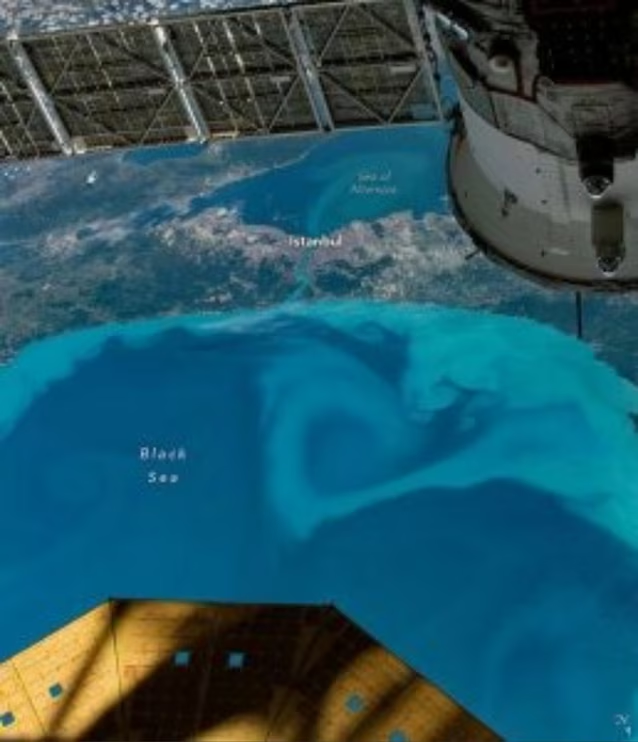
Although coccolithophores are microscopic, during a bloom (an extended flowering period) become so numerous that they are visible from space. This makes satellite remote sensing a valuable tool for studying bloom dynamics in regions where direct sampling is difficult.
The dynamics of blue phytoplankton: the study
The study by Silkin and colleagues, thanks to 25 years of systematic observations in the northeastern Black Sea, identified a very precise seasonal pattern: coccolithophores dominate from late spring to early summer, then pass the baton to diatoms (Pseudosolenia calcar-avis). Normally, coccolithophores bloom peters out by mid-June.
In 2022 and 2023, however, that wasn’t exactly the case. Coccolithophores continued to dominate until the end of Julywith 2023 recording carbonate pump activity lasting four consecutive months. In June 2022, the abundance of cells of Gephyrocapsa huxleyi (the protagonist species) has reached i 9 million cells per liter of watercontributing 98% of the total phytoplankton biomass.
The cause, according to the researchers, was one combination of anomalous meteorological factors. The absence of strong winds stabilized the water column, preventing mixing at depth. Added to this is a chemical condition favorable to coccolithophores: high concentrations of phosphorus And low nitrogen concentrations. Torrential rains in July 2022 further replenished phosphorus in coastal waters, lengthening the dominance of the carbonate pump. Diatoms, which need turbulent, nitrogen-rich waters to grow, stood by and watched. For weeks longer than usual, the Black Sea has reduced its capacity to absorb CO₂ from the atmosphere, a mechanism that goes against the trend of the role that the oceans normally play as the “lungs” of the planet.
The authors of the study are cautious in characterizing this as a structural trend linked to climate change given that two years of observation are too short to draw definitive conclusions. If rising temperatures lead to greater stratification of ocean waters, coccolithophores could increasingly prevail.
