Next, the newsletter of Europa Today which every Monday morning tells you what will happen in the European week
Top of the agenda
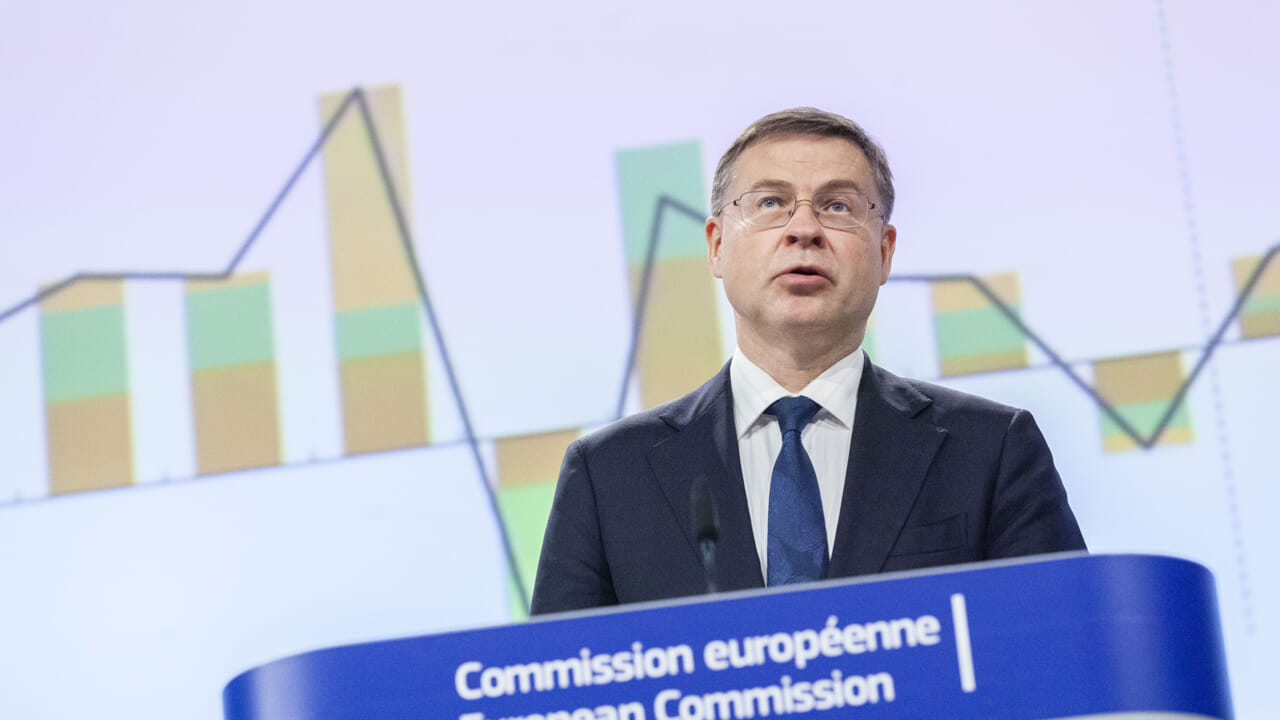
The state of the European economy – The publication of the 2026 spring economic forecast by the European Commission is expected on Thursday 21 May. “As usual, the forecasts will cover a wide range of economic indicators relating to all EU member states, candidate countries, EFTA countries and other important advanced and emerging economies”, is the announcement made to the press by the EU executive.
What it’s about – The European Commission’s economic forecasts are detailed analyzes published twice a year – usually in May in spring, in November in autumn – which estimate GDP growth, inflation, employment and public finances (deficit/debt). The forecasts are mainly used to guide the EU’s economic and budgetary policies with a two-year time horizon, i.e. the current one and the following one, and to monitor national budgets in the context of the European Semester.
Where do we start from – According to what emerged from the latest economic forecasts (autumn 2025, published on 17 November), the Commission had forecast growth in the EU of 1.4 percent in 2025 and 2026, reaching 1.5 percent in 2027. The same trend was true for the euro area, with real GDP growth of 1.3 percent in 2025, 1.2 percent in 2026 and 1.4 percent in 2027, while inflation was expected to continue to decline, falling to 2.1 percent in 2025 and fluctuating around 2 percent at the end of 2026.
The impact of the war – Six months ago, however, seems like an eternity on a geopolitical and economic level. Half of this time span was occupied by the US war against Iran, the subsequent closure of the Strait of Hormuz and the energy and economic crisis that has hit Europe. This is why we are waiting for the spring forecasts to understand what the state of health of the European economy actually is, in particular on the prospects of how much growth will be affected and to what extent inflation will risk undermining the moderate optimism of autumn 2025, when fears over US tariffs had ultimately not materialized. The risk is called stagflation, one of the economic phenomena most feared by analysts and politicians, because it combines stagnation – i.e. zero economic growth – with inflation, i.e. a constant increase in prices.
Word to the ministers – After the publication of the new economic forecasts by the Commission, the Ministers of Economy and Finance will continue the discussion on the state of the art and the solutions that need to be evaluated in response to the current and expected situation. It will start in Brussels on Friday 22 May with the meeting of the Eurogroup, which includes the 21 eurozone ministers. The discussion will then move to Nicosia, where the rotating Cypriot Presidency of the Council will organize on Friday 22 and Saturday 23 May an informal meeting between all the EU Ministers of Economy and Finance and central bank governors, with at the center of the agenda the policies to be adopted to face the economic challenges that the EU is facing. In this regard, Italy continues to push for the option of suspending the Stability and Growth Pact, i.e. the European rules that require public deficits below 3 percent of GDP and public debt below 60 percent of GDP.
ECB and Fed leave rates unchanged, but the energy shock threatens the recovery. Lagarde admits: “We considered an increase”
Other hot topics
How war changes sustainable development… – During the Foreign Affairs Council on Monday 18 May, in the “Development” conformation, the EU High Representative, Kaja Kallas, will lead ministerial discussions focused on the future of European external action in relation to the evolving geopolitical context and the need to support development cooperation to promote sustainable development in partner countries. In particular, during an informal working lunch, the 27 ministers will discuss the global consequences of the conflict in Iran, focusing on disruptions in the sectors of energy, transport, food security, migration and the evolution of the international order.
… and trade – Four days later, Thursday 22 May, the Foreign Affairs Council will meet again, but in the “Trade” format. The war in Iran and the general unstable situation in the Middle East will still be the main agenda item, with an update regarding the impact on economic security and trade. Ministers will have to address in particular the short and long-term consequences of the disruption caused by the closure of the Strait of Hormuz. Another important point, which will be addressed during the working lunch, will be that relating to trade negotiations, including those with Thailand, Malaysia, the Philippines and the United Arab Emirates.
A new trade agreement – In this regard, on the same day – Thursday 22 May – the President of the European Council, António Costa, and the President of the European Commission, Ursula von der Leyen, will travel to Mexico City to participate in the eighth EU-Mexico summit together with the President of the host country, Claudia Sheinbaum. The high-level meeting will serve to renew momentum in relations between the two sides, with the signing of the modernized EU-Mexico Agreement and the Interim Trade Agreement, negotiations of which concluded in January 2025. Trade last year amounted to over 86 billion euros. The signing of the agreement will lead to the elimination of almost all Mexican tariffs on imports from the EU, as well as non-tariff barriers to trade, facilitating both imports from Mexico and European exports to the American partner.
Trump’s tariffs – Monday 19 May, trilogue on the trade agreement with the United States. Europe is under an ultimatum: Donald Trump has warned that if the agreement is not approved by July 4, tariffs will “immediately jump to much higher levels” than the agreed 15 percent. MEPs are pushing to insert “sunrise” and “sunset” clauses that would make the agreement automatically ineffective in the event of American default or if steel products are not included. The EPP is holding back: it wants rapid approval and fears that too rigid mechanisms could derail everything. The centre-left and other groups, however, want a hard line. The German socialist Bernd Lange, head of the parliamentary delegation in the negotiations, will try to find the right solution.
Repatriations – Wednesday 20 May, trilogue on the repatriation regulation, the last pillar of the Pact on Migration and Asylum. The text is supported by the so-called Venezuela majority, the axis that unites the People’s Party, the Conservatives of the Brothers of Italy, the Patriots for Europe of Matteo Salvini’s League and the Europe of Sovereign Nations, the group that includes the German AfD and Roberto Vannacci. The new regulation will allow migrant people to be expelled more easily to third countries, even without a direct link with those countries, paving the way for repatriation centers on the model of the Albania pact wanted by Prime Minister Giorgia Meloni. Compared to the trilogue on tariffs, the agreement here seems within reach.
Fertilizer plan – The European Commission will present the long-awaited action plan on fertilizers on Tuesday 19 May, which is expected to define the EU’s approach to the production, use and external dependence of these agricultural inputs. In a context characterized by price volatility and geopolitical tensions – from Ukraine to the Middle East – the plan will serve as a response to strengthen food security and renew the commitment to achieve the objectives of the European Green Deal. The plan is expected to be based on three pillars: reducing dependence on imports of fertilizers and critical raw materials; accelerating the transition to more sustainable fertilisers; and the protection of soil, water and biodiversity by aligning fertilizer use with European climate and environmental objectives.
The agreement between the European Union and Mercosur has been in force since May 1st
From the European Parliament
The House meets in plenary session and discusses two dossiers that reflect Brussels’ growing attention to protecting the European economy from external pressures.
Foreign investments – On Tuesday there will be a final vote on the reform of the regulation on foreign direct investments in strategic sectors: defense, semiconductors, artificial intelligence, critical raw materials and financial services. The new framework makes screening mandatory for all member states and closes an important loophole, extending controls to investments made within the EU when the investor is ultimately attributable to non-European entities.
Steel – Also on Tuesday, Parliament votes on updating the safeguard measures on steel, after Monday’s debate. The regime in force since 2018 expires on 30 June and the new text replaces it with annual duty-free quotas of up to 18.3 million tonnes, with a duty of 50% above that threshold. The most significant innovation is the “principle of melting and casting”, which links the origin of the steel to the place of first processing, closing the channel of fictitious transformations in third countries used to circumvent duties.
Victims of crime – On Thursday it’s the turn of the directive on the rights of crime victims, which updates a framework stuck in 2012. The new rules introduce a dedicated European telephone number (116 006), improve access to legal assistance and compensation, and provide for online reporting. An expected intervention, considering that every year around 75 million Europeans suffer a crime.
During the week we also vote on fertilizers, workplace safety, gender gap in care, and fishing in the Baltic Sea. High Representative Kallas responds to MEPs on crisis management in the Middle East on Tuesday afternoon. And on Tuesday morning, in the hemicycle, President Metsola presents the first awards of the European Order of Merit.
Read the presentation of all the debates and votes in the Plenary
