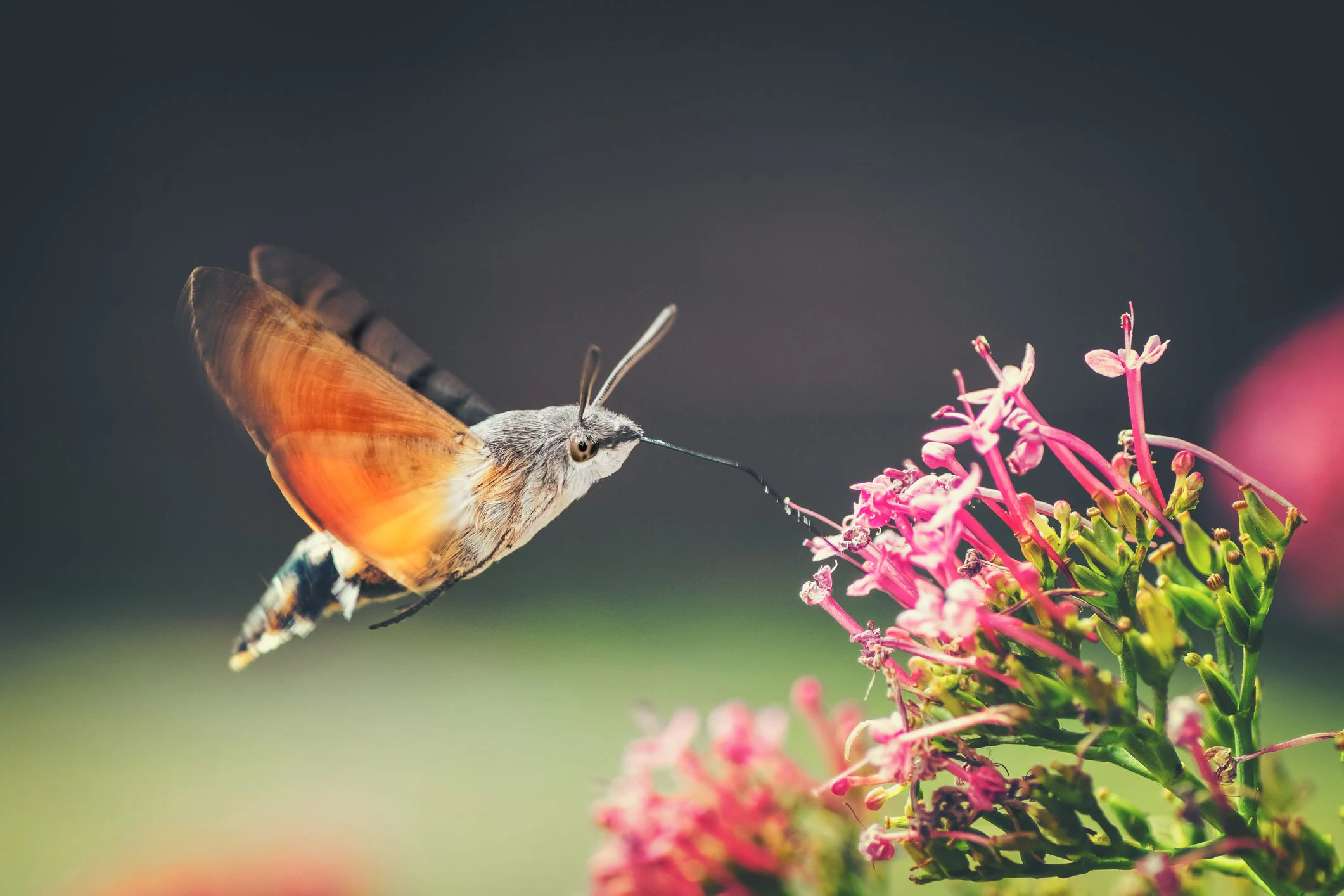
If you find yourself near a large flowering bush at dusk, you may spot a small figure hovering stationary in mid-air near the flowers, then quickly darting away. It’s there Galian Sphinx (Macroglossum stellatarum) a moth of the Sphingidae family also present in Italy and which is also called Falena hummingbird for its extraordinary resemblance to these birds. At first glance, the two animals look very similar in both size and behavior, which leads some people to think they have indeed spotted a hummingbird. However, these birds are native to the tropical and subtropical belts of the American continents and they are not present on Italian soil: unless you have encountered some specimen kept in captivity and escaped from the cage, it is therefore impossible to find one.
What is the Galician Sphinx, where is it found and what does it eat
The Galio Sphinx is part of the Sphingidae family, of medium-large sized moths typical stocky body and lanceolate wings – the best known of these is the Death’s Head Sphinx (Acherontia atropos) famous for the design on its chest that resembles the shape of a human skull. Most sphinxids have nocturnal habits but the Galician Sphinx is an exception: it is active especially during daylight hours and at dusk, where it can easily be spotted near hedges, gardens and woodland edges. It is 25-28 mm long with a wingspan of about 50 mm, dull gray color but with clearly visible orange hind wings. It has whitish tufts in the shape of a “tail” and a dark spot in the center of the composite eye, which resembles a pupil of the eyeball of a vertebrate: two elements that contribute to the confusion of those who mistake it for a small bird.
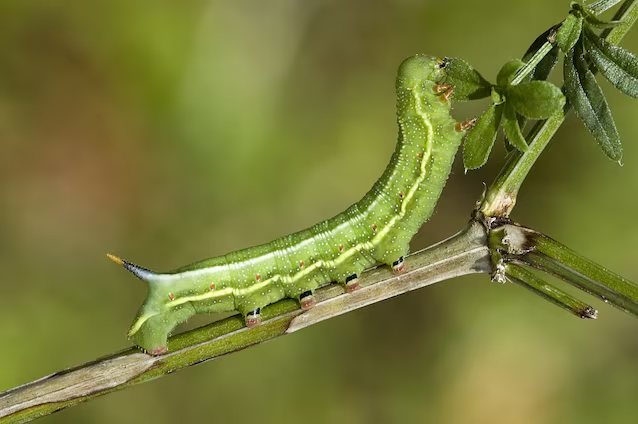
The common name “galium sphinx” comes from the plant galium plant (type Galium), favored during the larval stage by its caterpillars, recognizable by two green bands and dark eyespots on the sides of the body. The adults instead feed on the flower nectar with a very long and thin calyxsuch as valerian, verbena, jasmine and primrose. In these plants the nectar is very difficult to reach for most insects, too large to fit into the narrow calyx, but the Sphinx hummingbird manages to do so thanks to its trunk (called spirotromba), as long as its body and adapted precisely for this purpose. In this way, the Sphinx it does not compete with other insects for the same resources and acts as a fundamental pollinator for many plants that would not be able to propagate their pollen otherwise.
Macroglossum stellatarum does not sting and resembles a hummingbird: flight
The Galician Sphinx is a creature of habit, and tends to return to the same flower bush in the following days, while at night it rests in ravines of trees and buildings. Like all lepidopterans, it cannot sting and its proboscis is harmless and is used as a foldable straw. It passes from one flower to another on the same bush with sudden movements, flying in a stationary manner: as with the smallest hummingbirds, it can flap its wings at one frequency of approximately 70-80 times per second (as measured by a Lund University study). If she wants to move to another bush or if she feels disturbed, she can move away in the blink of an eye: sphingids are excellent fliers, with one species capable of reaching speeds of 5 meters per second in a laboratory environment.
The similarity between galian sphinxes and hummingbirds is a case of convergent evolutionor the development of similar adaptations in groups of animals that are not closely related to each other. Both in the case of sphinxids and hummingbirds, this allows it to be occupied ecological niche: that of small birds capable of feeding on very energetic resources but difficult for other animals to reach. Both animals have adaptations to be able to reach the nectar of flowers with a narrow and long calyx (the proboscis in the first, the elongated beak in the second) and the ability to fly precisely and stationary, which allows you to get close to the flowers without having to lean on them. Even in places very distant and different from each other, a galian sphinx and a hummingbird are thus the same ecosystem roleacting as very important pollinators.
