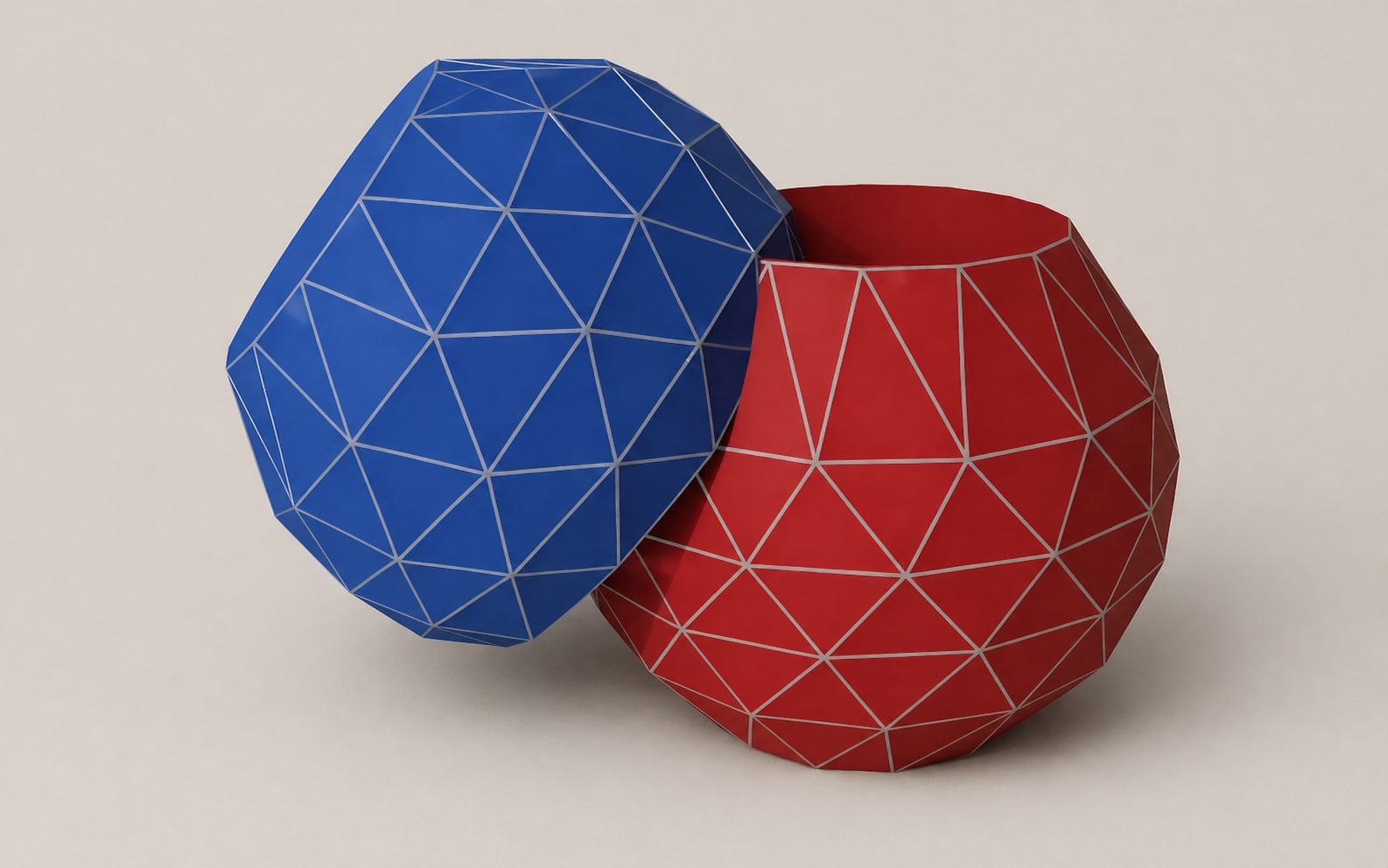
There is a new geometric figure, the Noperthedron, a convex polyhedron that defies the laws of geometry because it cannot pass inside itself. In mathematics, it is said that the Nopethedron has disproved the Rupert’s propertywhich we will see shortly.
But what does it mean that it can’t pass through? Let’s try to understand it with an example.
Let’s imagine we have two identical cubes and we dig a hole in one of them in order to make ourselves pass inside the other. This procedure is certainly possible and we know this thanks to a bet won by Prince Rupert of the Rhine at the end of the 17th century. But will it be possible to do the same thing with any other solid? For a while it was thought the answer was yes for all convex solidsthose without recesses, until, in 2025, the Austrians S. Yurkevich and J. Steininger invented the Noperthedron, a convex solid that does not enjoy the Rupert’s propertythat is, it cannot pass through.
In the late 17th century an unidentified person challenged Prince Rupert of the Rhine by claiming that:
given two identical cubes it is not possible to take one and dig a hole large enough to fit the other cube through without breaking the first cube in two.
Let’s try to understand, let’s imagine taking a gaming dice and drill it through with a drill. If the tip we use is not too small we will have a hole through which, for example, a grain of rice can pass. Now let’s imagine enlarging the little hole a little, giving it a square shape instead of a circular one, we can imagine trying to pass another nut through it.
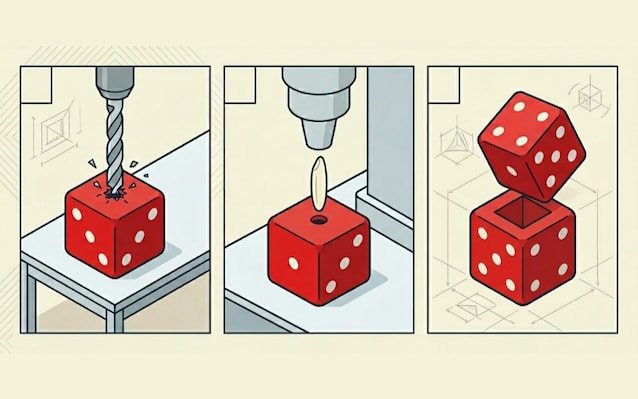
But will it be possible to pass through a nut identical to the one we pierced, of the exact same dimensions?
Intuitively one would think that no matter how much we enlarge the hole: we will never be able to fit the nut through it. On the contrary, according to Prince Rupert there had to be a way of drill the nutperhaps trying different angles, so as to be able to pass a second identical nut through it.
Rupert won his bet, as demonstrated by the English mathematician John Wallisalso at the end of the 17th century, which showed how with a diagonal hole compared to the nut, it is possible to pass an identical nut through it.
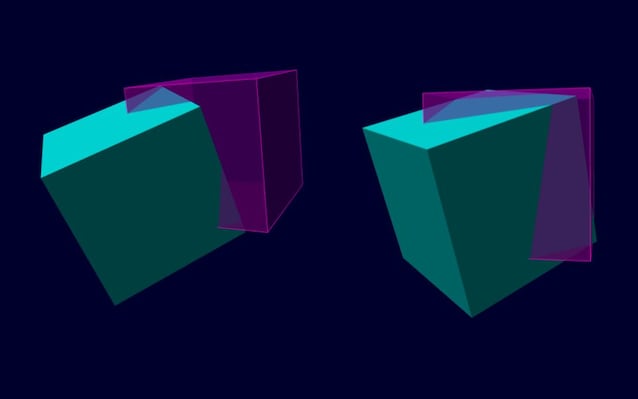
To succeed in the undertaking it is necessary to make a particular hole in the first cube, with very precise measurements, creating a particular hole cube which takes the name of Rupert’s cube (or Rupert’s cubesee figure below).
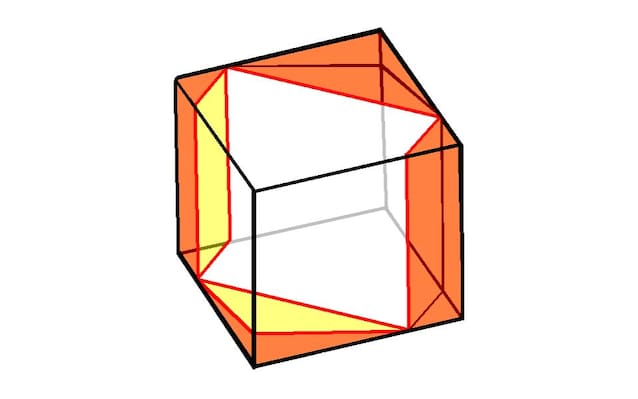
The cube therefore has a rather curious characteristic, manages to cross itselfand in mathematics when you think that a characteristic of a mathematical object is interesting in some way you give it a name. In this case we are talking about Rupert’s property or of
ability of a solid to pass through itself through a hole that does not break it in two.
For about 400 years the cube remained the only known solid to enjoy Rupert’s property, but in 1968 the mathematical historian Christoph Scriba demonstrated that even the tetrahedron (the equilateral pyramid with a triangular base) and theoctahedron (two pyramids with a square base glued together via the square face) enjoy this property.
In the following years it was demonstrated that other fairly regular shapes, such as the soccer ball (the one today made with hexagons and pentagons), also enjoy the Rupert property, and it began to be thought that all convex solids enjoyed it. THE convex solids they are those solids that have flat faces and that have no recesses, that is, a box without a lid is not convex because it has a recess, while a closed cubic box is convex because it has no recesses.
One was formulated in 2017 conjecture according to which all convex solids should enjoy the Rupert property, but as we know a conjecture remains such until it is proven or disproved, until that moment we cannot be sure whether it is true or false. This conjecture, in fact, proved itself false given that in 2025 S. Yurkevich and J. Steininger invented the Noperthedron which, despite being convex, cannot pass through itself, no matter how we pierce it.
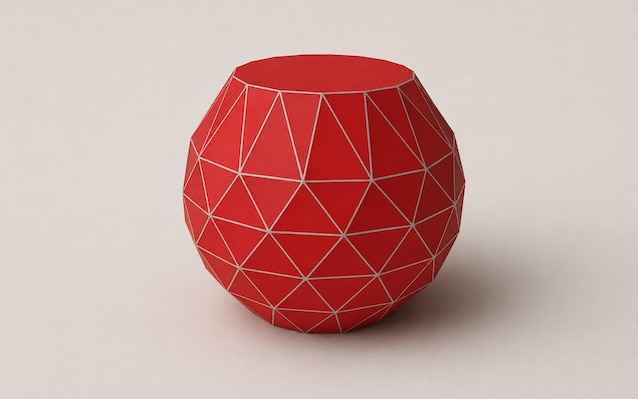
The Noperthedron, a solid with well 90 vertices, 240 edges And 152 facesis called this way by combining the word No with pertthe final part of the name Rupert, precisely because this solid it can’t get throughthat is, it does not enjoy Rupert’s property: its magic lies precisely in the fact that, as far as we know, it is the only convex solid that cannot pass through itself.
