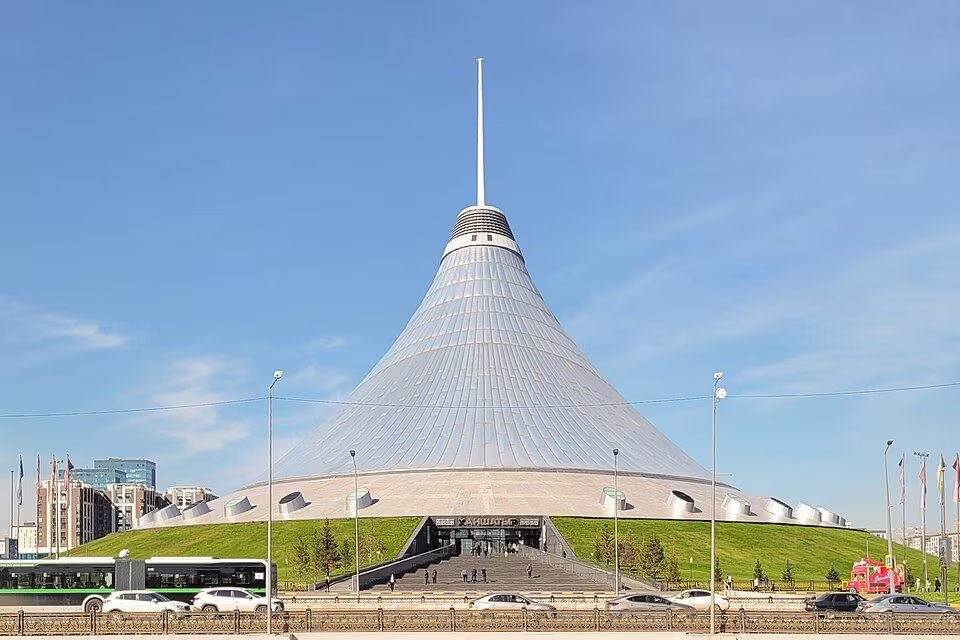
When you think of a tent, your imagination immediately runs to camping tents or, at most, picturesque circus tents. Yet, the largest tent in the world is the Khan Shatyr Entertainment Center of Astana, Kazakhstan. Supported by a monumental tall steel mast 150 meters and heavy 2,000 tonsthis colossal tensile structure covering an area of 127,000 m2 is a true masterpiece of engineering and materials science. Designed to challenge a hostile climate characterized by strong winds and brutal temperature variations (from -35 °C to +35 °C), the work uses innovative materials such as ETFE polymers to create a protected oasis, capable of hosting even a tropical beach all year round. The building designed by architect Norman Foster contains shops, supermarkets and event spaces.
Khan Shatyr in Astana: the project description
From an engineering perspective, Khan Shatyr is a colossal tensile structure. The core of the entire work is made up of a central steel trellis mast150 meters high and weighing approximately 2,000 tons, inclined at an angle designed to accommodate the dynamic forces. From this fulcrum we have the branch of a twinge steel cable network which are anchored to a large annular reinforced concrete foundation placed on the base. This real structural web supports a transparent membrane, creating an asymmetric conical volume capable of reducing the visual impact with an optimization of the load distribution aerodynamics due to the strong winds of the Kazakh steppe.
The materials of the largest tent in the world
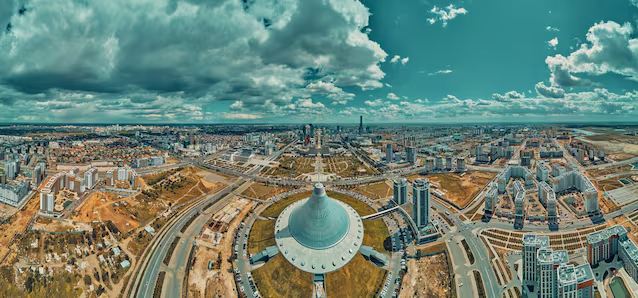
From the point of view of the materials used for the creation of this interesting work, one of the most relevant aspects is the use of ETFE polymer (Ethylene Tetrafluoroethylene) for the production of the coating. The surface is made from a triple layer of ETFE inflation cushions, which guarantee exceptional thermal insulation while remaining incredibly light compared to traditional glass.
This choice was fundamental to deal with the temperature range of Astana, where temperatures fluctuate from -35°C in winter to +35 °C in summer. The air cushions enclosed in the ETFE, combined with a forced ventilation system that directs the warm air upwards, act as a protective greenhouse. This allows it to maintain a constant temperature of around 20-24 °C inside all year round, even hosting an artificial tropical beach on the top level.
The logistics and construction of the building
The construction of Khan Shatyr required major logistical and engineering solutions. In particular, the creation and raising of the central tree was achieved thanks to the use of huge hydraulic jacks to lift the structural macro-blocks in an certainly hostile environment, where the freezing of the steel made the metals brittle and the welding activities very complex (many structural works were interrupted when temperatures dropped below -20 °C).
Furthermore, the structure was designed to respond flexibly to seismic stresses and deformations induced by snow and wind loads. The tension cables are equipped with a continuous monitoring system that allows structural movements to be absorbed without stressing the covering membrane, guaranteeing maximum safety and durability of the work.
