The origin of the has been discovered loud “boom” registered in National Laboratories of Gran Sasso (LNGS) of the National Institute of Nuclear Physics (INFN): its causes of the event, which occurred during the night between 14 and 15 August 2023, remained unknown for a long time, but now researchers from INFN, INGV (National Institute of Geophysics and Volcanology) and the Universities of Pisa, L’Aquila and Sapienza in Rome have managed to provide a scientific explanation.
The study, published in the journal Scientific Reportsreveals that it was a natural phenomenon related to changes in the aquifer of the Gran Sasso massif. Using data collected from highly advanced underground and surface instruments, the researchers demonstrated that theincrease in water pressure in the aquifer triggered processes that culminated in the roar. The research opens new perspectives for the aquifer monitoring in complex contexts.
What caused the roar in the Gran Sasso National Laboratories: the movements of the water
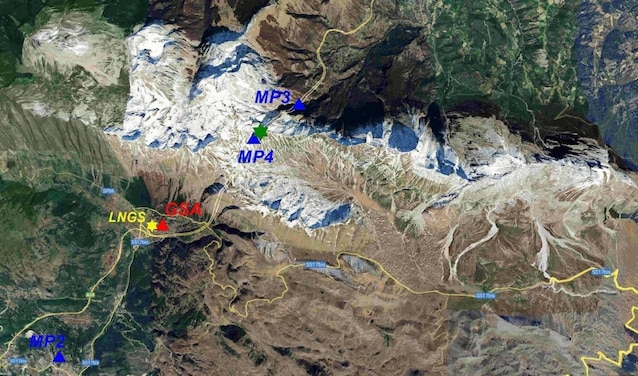
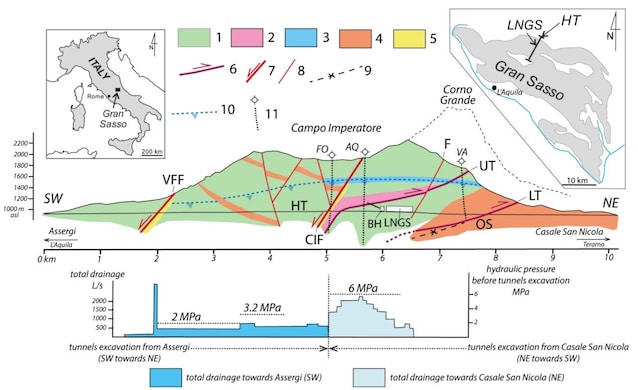
The roar, heard by the staff of the Gran Sasso underground laboratory, was a acoustic event which is often associated with superficial earthquakes, the triggering of landslides and others turbulent movements in highly fractured aquifers of karst nature. The case of Gran Sasso can be traced back to this last event. This is demonstrated by the reconstruction made by researchers on the basis ofhuge amount of data collected with monitoring tools installed on site. Already three months earlier of the roar, some of these instruments had recorded anomalies in the quantity of water present in the massif’s aquifer and its pressure, probably due to the abundant spring rainfall. The Gran Sasso massif is mainly made up of limestone and constitutes one of the largest fractured carbonate aquifers of central-southern Italy. The numerous fractures originating from rainwater capable of dissolving the calcium carbonate of the rocks and the faults due to the tectonic activity of the area further favor the infiltration of precipitation water. On the surface, infiltration occurs mainly at Emperor Campdue to the morphology of the area. Once the deep aquifer is reached, the water flows until it re-emerges on the surface, feeding numerous springs.
The event that occurred in August 2023 is not isolated, the mountain often speaks to us in the strict sense of the term, producing loud noises for which the experimental rooms of the Gran Sasso National Laboratories become a sounding board,
he states Ezio Previtalidirector of the laboratories and author of the study.
How the origin of the roar was discovered
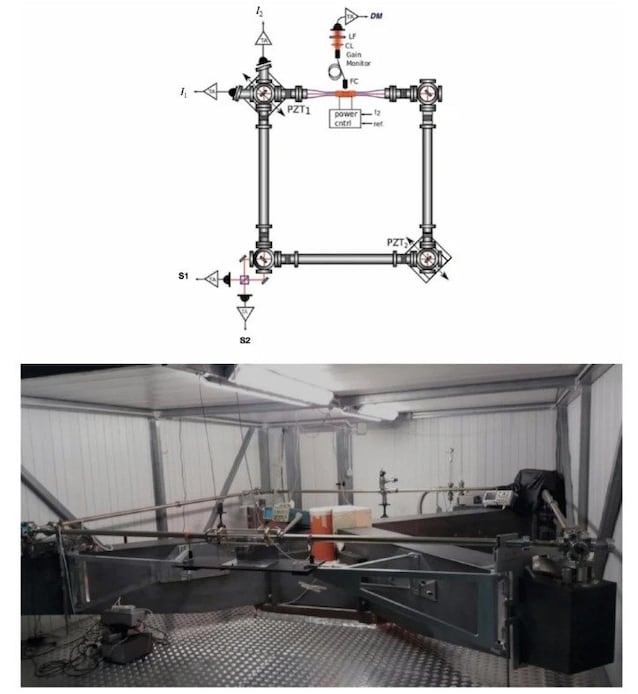
Identifying the causes of the roar was possible thanks to one large amount of data collected before, during and after the acoustic event. An important clue is given by the fact that at the moment in which the roar occurred, detected by a seismic station broadband and recorded by a acoustic sensorin the laboratories hydraulic pressure monitor groundwater showed an anomaly. Anomalies also emerged from the data groundwater monitoring on the border with the aquifer. A tool that has proven to be fundamental is GINGER (Gyroscopes IN GEneral Relativity), a laser gyroscope ring-shaped operational for ten years in the Gran Sasso laboratories, which has the aim of measuring very small variations in the rotation speed of the Earth. The gyroscope showed a unprecedented sensitivity to movements within the aquiferalso detecting movements not intercepted by the seismometer. GINGER will be further enhanced to make it even more efficient in studying the Gran Sasso, but also in monitoring of seismic events in other geological contexts. Overall, the integration of different monitoring techniques allowed us to reconstruct and analyze the phenomenon in detail, providing a unprecedented vision of the internal dynamics of the massif.