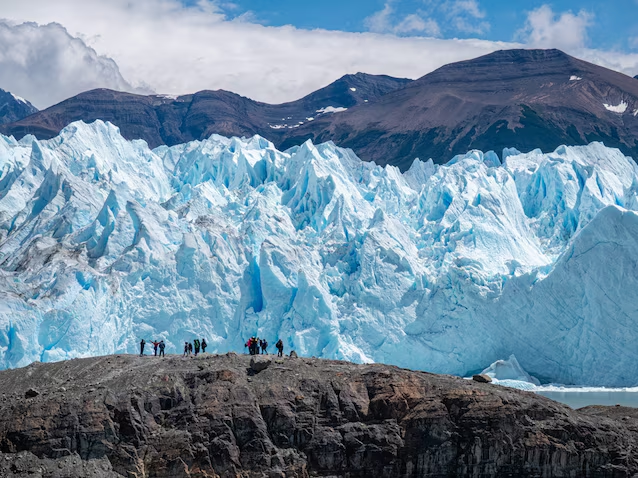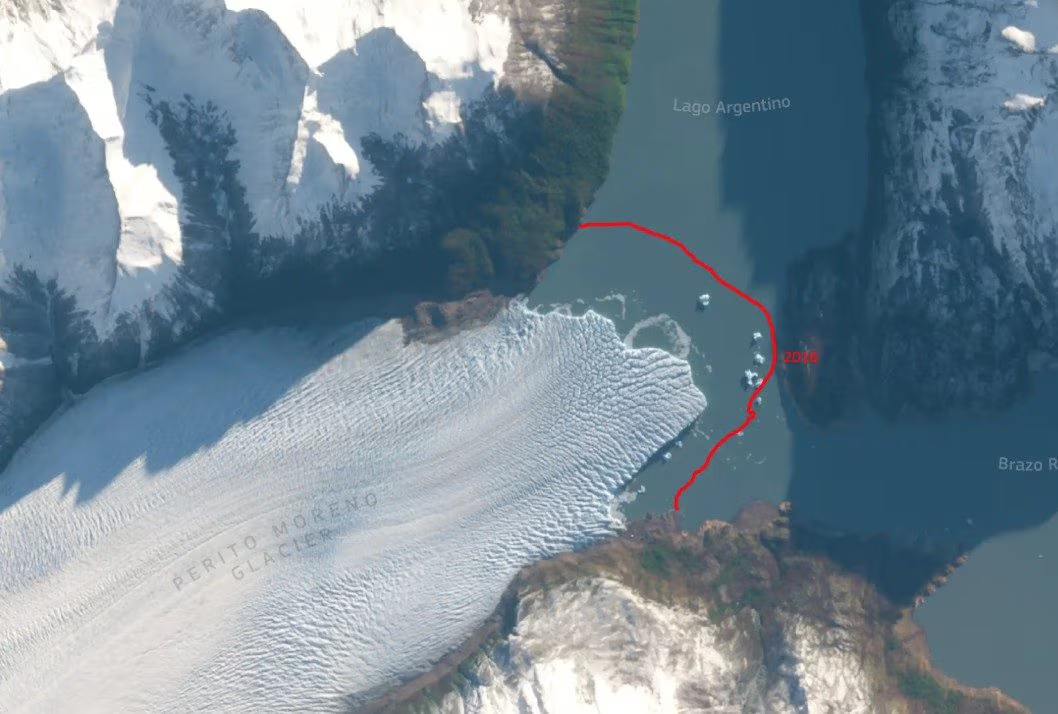
The glacier Perito Morenolocated in southern Argentina in the Los Glaciare national park, was considered an exception among the large glaciers of Patagonia because for decades it has shown no signs of retreating despite ongoing global warming. Lately, however, the situation has changed: the Sentinel-2 satellite of the Copernicus program June 30, 2026 has acquired an image of the glacier that clearly shows the retreat of Perito Moreno over the last decade. Satellite data confirms a recent study published in the journal Progress in Physical Geographyaccording to which between 1997 and 2023 the glacier has lost about 3 km2 of surface. THE’retreat major occurred in 2025 and it was 385 m.
Because Perito Moreno in Argentina did not retire for a long time
For thirty years, while the other glaciers of Patagonia melted, Perito Moreno remained stable. This means that the amount of ice that accumulated each year was equal to the amount of ice that melted. This was possible thanks to the conformation of the territory, in particular the topography beneath the glacier and the depth of the lake in front, and the internal dynamics of the glacier. The terminal part of Perito Moreno extended across the bottom of the Argentine Lake and during the advancement phases it reached a frontal rocky protrusion. In this way it blocked the channel that connects the lake with its southern arm, called Brazo Rico. A sort of dam was then formed and the water of the Brazo Rico rose for months, until it reached a height of thirty metres. At this point the pressure that the water exerted caused the dam to collapse, generating spectacular collapses. Now, according to recent studies, the base of the glacier is no longer in contact with the rocky bottom of the lake. In fact, the Perito Moreno, having become thinner, would tend to float on the water.
How far back is the glacier: 3 km2 in 26 years
The images of Sentinel-2 satellite show a significant retreat of the glacier compared to 2016, confirming the data of a recent study according to which between 1997 and 2023 the glacier has lost about 3 km2 of surface, equivalent to approximately 1% of the original surface. It might seem like a small loss, but we must consider that it was concentrated only in recent years and was accompanied by a general thinning of the glacier. The study found that Perito Moreno began to retreat more significantly since 2016. THE’retreat major occurred in 2025 and it was 385 m. To understand the state of the glacier, researchers analyzed almost 30 years of satellite images Landsat, obtained between 1997 and 2023 and compared the positions of the glacier front, i.e. its terminal part. Neighbor behavior was also studied as part of this research Upsala glacierwhich retreated by almost 7 km between 1997 and 2023, with a reduction in surface area of 73.5 km2. These are much higher values than those of Perito Moreno, where, however, based on what the data suggests, the retreat of the ice could accelerate in the coming years. The monitoring via satellites it is indispensable for the study of glaciers, because it provides regular observations of how even remote glaciers evolve, allowing us to better evaluate the effects of current climate change.