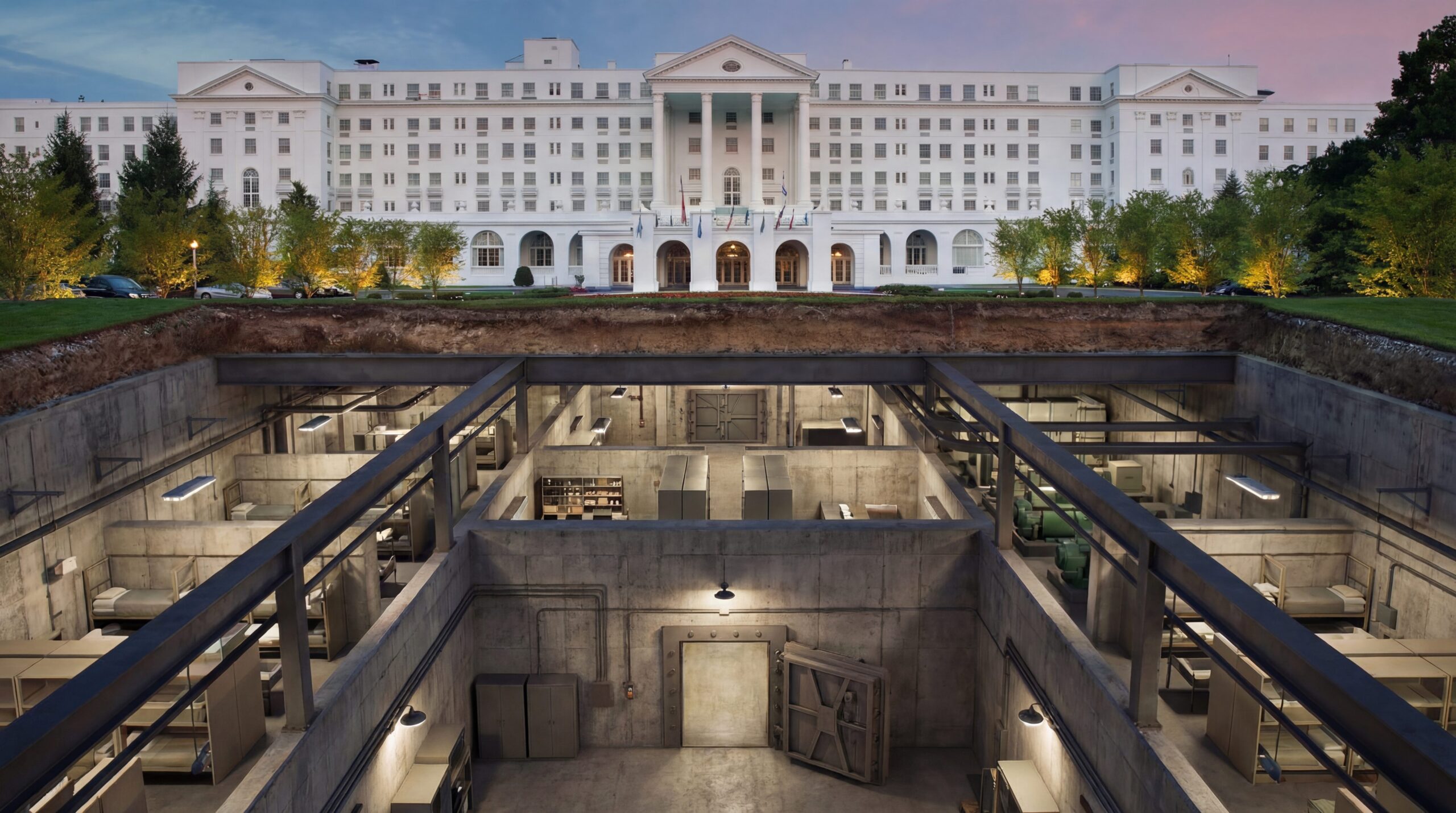
During the Cold War the United States built a luxury hotel underneath large anti-atomic bunker capable of welcome everyone and 535 members of the Congress at the time. The structure chosen was the Greenbrier Hotel and it is estimated that the project, completed in 1962it cost approx 14 million dollars – equivalent to around 150 million today! The really interesting aspect of this story is that the bunker remained completely secret from the national population for about thirty years: it was “unmasked” only in 1992 thanks to the article The Ultimate Congressional Hideaway written by the reporter Ted Gup for the Washington Post.
The construction of the nuclear shelter
Originally nicknamed Project Greek Islandthe bunker was designed to house all the main government officials in case of nuclear attack. The choice to make it happen precisely at White Sulfur Springsin West Virginia, was not accidental: it was a location far enough away to be able to survive a possible explosion in Washington but, at the same time, close enough to be reachable in a few hours’ travel from the capital. Clearly, if she had been attacked directly, she would have had no chance: according to what was reported by theAtomic Heritage Foundationit would be able to withstand an explosion at at least 25-50km.
For this reason its secrecy was of primary importance and when work began in 1957 the Government tried hard to disguise its intentions, declaring that those were only the works to create a new wing of the hotel, the West Virginia Wing. The inhabitants of the area actually immediately began to become suspicious: consider that the excavations were deep more than 200 meters and the whole area was guarded by security guards. At the same time, however, those were different times and in that period the fear of a possible Soviet attack was such that it didn’t lead people to ask too many questions about it.
What was in the secret bunker
The building developed on two different ones planseach with a surface area roughly the size of a football field. To access this facility were present 4 blast doors at least 20 tons each which, once sealed, would have guaranteed a sufficient quantity of air for 72 hours. After this time, the outside air filtration system would come into operation.
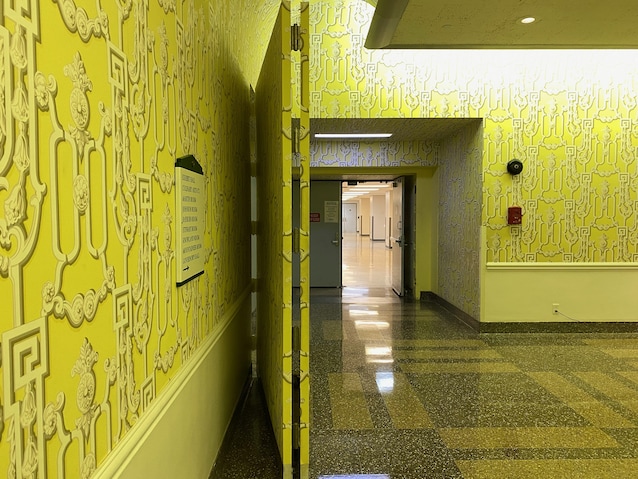
The dormitories were spread out 18 roomseach capable of hosting 60 people inside bunk beds. There was also one present 400-seat canteena hospital, an operating room, a pharmacy, and, upstairs, a series of storage rooms and offices for congressional leaders. Among the various rooms present, it is interesting to highlight the presence of a “pathological waste incinerator”, designed to cremate bodies, as well as a small collection of riot weapons such as rifles, pistols, batons and helmets.
The discovery of the Greenbrier bunker
The bunker remained completely secret in the eyes of public opinion for thirty years. Throughout this time, each bed was assigned to someone – as Greenbrier historian Bob Conte also confirmed. Furthermore, the structure was not abandoned to itself, given that in these three decades it was necessary to ensure that all the filters were replaced, that all the drugs were updated and that all the food was ready for use.
Things changed only in 1992, when the Washington Post journalist Ted Gup revealed its existence in his article entitled «The Ultimate Congressional Hideaway». Since the safety of this place was linked solely to its anonymity, the refuge was soon decommissioned. However, due to its very nature, a structure of this kind immediately attracted many curious people, so much so that it pushed the owners of the resort to offer private guided tours, then opening them to the general public in 2006.