The tire or the tyre? The dumpling or dumpling? Behind this doubt lies one of the most betrayed rules of the Italian language: the one that decides whether we must put the article “il” (or “un”) or “lo” (or “uno”) in front of a male name.
The good news is that behind the four male articles (the for the definite, a/one for the indefinite, and respective plural forms) there is a single general phonetic rule, which does not depend on the meaning of the word but on the sound with which the following term begins – and which has some exceptions of use.
Determinative and indeterminate: what are they for?
First of all, what is the difference between the and a? THE’definite article (“il”, “lo”, “la”; in the plural “i”, “gli”, “le”) indicates something already known or identified: «unfortunately the strawberry ice cream is finished» – that specific flavour, not just any one. THE’indefinite article (“un”, “uno”, “una”) instead introduces something generic or mentioned for the first time: «I would like an ice cream». The two couples move in parallel: where we use lo, we will use one; where we use the, we will use a.
The difference lies in the plural. That of the determinate is regular: “il” becomes “i” (dogs), “lo” and “l'” become “gli” (students, friends). The indefinite, however, plural does not exist: we don’t say “one books”. To make it, Italian uses partitive articles (dei, degli) or indefinite adjectives such as some, certain: “I bought some books”, “some students”. Even the expression “one and the other” is no exception: in this case “one” is not an article, but a pronoun.
When to use them: depends on the sound with which the next word begins
The choice between “il” and “lo”, “un” and “uno”, depends only on the initial sound of the immediately following word, whether it is a noun, an adjective and so on: let’s say “the student”, but “the good and the bad student”, because what is in charge is what comes immediately after the article.
Summarized schematically, the rule is this:
- if the following word begins with a vowel, as a friend, we use /gli and un, therefore: the friend, the friends, a friend, some friends.
- if the following word begins with a simple consonantor with a consonant group whose second element is “l” or “r”, “il” (the dog, the train, the meadow, the finch, the climate) and “un” (a dog, a train, a meadow, a finch, etc.) are used.
- if the following word begins with impure “s-“, i.e. followed by a consonant (he/a student), with palatal “sc-“. (the/a sheriff); with “z-” (the/a backpack, the/an uncle), with “gn-” (the/a gnome or the/a dumpling), with “ps-” (he/a psychologist), with “pn-” (the/a tyre), with “x-” (the/a xylophone), with “y-” (the/a yogurt, although some grammars also accept “the”), with “i-” semiconsonantal (the/a hiatus, the/a jinx) or with rare links “pt-“, “ct-“, “ft-” (the/one pterodactyl, the/one ctenophore, the/one phthalate), then “the” and “one” are used.
The pneumatic case: use made both forms correct
The word “tire” was born as an adjective, from Greek pneûma«breath, air» (in the philosophical sense also «spirit»): literally it therefore means «relating to air». The car tire is originally the pneumatic casing, i.e. the chamber filled with air.
According to the rule, tire begins with “pn-” and therefore means «the tire», «a tire», «the tires». Yet almost no one talks like this: in real use the tyre, a tyre, tires prevail. In spoken usage the initial group “pn-” often tends to be simplified or perceived as less marked than other initial groups, favoring the use of “il” and “un”.
Linguists accept this, as a matter of register: theCrusca Academy clarified that the tire(s) belong to a more familiar use, while the tire(s) belong to a register «more suitable in writing and more formal uses»; and adds, simply, that “nothing prevents us from using one or the other”.
There Treccani confirms that writings such as the tire “no longer receive, in fact, censorship”. The new grammar of the Italian language by Maurizio Dardano and Pietro Trifone, based on actual use, notes that the tire is now more widespread than the tyre: in speech, almost no one says “I punctured the tyre”.
The gnocco (fried) case: the license of the table
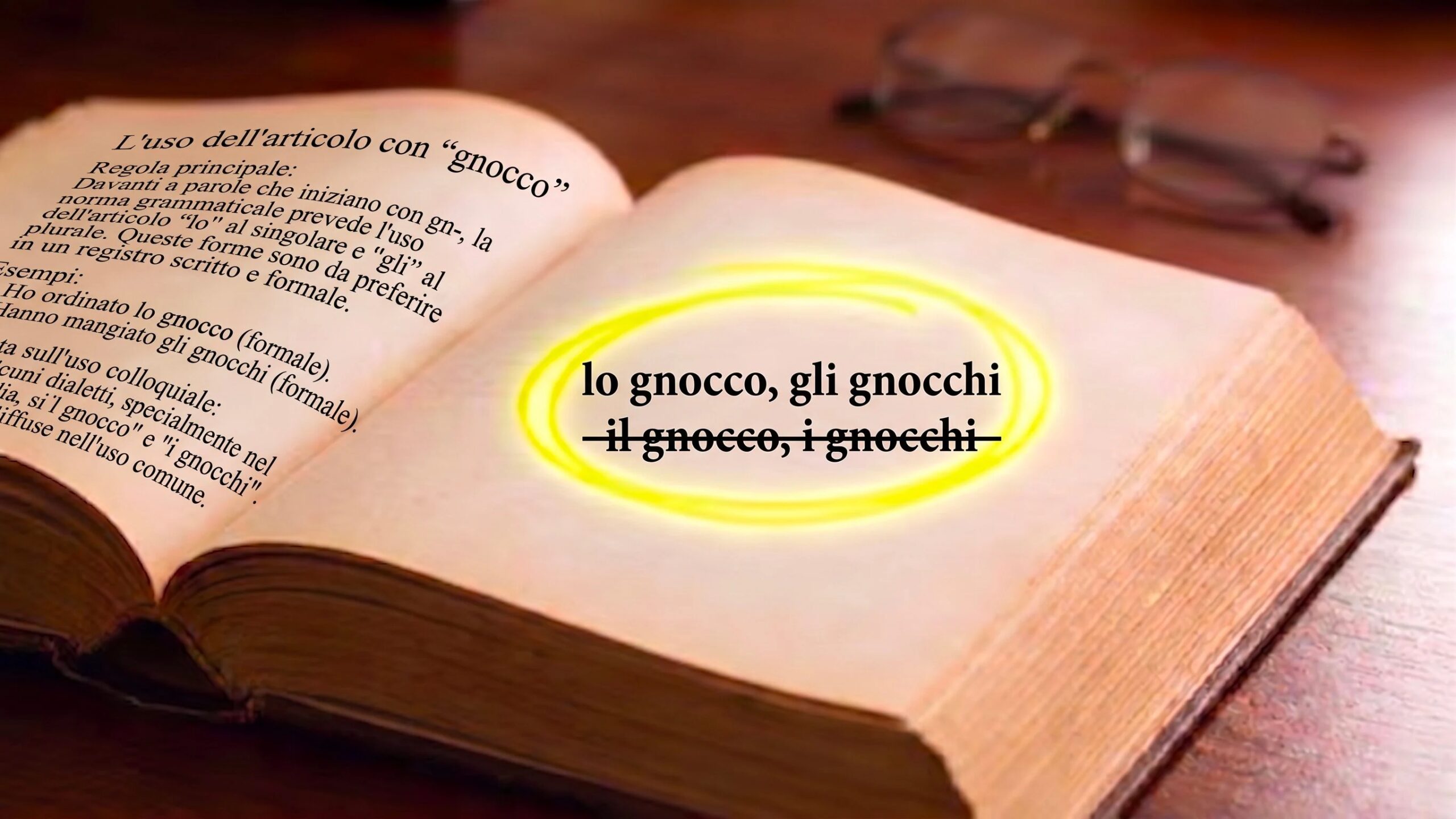
Same story for the “gn-” connection. The grammatical norm only prescribes a dumpling, the dumpling, the dumplings. But in Northern Italy, and in particular in Emilia-Romagna, the expression “il gnocco fritto” is very widespread, with the plural “i gnocchi”. This exception arises from the dialect: in Modena it is said to the gnoc, which translated literally produces «the dumpling». The variant is so deep-rooted that it has even entered gastronomic literature: the dish has been known as “fried gnocco” for centuries and has remained the usual one.
In response to yet another social debate, Dr Monica Alba (scholarship holder of the Accademia della Crusca for the drafting of an Artusian glossary relating to Science in the kitchen and the art of eating well by Pellegrino Artusi and contract professor of Italian Linguistics at the Carlo Bo University of Urbino), specified that «from a grammatical point of view there are no doubts about which is the correct form, which is gnocco»; however the phrase “must be read in its context”, because “gnocco is used in many dialects”. La Crusca specifies that the form with the/s «can occur in poorly supervised contexts, while it is definitely to be avoided in more controlled registers». Outside the local gastronomic tradition, “gnocco” remains a mistake.
In the case of the word “suocero”, the correct spelling prescribed by Italian grammars is “il padre”. Contrary to what happens with gnocchi and tyres, there is also a regional and popular use, that of “the father-in-law”.
