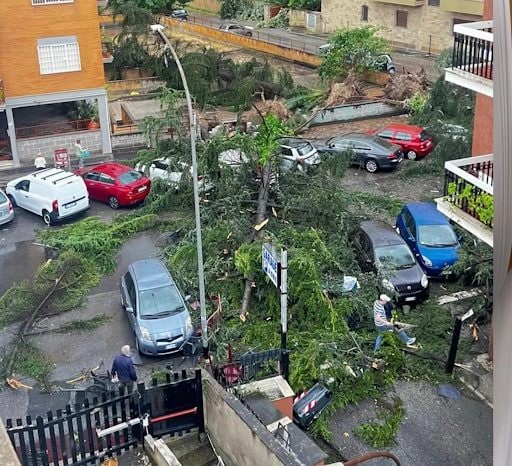
A violent storm that hit the city of Rome today morning, Wednesday 3 June 2026: the greatest damage was recorded in the Montesacro area (and, in particular, near the Conca d’Oro Metro B stop), where a whirlwindas visible from the video created by Giancarlo Razzi and published on Meteo Lazio.
The tornado, which occurred around 08:00, caused damage to some buildings and parked cars, as well as blocking traffic in the capital due to uprooted trees: in particular, damage was reported in via dei Prati Fiscali. Fortunately, the event did not cause any serious injuries: only one person was slightly injured.
Rome is not the only city to have been hit by bad weather: yesterday evening, 2 June, a storm hit the city of Arezzo (in Tuscany), during which several motorists were stuck in flooded underpasses. Meanwhile, the Civil Protection has issued a yellow warning for thunderstorms in 14 regions.
The damage from the tornado and the weather warning in 14 regions
The most affected area of the capital was that of Montesacroin the north-eastern quadrant of Rome, in particular near the B1 Metro stop Conca d’Oro. Here the tornado overturned bins and newsstands, uprooted trees (one of which fell on the roof of a petrol station) and broke the windows of some apartments. Power outages were also recorded in some places.
The most extensive damage, however, occurred on via dei Prati Fiscaliwhere roads were blocked by fallen branches, and on Eastern ring roadwhere motorists and motorcyclists even got out of their vehicles to try to clear the passage. The testimonies of the residents of the III Municipality speak of a sort of “vortex” that uprooted large objects, while several videos show a column of clouds stretching downwards until they touch the ground.
Lazio, however, is not the only region affected by bad weather in the last few hours: the Civil Protection has issued a yellow warning for thunderstorm risk in 14 regions (Liguria, Lombardy, Emilia-Romagna, Tuscany, Veneto, Trentino-Alto Adige, Friuli-Venezia Giulia, Umbria, Marche, Abruzzo, Molise, Lazio, Campania and Puglia).
Last evening a storm also hit the city of Arezzo, where they were recorded over 40 requests for assistance to the Fire Brigade in just a few minutes. Most of the interventions involved flooded garages and basements, but several people were left stuck inside their cars while navigating flooded underpasses. At the same time, the ANAS company – the company that manages the infrastructure of state roads and motorways – temporarily closed a section of the road State road 12 «Dell’Abetone e del Brennero» in both directions due to a landslide in Bagni di Lucca (in the province of Lucca).
How a whirlwind is formed
But why does a whirlwind form? During heavy storms, the atmospheric pressure decreases where there are ascending currents, i.e. currents that rise from the ground towards the cloud (usually a cumulonimbus).
If this decrease begins to become significant, a real one can be created low pressure cell which, in turn, can give rise to intense air movements and very violent circular winds which, in the worst cases, can actually form tornadoes.
This happens because in a low pressure area the weight of the atmosphere at that point on the surface is lower and, consequently, the density is also lower: for this reason, the air around it is almost “sucked in”. The whirlwinds become visible when the sucked in vapor condenses, making the typical funnel shape visible.
In general, for a whirlwind to form, a colder air mass (brought precisely by a disturbance) overwhelms one mass of warm, moist air near the ground: given that this conformation is more frequent in the warmer months of the year, whirlwinds tend to form more easily in the summer periods.
However, it must be specified that it is rather common phenomena in Italyalthough in recent years they are becoming more and more intense. The problem is that there is not yet an official warning system for this type of event: to date, in fact, no medium-term forecast programs have yet been developed for these meteorological phenomena, which therefore cannot be anticipated except in the very short term.
