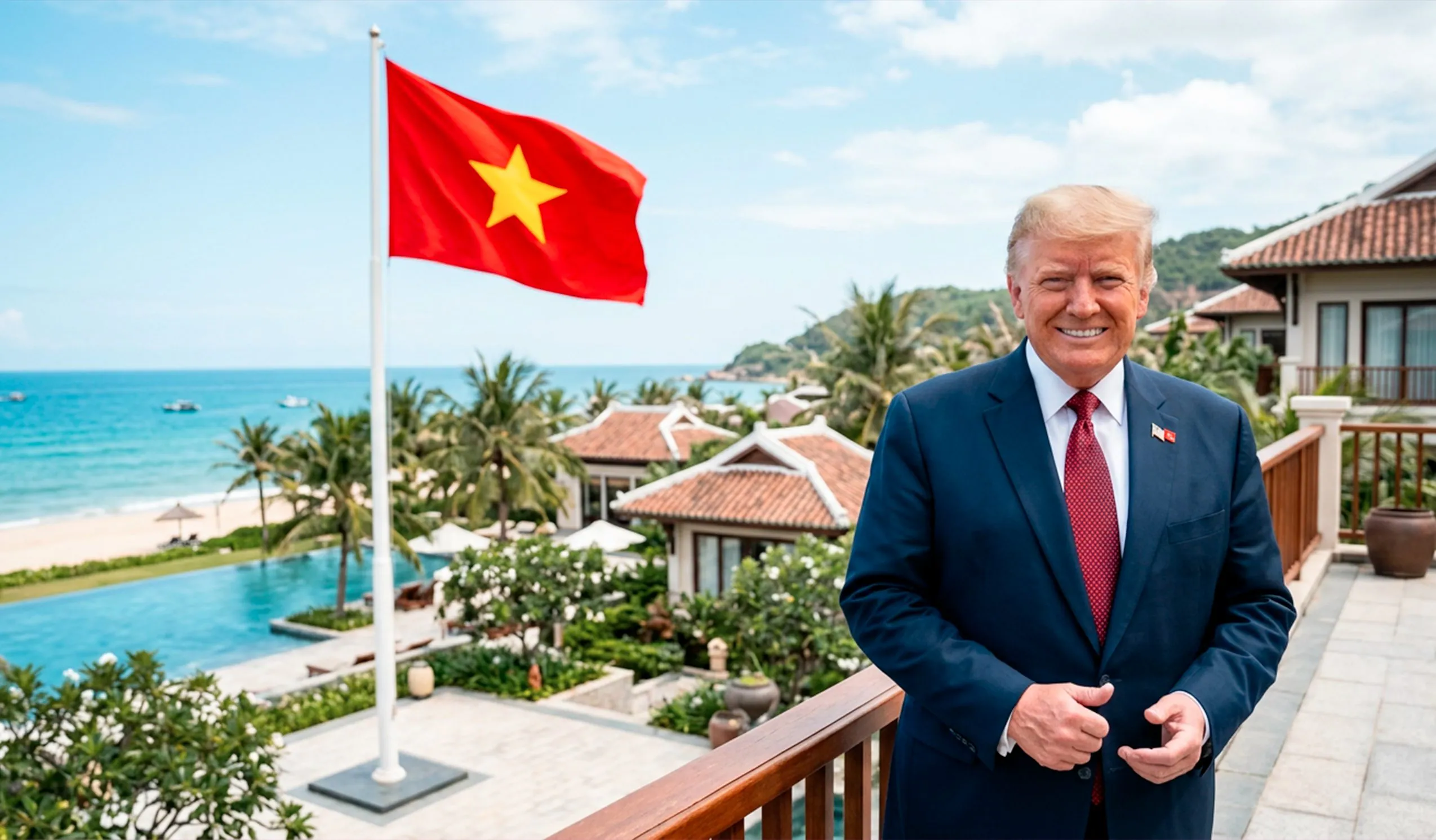
The president of the United States Donald Trump – or rather, its organization – has started the construction of a luxury maxi-resort from 1.5 billion dollars in Vietnamin Hung Yen province, a short distance from the capital Hanoi. It is a 5-star hotel surrounded by endless golf courses and facilities open to the public, whose construction, however, led to the exhumation of approximately 3500 bodies from an ancient local cemetery, as well as forcing 4000 families forced to relocate. But what exactly do we know about the project? And why did the Hanoi motive support him?
What we know about Trump’s Vietnam resort project
The complex Trump International Vietnam is located in the northern province of Hung Yenabout 45 minutes drive from the capital Hanoi, in a flat and extremely fertile area along the Red River. The complex, once finished, will boast a surface area of 9.8 km2and the plan includes two 5-star residential areas, luxury villas and a golf course that could have between 36 and 54 holes. But not only that: the project also includes a commercial centre, theme parks and urban services which will be able to accommodate up to 29,700 people.
The main investor is the Vietnamese real estate company Kinh Bac City (KBC)controlled by the manufacturer Dang Thanh Tam. KBC indirectly controls the 95.32% of the share capital of Trump International Vietnam Joint Stock Company. There Trump Organization does not participate directly in compensation or expropriation of land and its role consists in licensing the use of the famous “Trump” brand upon payment of royalties and in operationally managing the exclusive club once completed, thanks to a 50 year operating license.
The foundation stone laying ceremony took place on May 21, 2025 in the presence of Eric and Lara Trump and the Vietnamese Prime Minister. The estimated delivery date was originally on 2027but the construction site is experiencing major slowdowns.
Criticism for the 3000 tombs exhumed
Behind the appearance, lies a reality that is anything but serene. First, there is an ethical problem related to destruction of a historic cemeteryeliminated to make room for the project. Inside there were more than 3500 gravesforcing the authorities to exhume the bodies – in a country where the cult of ancestors is extremely strong. But not only that: the area involved is so large that 4,000 families have been forcibly relocated. Of course, each was given compensation, but according to what some of them declared, this would be incredibly low: between 3 to 12 dollars per square meter (with the addition of temporary rice supplies and compensation for uprooted plants).
In addition to ethical problems, there are also geological and environmental problems. In fact, the project managed to get the green light from the Vietnamese Government in record time, just 3 months – against the 2/4 years usually expected for works of this type – and this was only possible by completely skipping some steps, such as the environmental impact assessments. The problem is that i hydrogeological risks there are: the complex will in fact be built on a river plain which, only last year, ended up completely underwater due to flooding caused by a typhoon. Furthermore, the ground is littered with unexploded ordnance dating back to the Vietnam War.
But… why did the Government of Hanoi turn a blind eye to this project?
Why did the Vietnamese government support the project?
The answer is purely geopolitical and economic. Vietnam is a country heavily dependent on exports, sending almost the 30% of its GDP in the United States. Faced with the Trump administration’s threat to impose punitive customs tariffs up to 46% on Vietnamese goods, Hanoi’s leadership saw the luxury resort as a perfect “goodwill token” to sweeten the relationship with Washington. A confidential letter from Vietnamese government officials published by the NYTimes explicitly confirmed that the project received extraordinary preferential treatment because “enjoys the special attention of the Trump administration and President Donald Trump himself“. The rush to start the work was motivated by not wanting to “lose the time window to capitalize on the administration’s support“.
Furthermore, Hung Yen Province is not just any place: it is the homeland of To Lamthe powerful General Secretary of the Vietnamese Communist Party who supported the operation. Although the White House continues to deny any conflict of interest, claiming that the businesses are run by Trump’s children through a “blind trust,” financial documents show that proceeds from these foreign operations continue to flow directly to benefit personal of president.
