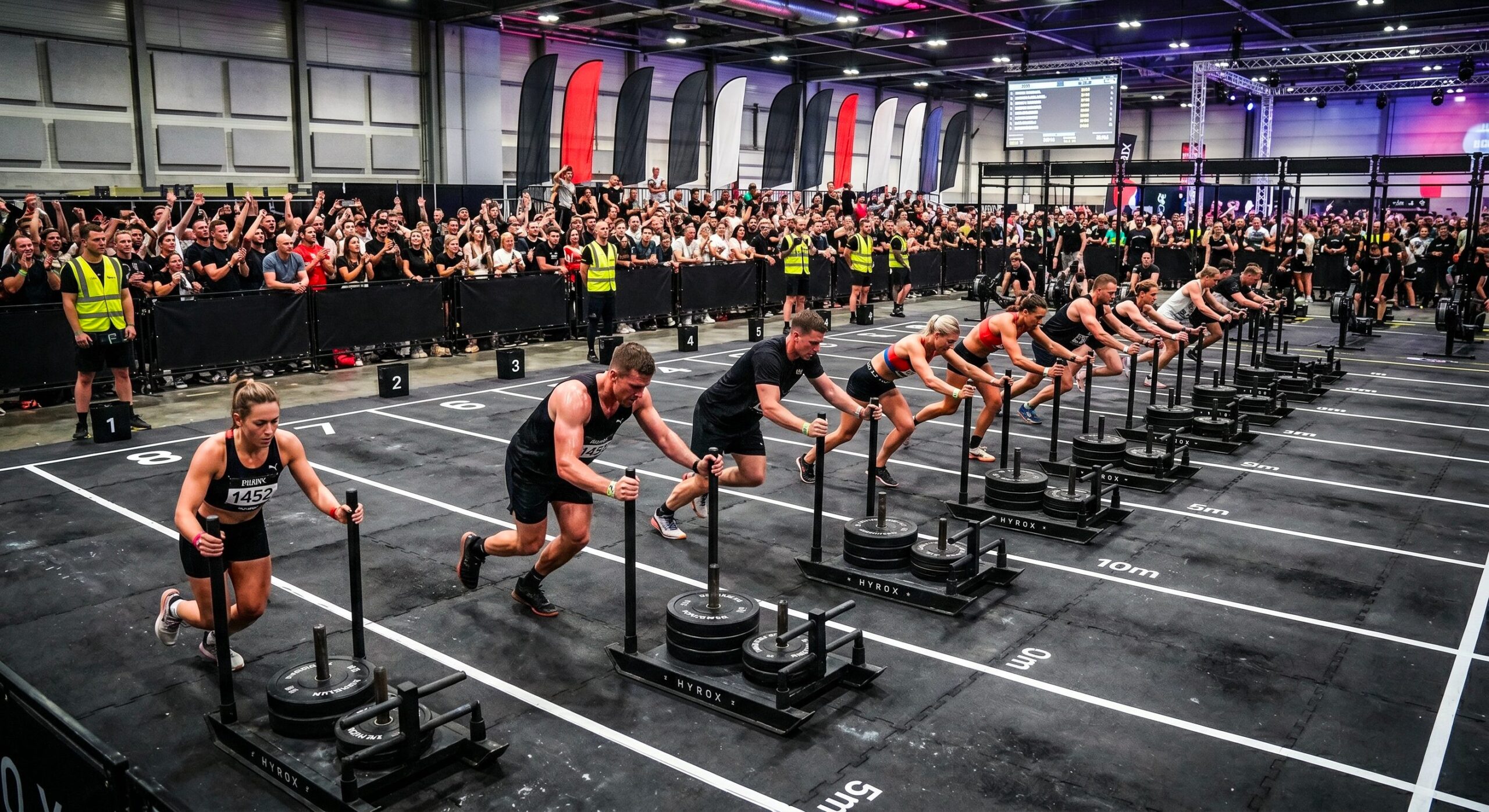
Born from the intuition of a sports event organizer and an Olympic champion, Hyrox it is the global phenomenon that has given a competitive goal to the millions of enthusiasts who train every day in the gym. The format is as simple as it is brutal and rigorously standardized throughout the world: 8 kilometers of running interspersed with 8 grueling stations of functional exercises.
Since the first edition in Hamburg in 2018 with a few hundred participants, the competition has recorded unprecedented growth, spreading to 43 countries and exceeding half a million participants in the 2025/26 season. Thanks to a 98% course completion rate, categories accessible to all and an atmosphere of a large indoor event-show, Hyrox has transformed the classic training into a truly global sporting challenge. The highlight of the season will be the 2026 World Championship, which will be held in Stockholm from 18 to 21 June. A phenomenon that has now also exploded in Italy: the 2026 edition staged at Rimini Wellness at the end of May is the definitive proof of this, having recorded absolute record numbers with over 10,000 registered athletes.
What the Hyrox race consists of with 8km of running + 8 exercise stations: how it works
The concept is simple to understand but brutal to execute. You run 1 kmthen you complete a functional exercise station. We run another km, we reach another station. And so eight times. Unlike the CrossFitwhere the exercises change every day (the so-called WODs, Workout of the Day) and include technical movements such as Olympic lifts or handstands, Hyrox always offers the same format with accessible functional movements.
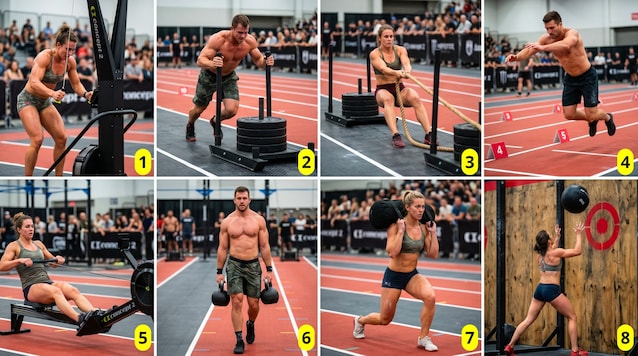
The eight stations are always faced in the same order, regardless of the division in which you compete:
- 1 km run
- SkiErg (1,000 m): a machine that simulates cross-country skiing. It starts by pulling down two handles connected to a flywheel: arms, shoulders, core and even legs work together.
- 1 km run
- Sled Push (50m): you push a loaded sled on a 25 m track, back and forth. The weight varies according to the category (from 102 kg of the sled included in the women’s Open to 202 kg of the men’s Pro).
- 1 km run
- Sled Pull (50 m): same sled, but this time you pull it towards you using a rope.
- 1 km run
- Burpee Broad Jump (80m): the burpee is a classic of military training, you throw yourself on the ground, get up and jump forward as much as possible. You have to cover 80 m of jumping strength. On average 40-60 repetitions are needed.
- 1 km run
- Rowing (1,000m): you get on the rowing ergometer and row a thousand metres. It is the second ergometer of the race, it marks the halfway point and is a critical point.
- 1 km run
- Farmers Carry (200m): you grab two kettlebells (the weight depends on the category: 2×16 kg for the women’s Open, up to 2×32 kg for the men’s Pro) and walk for 200 meters. Hand grip and core stability are put to the test.
- 1 km run
- Sandbag Lunges (100m): a bag of sand on the shoulders (10 to 30 kg) and 100 m of lunges.
- 1 km run
- Wall Balls (75 or 100 reps): the last station. You perform a squat while holding a medicine ball (4 to 9 kg), throw it high at a target and catch it flying. And we start again. 75 repetitions for the women’s Open, 100 for the other categories.
The key aspect is that the format is identical everywhere: those who run in Milan can compare their time with those who run in New York, Berlin or Tokyo. This is what allowed for the creation of global rankings and a World Championship at the end of the season.
Categories and records
Hyrox is designed for everyone. You can compete alone in the division Open (lighter weights, no time limit, average around 90 minutes) or in the Pro (definitely higher weights, with the possibility for the best to qualify for theElite 15the series that pits the 15 strongest athletes in the world against each other). Those who prefer to share the effort can sign up in Doubles (in pairs, alternating in the stations) or in Relay (teams of 4, each completes 2 km and 2 stations). The age groups range from 16 to 89 years old and 98% of participants cross the finish line, a sign that inclusiveness is not a slogan.
But how fast can the best go? The male record in the individual Pro it belongs to Alexander Rončevićwho closed in at the Warsaw Major in April 2026 51 minutes and 59 seconds. On the women’s front, the Australian Joanna Wietrzyk stopped the clock at 54 minutes and 25 secondsalso in Warsaw.
Why it became so popular and how the idea came about
Christian Toetzkea German veteran in organizing marathons, triathlons and cycling events, had noticed one thing: hundreds of millions of people around the world pay for a gym membership and train consistently, but they don’t have “their” race. Runners have the marathon, cyclists have the Giro, swimmers have their competitions. And who trains in the gym? Nothing. To turn the idea into something concrete, Toetzke teamed up with Moritz FursteGerman field hockey champion with three Olympic medals (including gold in Beijing 2008 and London 2012).
The first event was held in Hamburg in April 2018 with fewer than 700 participants. It jumped to over 90,000 athletes in the 2022/2023 season and today Hyrox organizes around 135 events in 43 countries, from Japan to Australia, Saudi Arabia to Brazil, with thousands of participants per race. In the 2025/26 season, it exceeded half a million in the 2025/26 season. Tickets for London, Chicago and Amsterdam sell out within hours. But why did it have this success?
As mentioned, these events gave a goal for those who train in the gym. As Elite 15 athlete and HYROX coach Jake Dearden explained to Red Bull: The movements required don’t require enormous technical skill compared to other sports. Furthermore, the standardized format has created a global community. The fact that the race is the same everywhere is a powerful mechanism. This has fueled a culture of personal challenge and continuous improvement typical of gaming (score, ranking, progression) applied to real fitness.
Finally, the atmosphere is that of a real event. The competitions take place indoors, in large exhibition pavilions. The public can follow the athlete from start to finish, which is impossible in a traditional marathon where you see the start and finish. The effect is that of an event-show: music, screens, constant cheering. A single event in London hosted 40,000 attendees over four days in December 2025, with over 70,000 total spectators.
