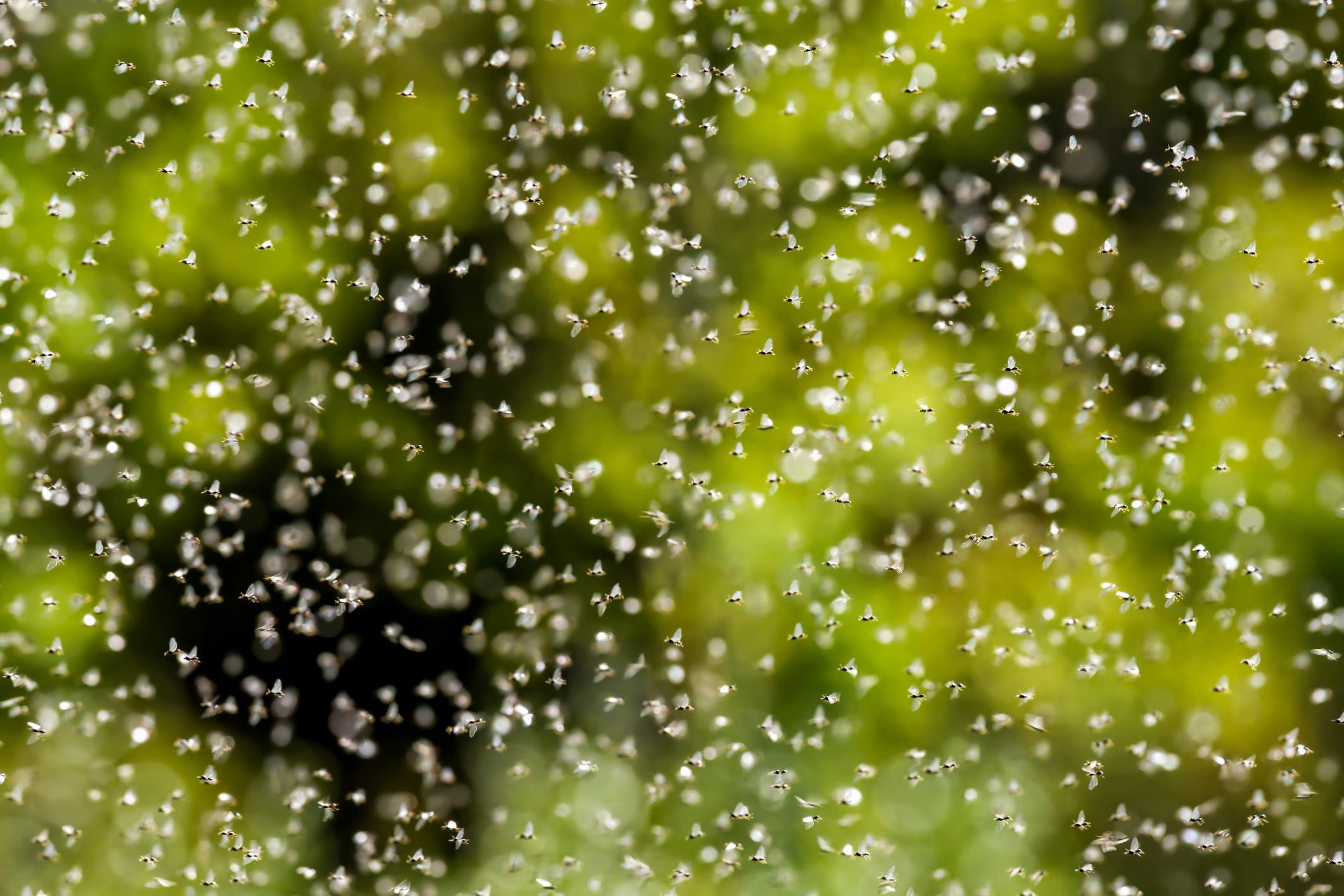
In the height of summer, in hot-humid weather conditions, we happen to see clouds of ants with wings which move in large numbers and with an almost disordered flight, gliding here and there on every surface. Are these some kind of winged ants? No, it’s actually a phase of life cycle of most species, the moment of mating and the so-called “Wedding Flight”. The famous French entomologist Jean-Henri Fabre, the father of insect ethology, also talks about it in a short but engaging description in a chapter of the book “Entomological Souvenirs“. He says that on a beautiful summer day, when the air is calm and the sun is shining, especially after the rain, the anthill begins to come alive and a multitude of young fertile ants, females and malesall winged, start to come out and fly everywhere. The insects all swirl together in the air and disperse away from the nest in a “cloud”. It happens that they can enter the house, but they are not dangerous for humans or other animals. As soon as the eggs are fertilized, the males fall to the ground dead and the females detach their wings and look for a mound of earth to found a new colony of which they become queens. This is an evolutionary strategy very efficient which allows the ants to reproduce and, at the same time, look for new spaces.
What does it mean if ants have wings and when they go out for nuptial flight
The nuptial flight, as Fabre has well described, is an essential moment for reproduction and for swarming (displacement) of most ant species, the mechanism by which a colony divides and a group moves to found a new colony. They only become winged the drones (the males) and the females destined to become queens of a new anthill, never worker ants. Wedding flights are short-lived, unpredictable and very difficult to study. Generally, individuals swarm from multiple colonies at the same time, so as to be able to increase the possibility of interbreeding between different families and therefore genetic variability. The timing of the start of the flight is governed in particular by local weather conditions. Several studies demonstrate that atmospheric conditions play a key role in activating this peculiar reproductive mechanism (temperature, air humidity and wind speed); the moment after the rain when there is heat and humidity, it is also optimal because Wet soil minimizes dehydration and it is softer and suitable for creating a new anthill.
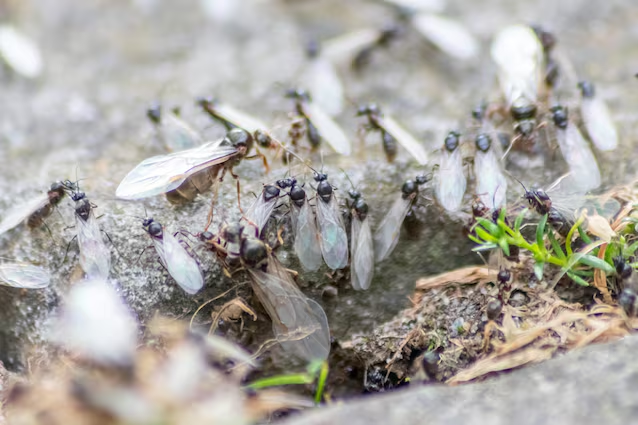
Each species adopts a different strategy
As reported in a 2022 article published on Science Advances, over 15,000 species of ants are known, and each species can adopt some particular strategies in nuptial flight. For example, the male Japanese carpenter ant (Camponotus japonicus), right during the nuptial flight, secretes from the cephalic capsule (on the animal’s head) three chemicals derivatives of salicylic acid and anthranilic acid (methyl salicylate, methyl 6-methylsalicylate and methyl anthranilate) capable of attracting both females and other males, thus increasing the concentration of male specimens available for mating; this behavior is known by researchers as “male aggregation syndrome“.
The female leafcutter ant (Atta sexdens) instead, accumulate lipids and proteins raw before the nuptial flight, as also found by direct measurements published in 2017, considering that both the flight and the creation of the new anthill require a considerable expenditure of energy. In the first phase after fertilization, in fact, the queen is alone and begins to create the nest and lay the eggs from which the first workers of the new anthill will emerge; this extremely delicate phase where the queen must make maximum effort to give rise to a new anthill is called cloistered phase (therefore of solitude, of seclusion).
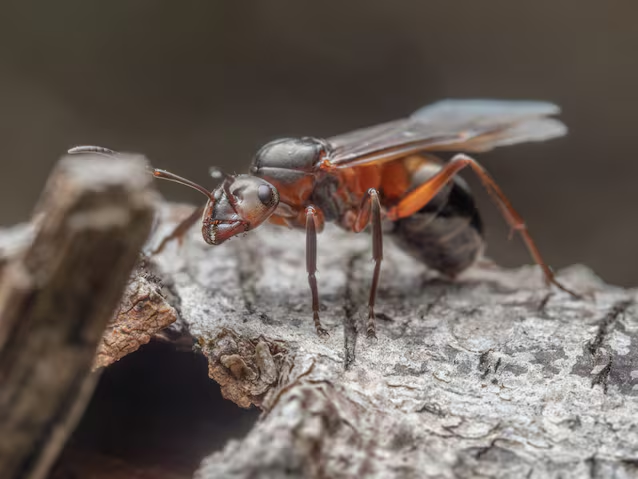
The queen loses her wings by tearing them off with her mandibles
The male, after having transferred the sperm into the queen’s spermatheca in flight, dies; the female instead lands and must get rid of the wings you have now become a useless encumbrance. For this reason he begins to carry out a sort of chest contractions and completes the detachment of the wings with the mandibles. Precisely for this purpose, the queen of ants has a thorax characterized by greater musculature than the workers because it needs to move its wings and then detach them. The process of losing wings (dealation) occurs in different times from species to species; for example, Huang and colleagues report that the fire ant (Solenopsis invicta) it loses its wings within an hour in fertilized females, while females that remain virgin lose them during the day on average in an interval of 2 to 6 days.
Flying ants as food for insectivores
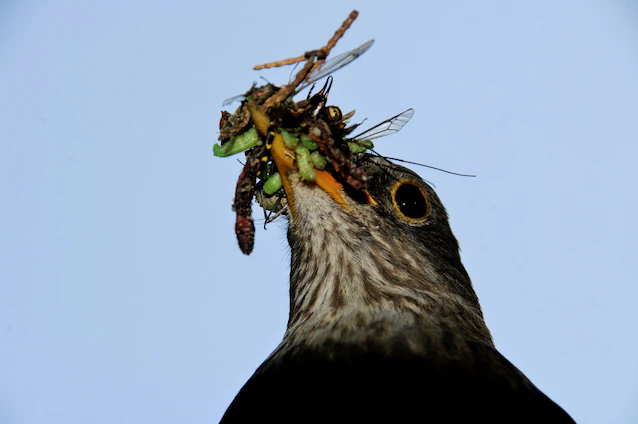
Ants in flight represent an important protein food source for different species; predators such as birds, bats and dragonflies feed on winged ants, taking advantage of the moving swarms. In particular the swift (Apus sp.) which feeds exclusively in flight, has a real specialization in the search for flying ants. On the other hand, ants group together by moving synchronously precisely because thecloud effect acts as a deterrent against predators.
Nuptial flight altered by climate change
A study conducted on 73 species of ants in Europe and Asia, between 2007 and 2021, has shown that the nuptial flight period is undergoing a time shift and it is at least two weeks earlier in Eastern Europe and Asia than in Western Europe. Eastern populations of many species are therefore responding more rapidly to rising temperatures. Similarly, a study conducted in the United States on specimens present in museum collections and dating back over a centurydemonstrated that ant mating seasons vary as a function of latitude and altitude, but they are changing in response to climate change. Considering all the ant species examined, mating dates are anticipated by approximately 1 day per decade.
