Why “Fatherland” is one of the strongest films of Cannes 2026
“Fatherland” by Paweł Pawlikowski is unlikely to leave Cannes 2026 empty-handed. Not after what everyone has seen inside the new work by the Polish director, capable of combining elegance and content, depth and mystery in a road movie in post-war Germany, together with Thomas Mann and his daughter Erika. Unmissable.
“Fatherland” – The plot
Thomas Mann (Hanns Zischler) can finally return to Germany after a long time. We are in 1949, the country is still divided into three zones of influence, controlled by the Soviets, Americans and French. He, a very famous writer and essayist, admired, followed and idolized by everyone, is expected in Weimar, where he will arrive by car together with his daughter Erika (Sandra Hüller).
They haven’t spoken to each other for a long time, there is a wall between them that has arisen over the years. That wall becomes even higher when the news reaches them that Klaus Mann (August Diehl), Thomas’ son and Erika’s brother, has taken his own life, after a long battle with depression. So that journey from Frankfurt to Weimar, that passage from the free or presumed free world to the communist bloc, will inevitably become a showdown, a confrontation between two generations, between a father and a daughter who try to understand what will become of their country and of them. But it’s not easy to put the pieces back together, to get out of the shadow of a man so big that he suffocates everyone around him, even now when it would be necessary.
“Fatherland” is written by Pawlkiowksi together with Hendrik Handloegten, and represents a complex reasoning by the director on a specific historical period, but also on an atypical family group, which contained within itself the different souls of that country still in pieces.
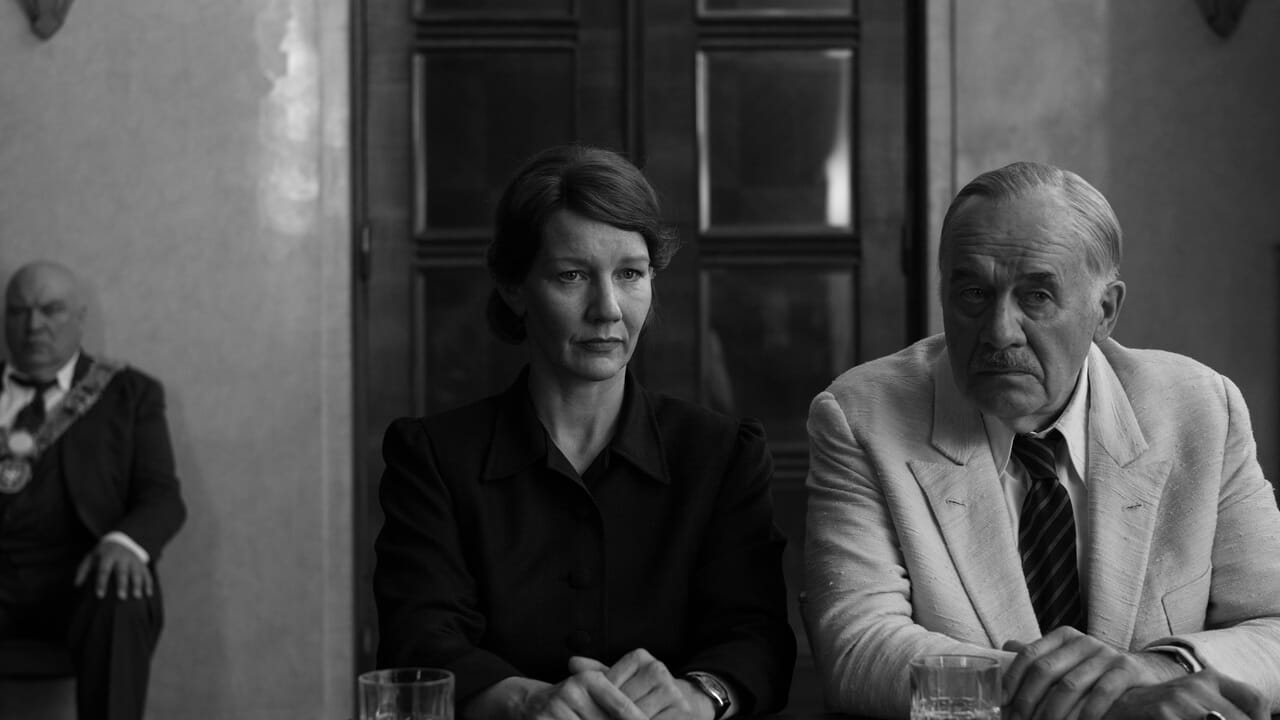
“Fatherland” is, however, above all else a sumptuous black and white painting. Thanks to Lukasz Zal and the editing done together with Piotr Wójcik, Pawlikowski manages to give us a total immersion in that precise moment of German history like no other. Magnificent is the impact of shadows, of the different shades of grey, which paradoxically enhance the light, making it dominant when it creeps onto the screen.
It would not have been possible to think of something different without losing power, expressiveness, that load of verisimilitude that the Polish director clearly wants to be dominant. That car crosses a country that in the West is free but still tested, while in the East, paradoxically, the Soviet giant rebuilds, imposes, guides, but does nothing to hide the stick, the terror and the fear used as a club.
Determinism and free will, rationality and feeling
“Fatherland” adopts a desire to unite the large composition for the exteriors, with the rubble of the lost dream of the Third Reich, with the interiors that wink at Expressionism, at the silent cinema of the beginning, and therefore becomes a means to talk to us about the past. Thomas Mann, Nobel Prize winner in 1929 for literature, lives in a decadent, manneristic atmosphere, in which death hovers over everything and everyone.
Klaus appears briefly, a dialogue on the telephone from which emerges the exhaustion of a generation, of which he was unable to prevent Hitler from his course, of which now finds itself crushed by two equally destructive ideologies. A very good Sandra Hüller contrasts the almost oppressive and ultimately proud silence of her father with explosions of anger and very powerful tears, only to then regain her composure and continue to follow him on that journey into a country they no longer recognise, despite the honors paid to both of them by the Red Army. Pawlikowski keeps the new terror, the new massacres, the dictatorship that replaces the past one in the background but visible.
Thomas is the Germany of yesterday, the one that couldn’t stop the swastika, Erika is the one who now has to restart a country without knowing what will become of them. The brother’s ghost hovers over everything and everyone, it is the thorn in the side of a reconciliation that they both want but are unable to rationally achieve. Pawlikowski makes this research part of a fast road movie, 82 essential minutes, in spite of certain bricks that besiege Cannes every year. This is also the beauty of this director, his mastery in understanding what is needed and what is not.
A bit strange if we think about how much Mann actually didn’t skimp on words and pages. But perhaps precisely in this contrast there is a humble homage to a man who here we finally discover as fragile, alone, heartbroken by having been (perhaps) a great mind, but not a great husband or father, perhaps also because of his hidden homosexuality. In him we also see here the failure of that bourgeois ideal that he himself had analyzed several times.
A perfect film precisely because it is balanced, essential, even humble in wanting to focus on a small but powerful moment.
Rating: 8.5
