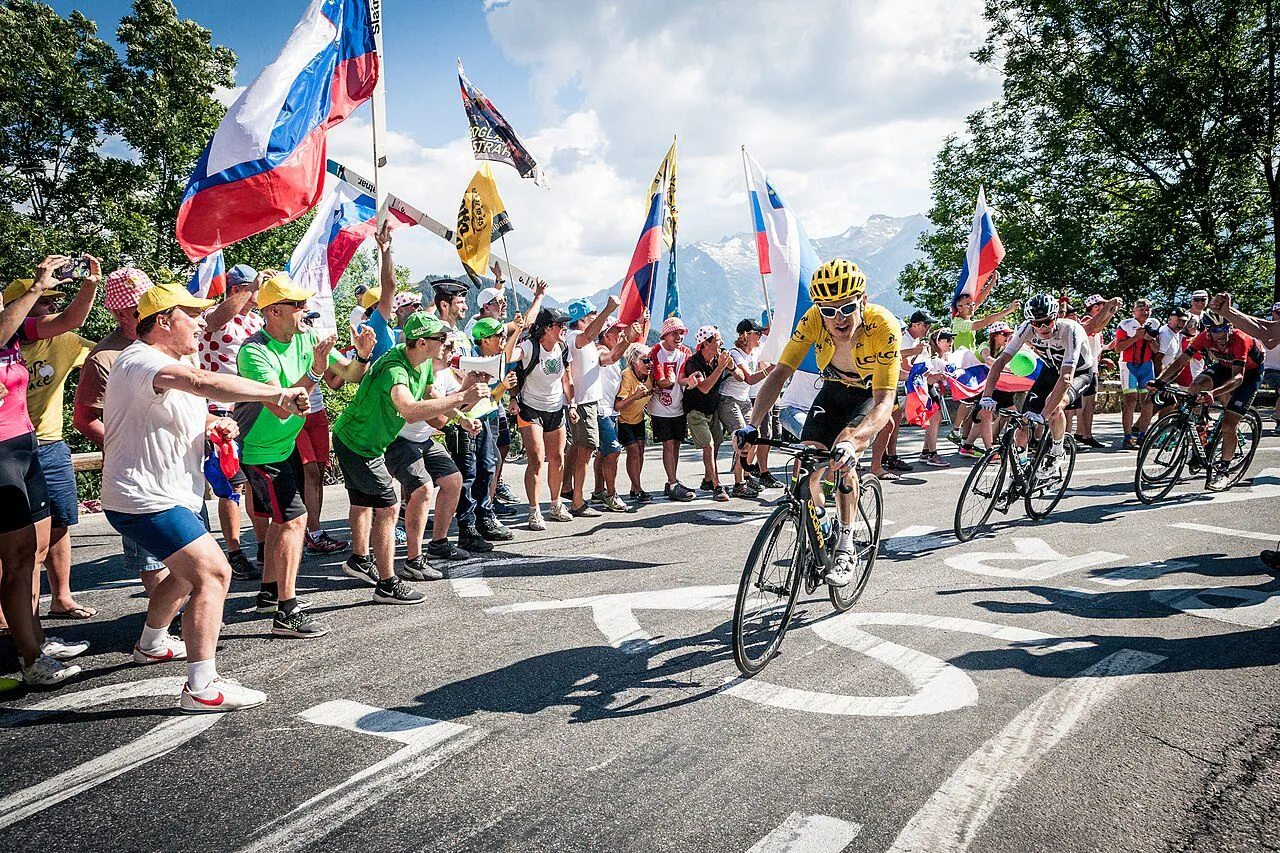
Nello sport we are used to often taking for granted that a WIN be the athlete stronger, more powerful or faster. In cycling, however, there is a situation in which this rule is reversed: when the road begins to climb, it is not the strongest riders who dominate but the smallest and lightest ones. On slopes, in fact, the cyclist’s work serves almost exclusively to overcome the force of gravity. The reason has to do with a physical quantity that we also encounter far from sport, for example when comparing engines: the weight/power ratio (expressed in W/kg).
It’s the same principle by which, uphill, a small zippy motorbike overtakes a much more powerful truck: it’s not the power itself that counts, but how much you have available for every kilogram you have to carry upwards. These days, with the Tour de France getting underway, it is precisely this number that can decide who will wear the yellow jersey.
What is the weight-power ratio in cycling and how much does it affect climbing
The weight/power ratio is simply the power that a cyclist can develop divided by his body weight, and is measured in watts per kilogram. It is used to compare athletes of different sizes: 250 watts produced by someone weighing 60 kg (4.2 W/kg) is “worth” more than the same 250 watts produced by someone weighing 80 (3.1 W/kg). Some references to orient yourself: a well-trained amateur can manage to maintain around 3 W/kg for an hour, a professional is around 6, while the champions who compete for a great Giro manage to sustain values between 6.5 and 7 W/kg on 30-40 minute climbs. But this ratio becomes the decisive factor only in a precise condition: when the road goes up.
On the flat the power counts, on the climbs it’s the gear ratio
To understand why this data is so important when going uphill, it is necessary to understand what stops a moving bicycle. A physical model still used today as a reference, proposed in 1998, breaks down the power needed to pedal into a few items: the resistance of the air, the friction of tires on the asphalt, the friction mechanics and the gravity force when you go up. The weight of each voice changes dramatically with speed and slope.
In plainsAt the current speed of the group (45-50 km/h), air resistance reigns supreme, which can absorb up to 80-90% of the power. Here the winner is the one who pushes the highest watts and is most aerodynamic: it is no coincidence that, on the plains, a heavy but powerful runner is able to overtake a light climber.
In climb the scene is reversed: below 25 km/h the air offers little resistance, and the number one enemy becomes gravity: every meter of altitude difference means lifting one’s own weight (plus that of the bike) against the earth’s attraction, and the cost of this work is proportional to the mass to be lifted, so the lighter athlete goes faster uphill for the same watts expressed. Before power meters became commonplace, enthusiasts estimated this uphill performance with VAM, the average climbing speedwhich expresses the meters of altitude gained in an hour by a cyclist.
Climbers and long distance runners: why they have such different physiques
The physics of cycling has shaped the very bodies of riders, dividing them into “species” suited to different terrains. The time trial specialists and the so-called long-distance runners they are generally over 180 cm tall and weigh at least 70-75 kg, and this structure allows them to express the highest absolute power. Filippo Ganna for example, he is 193 cm tall and weighs around 82 kg and is one of the most powerful long-distance runners around: world hour record holder and six-time track pursuit world champion, but one of the first to break away on long climbs. The climbers are smaller, usually under 175 cm and no more than 65 kg, and for this reason they boast the best watt/kg ratio of the group. However, it is not enough to be ultra-light: below a certain threshold, losing weight means losing muscle and therefore watts, worsening performance rather than improving it. The goal is not to be as light as possible, but to find the weight at which the greatest sustainable power is expressed per kilo.
Ganna against Pogačar on Alpe d’Huez
Let’s compare, for example, the typical climbing data ofAlpe d’Huezwhich this year will see a double stage finish at the Tour de France, on 24 and 25 July. The Alpe d’Huez climb is 13.8km long with an average gradient of 8.1%, and the best reach the top in around 40 minutes. Tadej Pogačarwhich weighs around 66 kg, develops around 440 average watts to stay in front, i.e. almost 6.7 W/kg. For Ganna to climb at the same speed he would have to maintain the same ratio: 6.7 × 82, that is, about 550 watts for 40 minutes straight, all pushed against gravity. The climb “taxes” every single kilogramand the 16 kg difference between the two translates into over 100 watts of surcharge that Ganna would have to pay just to not lose Pogačar’s wheel. Its engine, unbeatable on time trials and on the flats, becomes a burden to drag in the mountains.
Similarly, on the same climb, if a cyclist like Ganna expressed the same watts as Pogačar (440 average watts), he would reach the top with approximately 6 minutes late. This is because on a climb like this (13.8km at 8.1% gradient) each kilogram “costs” around 22 seconds for the entire climb, so the 16kg that separate the two cyclists on the scale translates into around 6 minutes. It’s the same phenomenon seen from two angles: either Ganna finds extra watts that he doesn’t have, or he gives up precious minutes.
However, a Grand Tour is not just made up of climbs, but also hilly, flat and time trial stages. For this reason, today’s top cycling is not only populated by cyclists who are too light (Marco Pantani weighed around 55 kg), but by athletes above 60-65 kg capable of combining great weight/power ratios with enough watts to defend themselves in the time trial stages or, as in the case of Tadej Pogacar, to be able to win the spring classics such as the Tour of Flanders or Milan-Sanremo.
