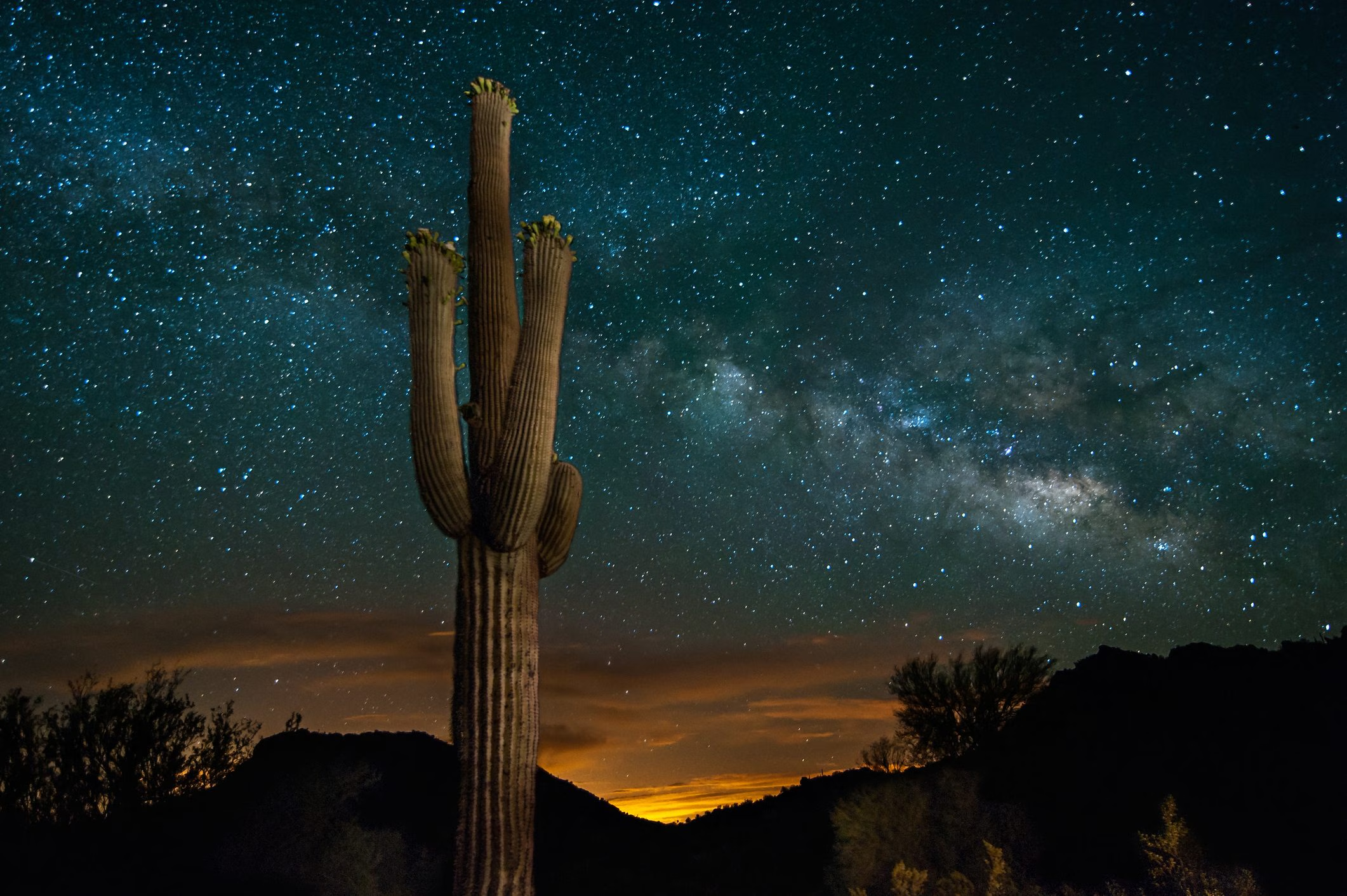
Beauty of the Night, Queen of the Night, Moonflower are not the names of fairies from a fantasy book, but rather common names of plants with a particular evolutionary adaptation: their flowers remain closed during the day and they open at night. Once again the evolution has gone towards solutions that are unusual for us, but extremely effective to allow, in this case, thenocturnal pollination of the plant, sometimes taking advantage of the lunar cycles and the faint moonlight, sometimes there light of dusk or dawn. The night has its advantages: competition between species to be pollinated is reduced, humidity and temperature vary, the pollinators in circulation also change, mostly moths and bats.
Little is known about nocturnal plant-pollinator interactions, however, some reviews estimate that approximately 69% of the Angiosperm Orders (the most advanced plants with flowers and seeds protected by fruits) presents species with nocturnal pollination and this indicates that, all in all, the diffusion of this strategy is quite broad and is not limited to some groups. The phenomenon prevails among xerophytesthat is, those plants that live in arid environments. The beauty of the flowers of many nocturnal plants has spread the fashion of Moon Gardengardens designed to be used in the cool of the evening surrounded by particularly fragrant blooms. However, the progressive light pollution now widespread across much of the globe is also interfering with the rhythms of these nocturnal plants.
Plants take advantage of nocturnal environmental conditions
As the sun goes down, the intensity of light, humidity, wind and temperature change. The intensity of electromagnetic radiation decreases, as does the light of the visible spectrum and infrared: on a full moon night, the light intensity is about a million times lower than on a sunny day. Twilight has a shift towards blue wavelengths and changes in the color of the light occur they modify the perception of colors by pollinators. This chromatic change marks a sort of passing of the baton between the diurnal and nocturnal pollinators who have adapted to live and feed in these specific conditions.
This nocturnal “brightness window”, however, is not a universal constant, but varies in space and time. Based on latitude, the duration of darkness compared to light changes according to a gradient and so, near the equator, the period of darkness is approximately 12 hours throughout the year, while moving away from the equatorial band the duration of the night varies according to the seasons. This geographical and seasonal variabilitycombined with the luminous alterations of the lunar cycles, profoundly shapes the strategies and effectiveness of nocturnal pollination.
As regards the air temperature, at night there is a temperature inversion on the ground which begins as early as sunset; the ground slowly begins to cool and warm air rises, wind speed tends to reduce and relative humidity values are generally higher than during the day. Since opening and maintaining the turgor of the flower itself are two processes that require water, the increase in humidity and lower temperatures allow the plant to reduce water loss through less perspiration: this is why this mechanism is very widespread among plants adapted to arid environments (xerophytes).
Nocturnal pollinators attracted by intense scents
Night-blooming plants mostly attract moths and bats, but there are a variety of other animals that are active at night. Among invertebrates, various species of beetles act as pollinators, as well as mosquitoes and calliphorids, cockroaches and orthopterans (crickets). The nocturnal bees (Apis mellifera) and carpenter bees (Xylocopa violacea) in India they begin to forage at dusk, as reported in a review last February, and tend to show greater activity on full moon nights than on dark ones. There is even a specific coevolution between the length of the spirotromba (mouthparts) of some species of moths and the tubular shape of the flowers of some nocturnal plants. In some cases, geckos and some rodents also engage in nocturnal pollination. Many species consume nectar as a reward, others use the open flowers to mate or lay eggs.
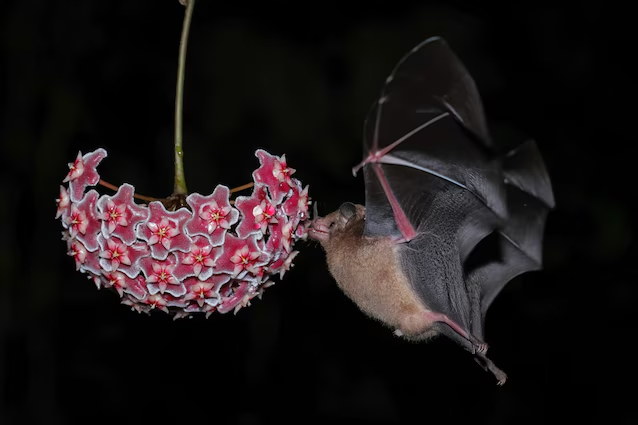
They all feature adaptations for move in the dark and to identify flowers more by smell than by sight. This is why the flowers of many nocturnal plants emanate intense and heady aromas, strong chemical attractors. Many pollinators have adaptations to see well even in low light: eyes and pupils larger than their body size, highly sensitive photoreceptors. Some moths sense CO gradients2 indicators of plant respiration. Some plants then open their flowers at dusk and dawn in order to attract those pollinators that are not completely adapted to the night, but have such a visual sensitivity that they can orient themselves at dusk. In fact, in colder climates, nocturnal or crepuscular insects often have an insulating layer of hair to operate at low temperatures.
What are the most common species that exploit the night
Among the most common species that we find embellishing the nights in parks and gardens, the Chicago Botanic Garden reports:
- The Moonflower (Ipomoea alba), climbing plant of tropical origin with large white trumpet-shaped flowers that open at sunset and close at dawn;
- The Night jasmine (Cestrum nocturnum) also celebrated in a poem by Pascoli, it is an evergreen shrub with particularly fragrant nocturnal flowers;
- there Queen of the night (Epiphyllum oxypetalum) a succulent plant typical of the rainforests of Central America, now imported as an ornamental plant. The showy white flowers open suddenly and briefly at night. Flowering is quite rare;
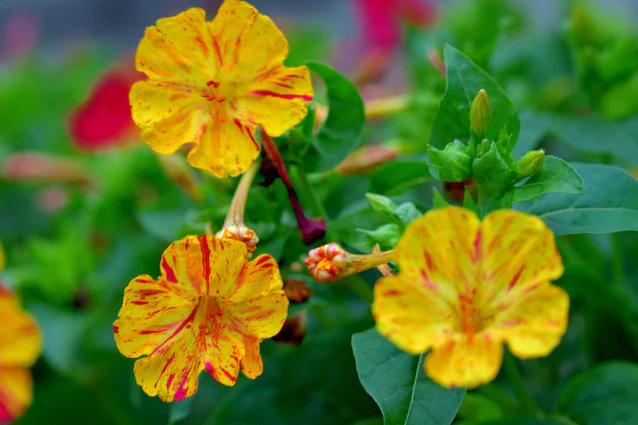
- There Beautiful at night (Mirabilis jalapa) a spontaneous herbaceous plant very common in our latitudes and easy to grow, has nocturnal flowers of various colours;
- there Night wallflower (Matthiola bicornis) whose flowers open at dusk and give off a sweet scent similar to cinnamon.
The Moon Gardens
These are particularly elegant and refined gardens, created with spaces designed to be enjoyed at night and enriched with these nocturnal flowering species in order to create corners with an intense scent and flowers that can shine if there is the light of a full moon night. According to the Chicago Botanic Garden, one of the first moon gardens in the United States was designed and built in 1833 in Massachusetts, but the origins of these spaces are much older and date back to ancient Persia, India and Arab countries where the scorching heat does not allow you to enjoy the gardens during the day. Mostly a plants are selected white flowers and silvery leaves which shine best on moonlit nights, as well as nocturnal and scented plantssuch as nocturnal jasmine, which release an intense scent after sunset.
Light pollution and nocturnal pollinators
A large number of Angiosperm species which over thousands of years have adapted their blooms to very specific conditions of weak light, they undergo imbalances together with their pollinators due to an increasingly widespread light pollution recognized as a global ecological stressor, with consequences for the functioning of biodiversity. Both the flashes of distant artificial lights and the direct artificial lights present in cities and inhabited centers distort the orientation of pollinators in space accustomed to the night, therefore, distract them or “confuse” them, preventing them from recognizing the flowers. After all, the color vision of nocturnal pollinators is adapted to certain wavelengths and so it is susceptible to artificial lights. Indeed, some studies have shown that light pollution can cause physiological damage to the visual system: in the sphinx Deilephila elpenorFor example, according to Somanathan, even just 8 seconds of exposure to intense blue light can reduce visual sensitivity for a few minutes. The changes do not only affect individuals, but entire pollinator networks altered by diffuse artificial lights.
