While smartphones become increasingly powerful, faster and feature-rich, some users seem to be looking in the opposite direction. In recent years, they have returned to the spotlight dumbphonephones designed to perform only the essential functions such as calling and texting and limiting access to social networks, notifications and other sources of distractions.
At first glance it might seem counterintuitive. Much of the technological innovation of recent decades has been driven by the goal of concentrating more and more activities within a single device. Yet, as attention grows towards digital well-being and the management of time spent online, so too does interest in tools that promise to do less rather than more.
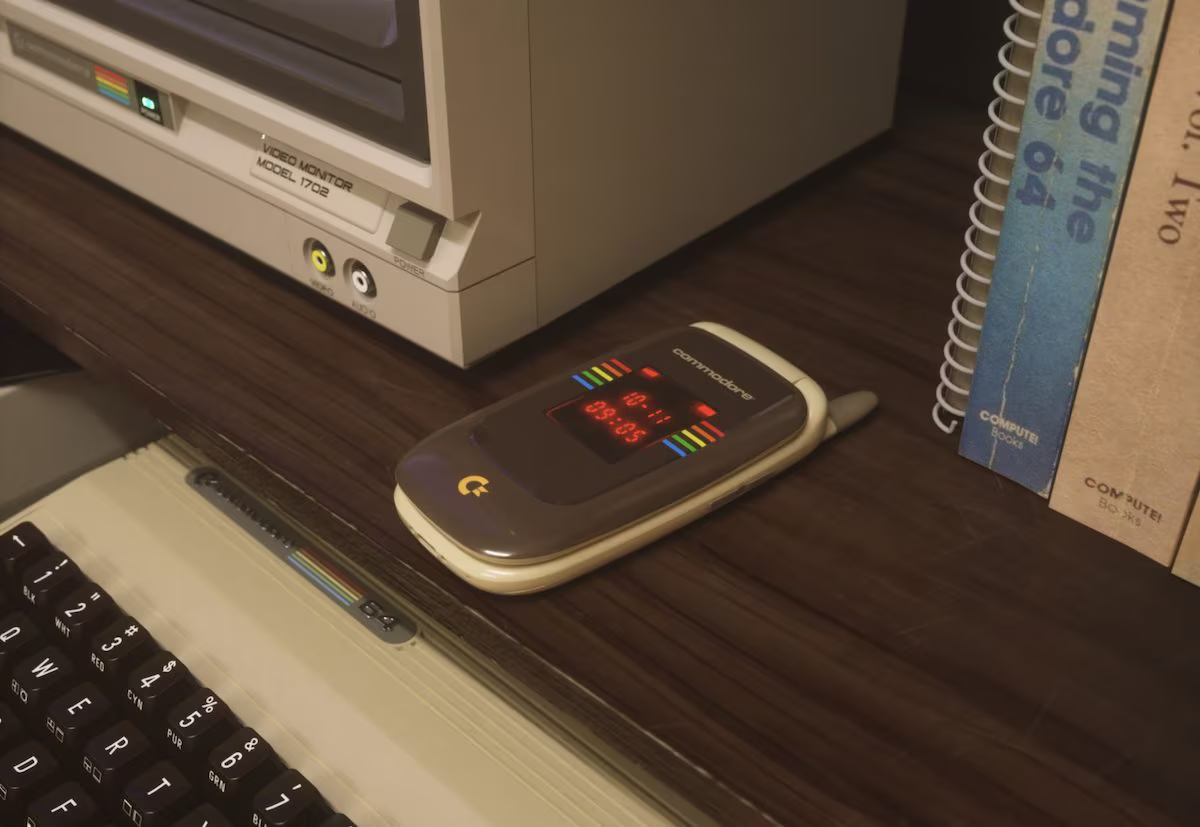
The new also fits into this context Commodore callbacka clamshell phone designed to offer a more basic experience than traditional smartphones. Its arrival not only represents the launch of a new product, but also offers the opportunity to observe a broader phenomenon concerning the relationship between people and technology.
What are dumbphones and why are they attracting attention
The Callback belongs to the category of so-called dumbphones, literally “dumb phones”. Despite the name, these devices are not simply the old cell phones from the early 2000s brought back to the market.
The term is often used as a synonym for feature phonesbut the two definitions do not coincide perfectly. Feature phones are in fact simpler phones than smartphones, but equipped with some additional features such as cameras, 4G connection, messaging applications or FM radio. More recent examples include the Nokia 235 4Gwhich combines a physical keyboard and connectivity to next-generation mobile networks, and the Doro 7010designed to offer a simple and intuitive user experience with functions such as WhatsApp and email. Dumbphones instead represent the most radical declination of this philosophy, placing the emphasis on reducing access to social networks and online services. Among the other models closest to this philosophy we find theAGM M8 Flipa flip phone designed primarily for calls and texts.
The spread of these devices is often linked to the concept of digital detoxor the voluntary choice to reduce the time spent online. While integrating updated connections and some modern features, many of these phones give up social networks, infinite scrolls and continuous notifications, with the aim of limiting distractions and encouraging a more conscious use of technology.
This trend is confirmed by the data. According to an investigation cited by the French newspaper Le Monde, the 47% of people between 20 and 34 years old in France says it is actively trying to limit the use of screens. Particularly significant is the fact that this phenomenon concerns the generations who grew up together with the Internet, smartphones and social networks. It is therefore not a rejection of technology, but the search for a different way of using it.
In recent years the topic of digital well-being has become increasingly central in public debate and dumbphones are seen by some users as one of the tools to regain greater control over their time.
From Gen Z to digital detox: a phenomenon that continues to grow
The desire to disconnect at least for a few hours a day seems to particularly interest the younger generations. An in-depth analysis published by Axios highlights how the events dedicated to disconnecting from smartphones.
The Guardian also reported on the growth of communities promoting the use of minimalist phones. Among these is the “Month Offline” movementwhich invites users to spend more periods without traditional smartphones. According to the British newspaper, the community has over 1,000 members and around 300 people have participated in its initiatives in the last year.
Numbers still very small compared to the billions of users who use smartphones every day, but sufficient to show how the search for a more balanced relationship with technology is no longer an isolated phenomenon.
The new phone that focuses on simplicity: the Commodore model
For those who grew up in the Eighties and Nineties, the name Commodore it immediately recalls some of the most iconic computers in the history of computing. Today the brand is back in the news with the Callback, a clamshell phone that takes us back to the Motorola StarTAC of 1997 and which is proposed as an alternative to traditional smartphones.
According to the company, the device is designed for those who want to distance themselves from constant notifications, social networks and content designed to absorb users’ time. Among its features we find a 3.5 inch main displaya screen 1.77 inch external to quickly view calls and essential information, one 48 megapixel cameraThe 4G support for connectivity, 4 GB of RAM And 64 GB of internal memory. The phone also uses a customized version of Sailfish OSthe operating system developed by Jolla.
His philosophy, however, is the most interesting aspect: instead of adding new functions, aim to eliminate those considered superfluous or excessively invasiveoffering an experience closer to that of traditional mobile phones.
There is still demand for essential phones
The interest in dumbphones is also reflected in the sales data of feature phones.
In 2025 HMD, the company that makes Nokia phones, said it had registered a 10% growth in feature phone sales during the previous year. While the data doesn’t represent the entire global market, it suggests there’s still demand for devices with a more streamlined experience.
The reasons that push users to purchase can be very different: economic reasons, professional needs or the desire to reduce the use of social networks and more engaging applications.
The paradox of cell phones that do fewer things
The growing attention towards devices such as Callback tells an interesting paradox. For years the technology industry has tried to make smartphones more and more complete, integrating advanced cameras, applications of all kinds and services capable of accompanying users at any time of the day. Today, however, some users seem to attribute value to the opposite direction. In a world characterized by almost continuous connectivity, the real differentiator is no longer having access to a greater number of functions, but being able to limit them when necessary.
Dumbphones are unlikely to replace smartphones in the near future, which are now central to the daily lives of billions of people. However, the media success of the new Commodore phone and the spread of initiatives dedicated to digital detox show how the debate is no longer just about the available technologies, but also about the way in which they are used.
More than a return to the past, dumbphones they seem to represent the attempt to find a new balance in the era of hyperconnectionwhere for some people the real luxury is not doing more, but being able to be distracted less.
