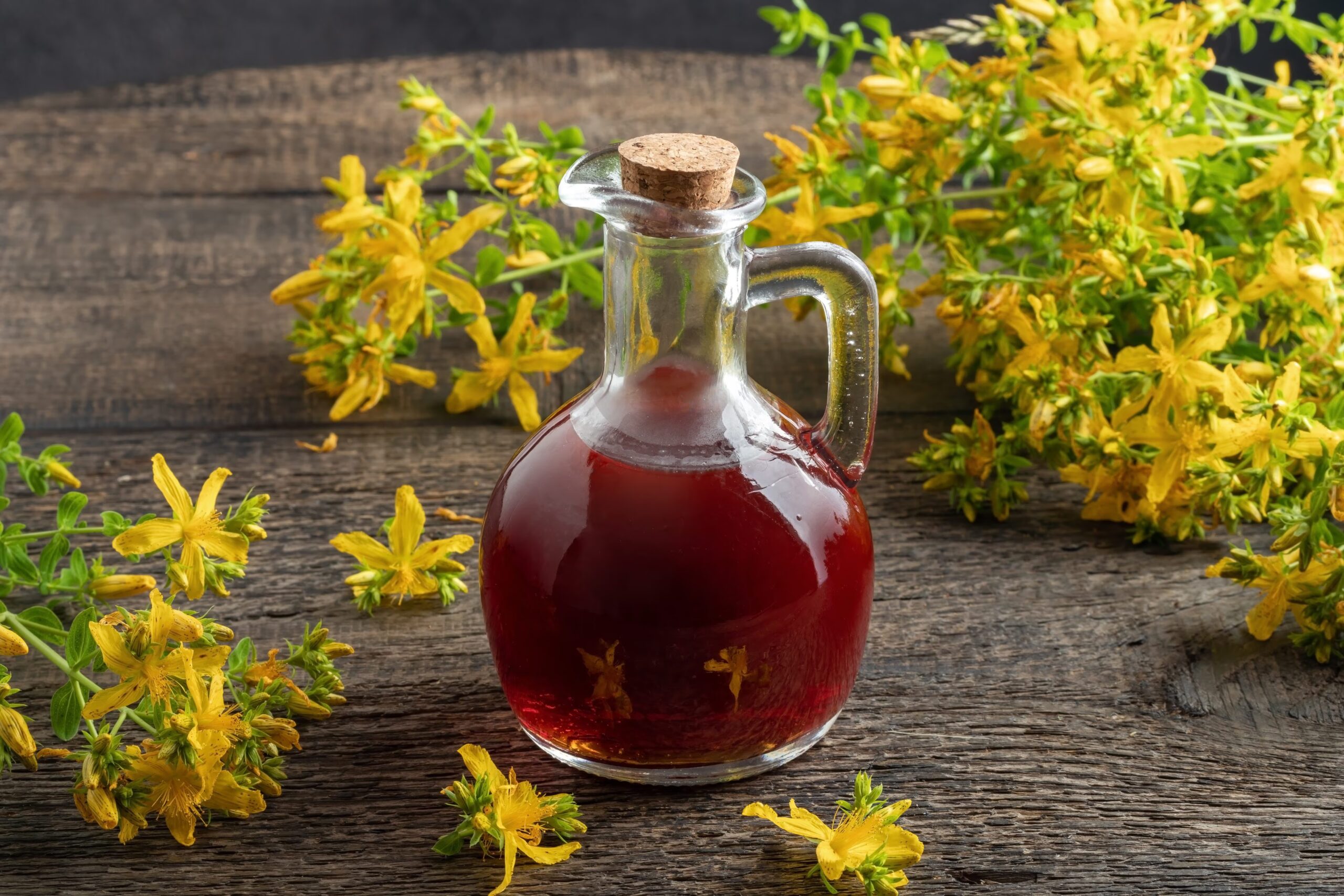
In the night of June 24th to keep devils away and sadness must be collected St. John’s Wort. What is it actually about? Legends aside, in the week in which the summer solstice and the anniversary of Saint John fall (on June 24th), the peak flowering of St. John’s wort (Hypericum perforatum), called for this reason “St. John’s Wort”.
The “magic” lies in the fact that, if you rub its yellow petals between your fingers, they release a intense red juice, which legend associated with the blood of the beheaded Saint. The flowers of a very intense yellow, almost golden, grow spontaneously dry and stony meadows throughout Italy at this time of summer and the plant is highly appreciated in phytotherapy and traditional medicines for its therapeutic properties. For centuries, its extracts have been used as a remedy to treat various pathologies, including depressive disorders. The European Medicines Agency (EMA) has approved some applications, always under medical supervisionspecifically for the treatment of mild to moderate depressive symptoms and for the treatment of small skin lesions. It is a very delicate plant and should not be used as a “do-it-yourself” remedy, because it can have serious side effects, such as photosensitization if applied to skin exposed to the sun, and reduce the effectiveness of many drugs. The most famous? Oral contraceptives!
Disclaimer: This article is for purpose only informative. For any medical information is essential contact your doctor.
What is St. John’s wort and why does its flowers release a blood-red liquid
A perennial herbaceous plant of Asian origin, St. John’s wort is now widely distributed throughout almost the entire world and is very common in Italy. The name of the species H. perforatum it is due to the fact that the leaves, rich in glands from which an essential oil is obtainedif looked at against the light they appear perforated. The plant prefers arid and stony environments up to 1600 meters above sea level, but also adapts well to uncultivated lands and roadsides. It can reach a height of one meter and the flowers, a very bright yellow-gold, are gathered together inflorescences (i.e. groups of individual flowers) at the apex of the stem. If infused in olive oil and left to macerate for about 40 days, the flowers dye the oil intense and “sanguine” red thanks to the hypericina pigment present in the plant that accumulates in particular in the inflorescence. The preparation obtained is called “oleolite” in technical jargon, but is known by most as “St. John’s wort oil“, widely used in the phytotherapeutic tradition, as well as various other extracts of the plant, especially in the states of the Balkan peninsula.
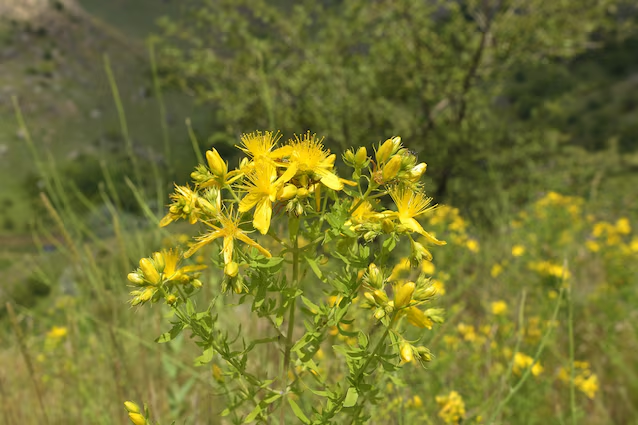
The properties of the plant: approvals from the European Medicines Agency
It is a well-known medicinal plant, used for centuries in phytotherapy: both for skin use, as a treatment for bacterial infections and as a healing agentboth in preparations for internal use to combat inflammation and mild forms of depression. The part of the plant richest in active ingredients is represented by the flowers, even more than the leaves. The two main molecules that give these antibacterial properties are ipericin and the iperforin and their content changes as environmental factors vary and based on the geographical areas of origin of the flowers. Long periods with cold temperatures favor its production by the plant, as demonstrated by various studies.
Given its great use in the phytotherapeutic tradition of various countries, the plant has been the subject of evaluation by the European Medicines Agency (EMA) which has approved its use for various indications, both as a medicinal plant and well-established use (Well established use) that how traditional use (Traditional use). The difference between the two approvals, as reported by the Agency, is that the first (consolidated use) requires that the plant has stable and constant use in Europe for at least 10 years and that its effectiveness is proven by clinical studies; for traditional use, however, at least 30 years of use in the world are required, of which 15 in Europe, even without clinical studies. Marketing, therefore, is authorized on the basis of very specific community directives.
Preparations based on St. John’s wort are approved by the EMA as consolidated use for the treatment of mild to moderate depressive episodes or symptoms associated with mild forms of depression and, as traditional use, to treat mild skin inflammation or small wounds. In some cases also for the treatment of mild gastrointestinal disorders or to promote sleep. Remember: always under medical supervision!
The mechanism of action against depression and what the studies say
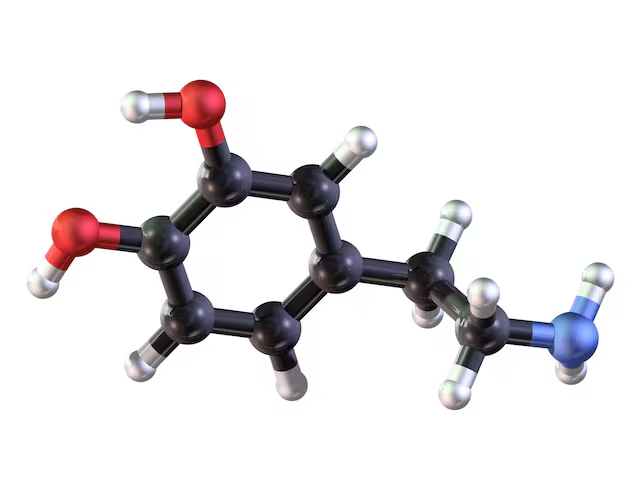
THE’hyperforinalso isolated from the flowers and glands present on the leaves, is one of the most examined compounds of this plant for two properties: it is being studied for its ability to induce apoptosis, i.e. the death of some lines of tumor cells or to inhibit their growth and it is effective in treating the symptoms of mild to moderate depression, as reported by the EMA. For this reason, St. John’s wort is also called the “Prozac from herbalist“. Its mechanism of action is still debated, but it is believed that it works as inhibitor of the reuptake of some neurotransmitters involved in mood regulation, such as dopamine, norepinephrine, serotonin and glutamate. In practice, it prevents that, once released by specific neurons, they are “recaptured” by these same neurons to store them again, increasing the concentration of these neurotransmitters and their duration of action.
A systematic review of studies conducted on the effectiveness of St. John’s wort for the treatment of depressive disorder demonstrated a certain efficacy of the product, which was shown to be superior to placebo and in general, according to a Cochrane review (one of the most authoritative and rigorous organisations), with efficacy comparable to that of antidepressant drugs. It must be admitted that the studies were conducted on patients from different countries and tested St. John’s wort extracts of different origins so it is difficult to objectively evaluate the results, given the great variability of the data. In any case, it is always useful to remember that any therapeutic choice must be prescribed and monitored by your doctor and it is never appropriate to opt for solutions”do it yourself“.
Beware of side effects: natural does not mean safe
The idea that a herbal remedy or plant extract is automatically risk-free is very common, but does not correspond to reality. Even products of natural origin can have contraindications, interactions with drugs and side effectsand this is also the case of St. John’s Wort, which interacts with some enzymes at the liver level (in technical jargon it is an inducer of CYP3A4), speeding up the metabolism and elimination of some drugs from our body, and therefore reducing their effectiveness.
Preparations based on St. John’s Wort may have interactions for example with ciclosporin and with some antivirals, therefore, concomitant use with these products is prohibited. The most famous example, however, is that of contraceptives: if you take St. John’s Wort and an oral contraceptive together, you risk that the latter will have a very reduced effect or that they don’t work at all! St. John’s Wort-based extracts can have a clear photosensitizing effect, so much so that it is best to avoidintense exposure to UV rays of the treated skin areas. Do not expose yourself to the sun after rubbing your skin with St. John’s wort oil, because you could most likely cause a painful rash, sunburn or dark spots. And this applies both to creams and ointments and if you take it orally, as tablets. It is clear at this point, as we have already anticipated, that it is essential consult a doctor or pharmacist before taking preparations based on St. John’s wort.
