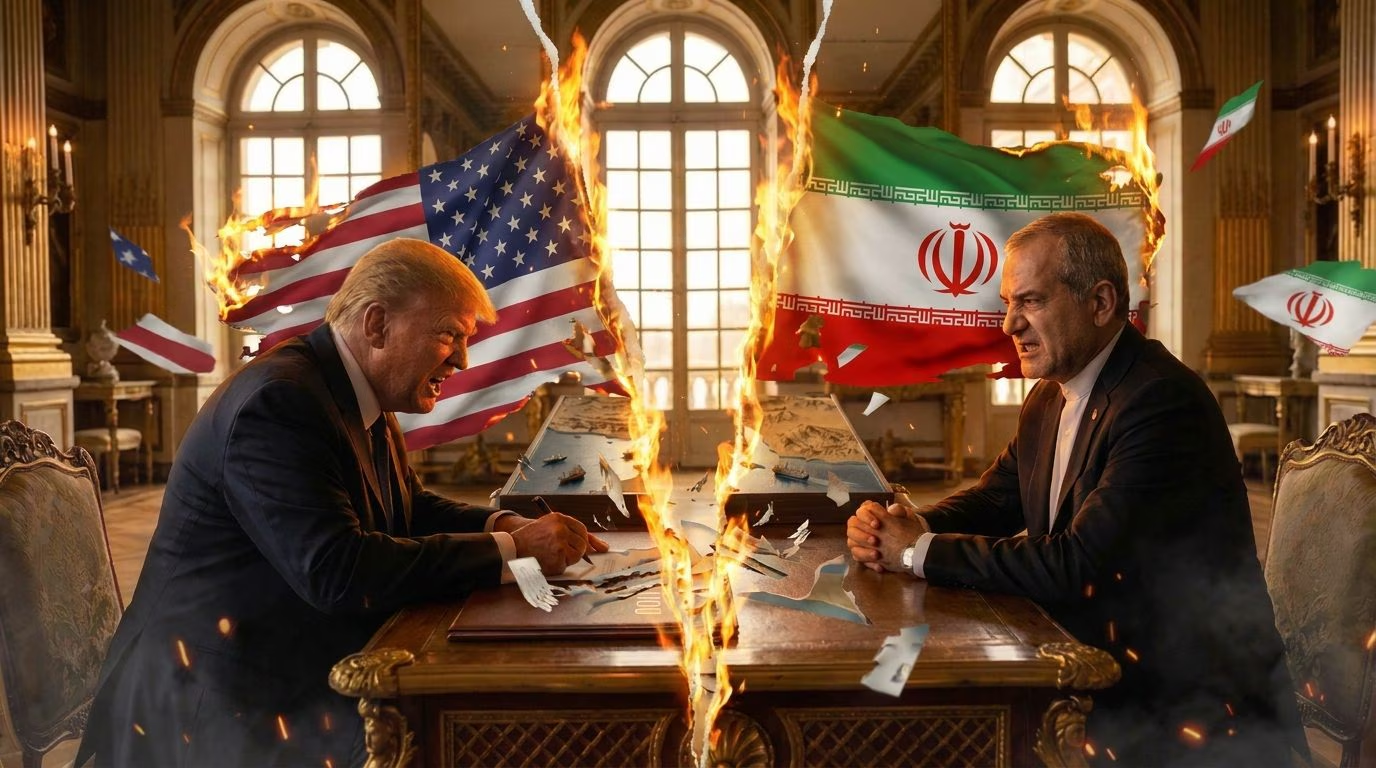
In the last few days the United States has struck over 100 targets Iranian military sites located along the coastal areas and Iran has attacked American bases located in the region with missiles and drones. It’s from the beginning of July 2026 that the geopolitical tensions in the area located around the Strait of Hormuz have intensified again in the US-Iran war, so much so that the American president himself stated Donald J. Trump during a press conference alongside the last one NATO summit in Ankara which, among other things, “the truce is over”. These events – in addition to talks with Netanyahu and an alleged Iranian plan to assassinate Trump – once again cast a shadow over the possibility that peace negotiations between the United States of America and the Islamic Republic of Iran can reach a positive conclusion.
The Islamabad Memorandum: a strategic defeat for the USA
On June 17, 2026 during two separate ceremonies held respectively in Tehran and to palace of Versaillesnot far from Paristhe American president Trump and the Iranian one Pezeshkian they had countersigned the so-called “Islamabad Memorandum”, articulated on 14 points and interpreted by most analysts as a sort of American capitulation towards Iran, which has in fact emerged significantly strengthened on the diplomatic side and in virtual route control entering and exiting to and from the Persian Gulf via the “choke point” consisting of Strait of Hormuz. Iran and Oman are now reportedly working on a plan to introduce toll collection for ships transiting the Strait: US Central Command (Centcom) has formally denied that Iran has control of the Strait.
Then there is the geopolitical issue of the situation in Lebanon. Iran has in fact linked the implementation of the Memorandum to the complete cessation of hostilities in Lebanese territory and therefore to the end of Israeli military operations against Hezbollahbut it Jewish state has until now continued to maintain a freedom of action independent of the wishes of the main players in the Middle Eastern dispute. Given these premises, many wondered how long this false truce could last.
The continuation of tensions, the new cross-attacks and the funeral of Ali Khamenei
The situation saw a sharp acceleration during the last days of June, when the cross-attacks began again amid the stalemate in negotiations. Obviously the duelists in both Washington and Tehran did not hesitate to shift the blame onto their opposing counterparts, simultaneously announcing an expansion of their respective military actions in response to the violation of the spirit of the Islamabad Memorandum.
Between July 7th and 8th the escalation led the United States to strike around eighty Iranian military sites located along coastal areas, especially in the area of Bushehr, Bandar Abbas And Konarak (to which were added other targets hit in recent days), while i Pasdaran they attacked with missiles and drones the American bases located in the regionespecially those located in Kuwait, Qatar And Bahrainwhich had already been damaged during the active phase of the war. In addition to attacks directed against US bases in the Gulf, some Iranian missiles were also intercepted in Jordan.
Making the atmosphere even more incandescent were the funerals, just concluded in Mashhad, of the former Supreme Leader Ali Khamenei, who was killed at the start of hostilities together with some family members. An epochal event – which the local press celebrated as the largest funeral in world history, with 40 million participants – which profoundly shook the country, also marked by the absence of his successor Mojtaba for security reasons.
Truce or new Iran-USA war: predictions for the future and the plan against Trump
It is very difficult to say at the moment what the future holds for us. Some analysts have openly spoken about return to war while others have instead read the American action as a way to recover some coercive levers in the diplomatic sphere.
Although no scenario should be discarded a priori, it would seem that the second explanation is the most probable because at the moment the Americans, who over the past few months have withdrawn a whole series of fundamental naval and air assets from the area, can no longer rely on a logistical support adequate to carry out a large-scale and long-lasting conflict. That same support that, proved lacking during the month of March 2026, he decreed the interruption of American military operations and their allies and Iran’s victory during the first phase of the war.
To then understand, once again, what the role of will be Israel. According to what was reported by the newspaper Axiosin the last few hours the American President Trump and the Israeli Prime Minister Netanyahu they had a long telephone conversation to coordinate their future actions with the ever-active defense minister Katz claim that Israel is ready to resume airstrikes.
According to rumors published by Wall Street Journal, the Israeli secret services they would also share with their counterparts a Stars and Stripes the details of an Iranian plan to assassinate Trump, but such news must be treated with the utmost attention given the massive use of propaganda and the dissemination of false information which the contenders have resorted to several times in the past.
