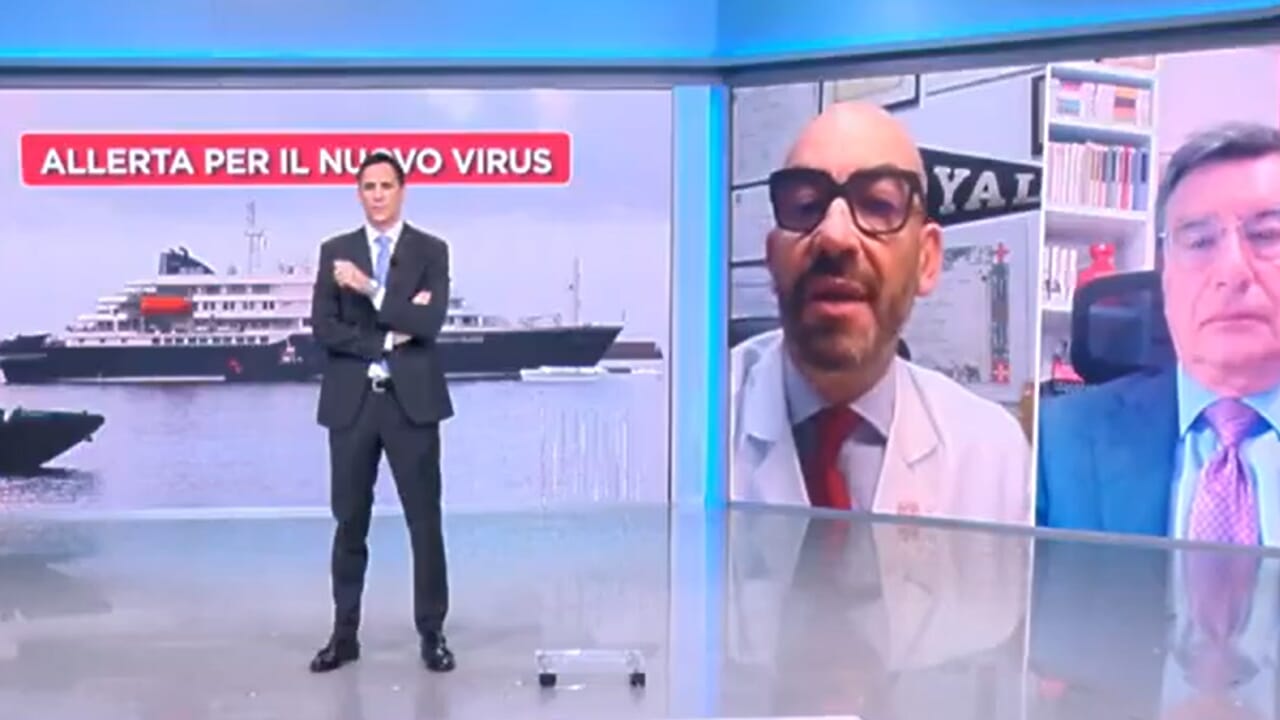
With the hantavirus, health plans and virologists are back on TV
It was enough for the first news to spread about the hantavirus infection, the new “global scourge” this time caused by mice, for everyone to feel like they were seeing a movie they had already experienced, unfortunately. All in all quite distant in time, but so lacerating for life and collective civil conscience that the wound took very little time to reopen.
The two effects of the hantavirus
The effects of this backwards turn of the clock did not take long to manifest themselves. The first was the massive return to TV of all those infectious disease specialists who had become so familiar in the Covid era, who, like when tombs are uncovered and the dead are resurrected – with all due respect for their most honored science – in the blink of an eye they started popularizing talk shows and news programs again. Someone had an extra gray hair, someone had just gained weight or had changed their hairstyle, but in short it was them.
The second effect was the reappearance of the first controversies similar to six years ago, precisely in these days, when in the blink of an eye Italy and the world plunged into the nightmare, hitherto never experienced, of the global pandemic. For now everything has remained fairly under control because no one is talking about vaccines, collective prophylactic measures, masks, but in short, like in a game of Risk, the sides have started to position their troops. You never know.
Three reassuring things about hantavirus and the red signal not to ignore
Especially on social media, conspiracy theorists, anti-vaxers, or, on the contrary, turbo scientists, those who would vaccinate even statues at the first sign of the flu, have made a comeback. Although the “real” news, those coming from the front line, are all in all reassuring, and it is quite clear to scientists that we are not faced with a “new Covid”, that the risks are infinitely lower precisely due to the structure of the infection, less dangerous and less transmissible from man to man. However, given that even six years ago the first news was deliberately reassuring and instead what happened happened, psychosis began to spread.
From bats to mice
Psychosis aside, it is however legitimate to question the state of health of our healthcare institutions and the tools that have been prepared in the meantime to deal with any new situations of generalized infections. Fortunately for him, the Minister of Health Orazio Schillaci arrives faced with the hantavirus case having recently completed the approval process of the National Pandemic Plan, agreed with the Conference of Regions and launched just a few days ago, on 30 April, approximately three years after the expiry of the previous one in 2021, which was heavily affected by the ongoing Covid situation. Not even doing it on purpose.
The plan has a validity of 2025-2029 and envisages a broad involvement of the Regions, to which a good part of the work is delegated – funds are allocated only to the Regions that have demonstrated that they have implemented the rules – and confirms the “vaccinationist” approach, which is not entirely obvious for a government majority in which certain cold positions harbored regarding the use of mass prophylaxis.
What’s in government health plans
According to Minister Schillaci, the plan, criticized by some well-known infectious disease specialists – such as Matteo Bassetti of Genoa – who judged it to be excessively generic, implements the indications on the matter provided by the World Health Organization. And here comes the point. In fact, when we talk about the pandemic and the WHO, we cannot help but remember that Italy did not join the first global pandemic agreement, the Who Pandemic Agreement, approved in May 2025 with 124 votes in favour, thus finding itself side by side with countries such as Russia and Iran. Not even the USA joined because by Trump’s decision they had just withdrawn from the WHO itself, in one of the first decisions of his second explosive mandate in the White House.
A decision, the Italian one, strongly criticized at the time by the opposition, who dusted off some of the aforementioned accusations made against the right during the pandemic, those of winking at the anti-vax world. Accusations which, especially if the hantavirus infection were to spread, will certainly come back into fashion.
Local responses and global threats
The spread of Covid had in fact highlighted how, in the event of a global alarm, it was more necessary than ever to implement equally global responses, both in prophylactic measures and in the production and supply of vaccines. Infections do not stop at borders and, indeed, travel very quickly, as this hantavirus outbreak confirms.
In recent days, Foreign Minister Antonio Tajani in Brussels recalled the importance of “global” health, but we know that Tajani embodies the pro-European and more open soul of the coalition. It’s not a given that everyone in the government thinks like him. Or it will be the right time that the rodent virus will end up “forcing” the government to adhere, albeit late, to the WHO protocol. Infecting us with a little common sense and getting back on board the international community. Good often comes from evil.
